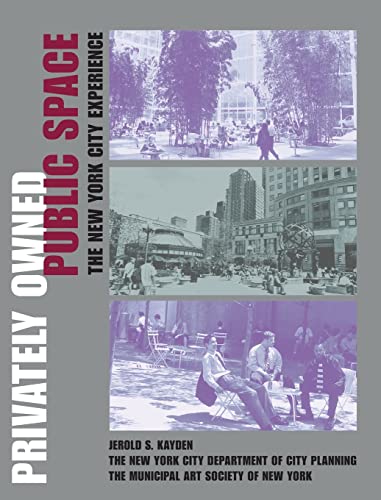

Privately Owned Public Space : the New York City experience. / Jerold S. Kayden. txt
New York ; Chichester ; Weinheim ; Brisbane ; Singapore ; Toronto : John Wiley & Sons, Inc. , 2000Descripción: x, 348 p. ill. ; 26 cmTipo de contenido:- text
- unmediaded
- volume
- 9780471362579
- 333.3
- HT151 K345 2000
| Imagen de cubierta | Tipo de ítem | Biblioteca actual | Biblioteca de origen | Colección | Ubicación en estantería | Signatura topográfica | Materiales especificados | Info Vol | URL | Copia número | Estado | Notas | Fecha de vencimiento | Código de barras | Reserva de ítems | Prioridad de la cola de reserva de ejemplar | Reservas para cursos | |
|---|---|---|---|---|---|---|---|---|---|---|---|---|---|---|---|---|---|---|
| Libro | CARIBET Biblioteca Arquitectura Colección General CARIBET | General HT151 K345 2000 (Navegar estantería(Abre debajo)) | 1 | Disponible | 91000000035972 |
Descripciones mejoradas de Syndetics:
Hailed by the Wall Street Journal as a "juicy little time bomb of a book", Privately Owned Public Space: The New York City Experience examines for the first time, New York City's 39-year mixed experience with the production of more than 500 plazas, parks, and atriums located on private property yet by law accessible to and usable by the public.
Until now, comprehensive, systematic knowledge about this vast collection of public spaces has not existed, either for experts or members of the public. To remedy this gap, Harvard University professor Jerold S. Kayden, The New York City Department of City Planning, and The Municipal Art Society of New York have joined forces to research and write Privately Owned Public Space: The New York City Experience. Through words, photographs, scaled site plans, maps, and analysis of newly assembled data, they examine history, law, design, and use of the city's privately owned public spaces. Each of the more than 500 spaces is individually discussed to provide far-reaching comparative information about this unique category of public space.
In reading this book, designers, planners, lawyers, and academics will gain greater understanding about the possibilities and problems inherent in the design, management, and enforcement of privately owned public space. Public officials, private owners, and civic group representatives will learn more about their roles in ensuring public access and vitality of such spaces. Individuals will discover where New York City's public spaces are located and what amenities they offer. Everyone will comprehend more completely the contribution that privately owned public space can make toward open and attractive cities in which all individuals have access to a diversity of public places.
Includes indexes and bibliography.
Contents:
Prefaces vii --
Acknowledgments ix --
Introduction 1 --
Part I: The Context 5 --
1 History 7 --
2. Law: Design, Operation, and Enforcement 21 --
3. Record 43 --
4. Research 61 --
Part II. The Spaces 73 --
5. Lower Manhattan 75 --
Downtown 75 --
Greenwich Village 107 --
6 Midtown Manhattan 111 --
Clinton 111 --
Central Midtown 118 --
East Midtown 190 --
7 Upper Manhattan 241 --
Upper West Side 241--
Upper East Side 256 --
8 Brooklyn and Queens 297 --
Brooklyn 297 --
Quuens 300 --
Afterword 301 --
Notes 303 --
Bibliography 318 --
Table: Privately Owned Public Spaces, by Address and Classification 322 --
Photography Credits 336 --
Contacts 337 --
Index 339 --
Tabla de contenidos provista por Syndetics
- Prefaces(p. vii)
- Acknowledgments(p. ix)
- Introduction(p. 1)
- Part I The Context(p. 5)
- 1 History(p. 7)
- 2 Law: Design, Operation, and Enforcement(p. 21)
- 3 Record(p. 43)
- 4 Research(p. 61)
- Part II The Spaces(p. 73)
- 5 Lower Manhattan(p. 75)
- Downtown(p. 75)
- Greenwich Village(p. 107)
- 6 Midtown Manhattan(p. 111)
- Clinton(p. 111)
- Central Midtown(p. 118)
- East Midtown(p. 190)
- 7 Upper Manhattan(p. 241)
- Upper West Side(p. 241)
- Upper East Side(p. 256)
- 8 Brooklyn and Queens(p. 297)
- Brooklyn(p. 297)
- Queens(p. 300)
- Afterword(p. 301)
- Notes(p. 303)
- Bibliography(p. 318)
- Table: Privately Owned Public Spaces, by Address and Classification(p. 322)
- Photography Credits(p. 336)
- Contacts(p. 337)
- Index(p. 339)
Notas de autor provistas por Syndetics
JEROLD S. KAYDEN, a lawyer and urban planner, is Associate Professor of Urban Planning at the Harvard University Graduate School of Design. He has published widely, coauthoring Landmark Justice: The Influence of William J. Brennan on America's Communities and coediting Zoning and the American Dream: Promises Still to Keep .
THE NEW YORK CITY DEPARTMENT OF CITY PLANNING guides the City's physical development and formulates land use plans and strategic policies with major goals that include encouraging housing and economic development, improving the City's quality of life, and preserving its neighborhoods.
THE MUNICIPAL ART SOCIETY OF NEW YORK is a private, nonprofit membership organization that champions excellence in urban design and planning, and preservation of the best of New York's past. Situated in the Urban Center in midtown Manhattan, the Society engages citizens on issues of the city's built environment.