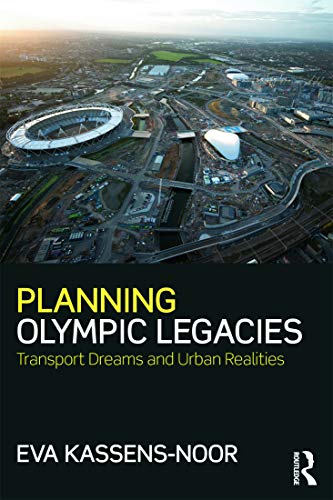

Planning Olympic Legacies : transport dreams and urban realities. / Eva Kassens-Noor. txt
London ; New York : Routledge , 2012Descripción: xxi, 131 p. ill. ; maps ; 25 cmTipo de contenido:- text
- unmediaded
- volume
- 9780415689717
- 9780415689595
- 9780203119488
- 307.1/216 23
- HT166 K3595 2012
| Imagen de cubierta | Tipo de ítem | Biblioteca actual | Biblioteca de origen | Colección | Ubicación en estantería | Signatura topográfica | Materiales especificados | Info Vol | URL | Copia número | Estado | Notas | Fecha de vencimiento | Código de barras | Reserva de ítems | Prioridad de la cola de reserva de ejemplar | Reservas para cursos | |
|---|---|---|---|---|---|---|---|---|---|---|---|---|---|---|---|---|---|---|
| Libro | CARIBET Biblioteca Arquitectura Colección General CARIBET | General HT166 K3595 2012 (Navegar estantería(Abre debajo)) | 1 | Disponible | 91000000027847 |
Descripciones mejoradas de Syndetics:
When a city wins the right to hold the Olympics, one of the oft cited advantages to the region is the catalytic effect upon the urban and transport projects of the host cities. However, with unparalleled access to documents and records, Eva Kassens-Noor questions and challenges this fundamental assertion of host cities who claim to have used the Olympic Games as a way to move forward their urban agendas
In fact, transport dreams to stage the "perfect games" of the International Olympic Committee and the governments of the host cities have lead to urban realities that significantly differ from the development path the city had set out to accomplish before winning the Olympic bid. Ultimately it is precisely the IOC's influence - and the city's foresight and sophistication (or lack thereof) in coping with it - that determines whether years after the Games there are legacies benefitting the former hosts.
The text is supported by revealing interviews from lead host city planners and key documents, which highlight striking discrepancies between media broadcasts and the internal communications between the IOC and host city governments. It focuses on the inside story of the urban and transport change process undergone by four cities (Barcelona, Atlanta, Sydney, and Athens) that staged the Olympics and forecasts London and Rio de Janeiro's urban trajectories. The final chapter advises cities on how to leverage the Olympic opportunity to advance their long-run urban strategic plans and interests while fulfilling the International Olympic Committee's fundamental requirements.
This is a uniquely positioned look at why Olympic cities have - or do not have - the transport and urban legacies they had wished for. The book will be of interest to planners, government agencies and those involved in organizing future Games.
Includes bibliographical references (p. [113]-122) and index.
List of Tables x --
List of Figures xi --
List of maps xii --
List of acronyms xiii --
Foreword xv --
Preface xvii --
Acknowledgements xx --
1 The Olympic Games: an ephemeral opportunity for cities 1 --
The creation of urban legacies 4 --
The creation of transport legacies 5 --
Planning Olympic legacies in four hosts and two future hosts 6 --
Book structure 7 --
2 The IOC as a powerful stakeholder in the planning process 9 --
Introducing the Olympic Games and the IOC 10 --
Olympic transport requirements as a vision for the host city 12 --
The IOC's power in the planning processs 17 --
Conclusions 21 --
3 Planning for the 1992 Olympics and Barcelona's urban legacy 23 --
Barcelona's urban and transport history 23 --
Barcelona's candidature and Olympic preparations 25 --
Transport performance during the 1992 Olympics 32 --
Transport outcomes and Barcelona's legacy 33 --
Conclusions 35 --
4 Planning for the 1996 Olympics and Atlanta's urban legacy 36 --
Atlanta's urban and transport history 36 --
Atlanta's candidature and Olympic preparations 39 --
Transport performance during the 1996 Olympics 44 --
Transport outcomes and Atlanta's legacy 47 --
Conclusions 49 --
6 Planning for the 2004 Olympics and Athen's urban legacy 67 --
Athens' urban and transport history 67 --
Athens' candidature and Olympic preparations 69 --
Transport performance during the 2004 Olympics 74 --
Transport outcomes and Sydney's legacy 62 --
Conclusions 65 --
6 Planning for the 2004 Olympics and Athen's urban legacy 67 --
Athens's urban and transport history 67 --
Athens' candidature and Olympic preparations 69 --
Transport performance during the 2004 Olympics 74 --
Transport outcomes and Athen's legacy 75 --
Conclusions 83 --
7 Planning for Olympic legacies: London 2012 and Rio de Janeiro 2016 84 --
Planning London's legacies 85 --
London's candidature and Olympic preparations 86 --
Prospects of a 2012 legacy 90 --
Planning Rio de Janeiro's legacies 92 --
Rio de Janeiro's candidature and Olympic preparations 93 --
Prospects of a 2016 legacy 97 --
Conclusions 99 --
8 Transport dreams and urban realities 101 --
Is the urban planning process altered due to Olympic requirenents ? If so, how? 202 --
What role does the IOC play in urban development and the creation of transport legacies? 105 --
Given the IOC's role, how can host cities plan for valuable Olympic legacies and aspire not only to host the best Games ever, BUT ALSO RETAIN THE BEST LEGACIES EVER? 107 --
Summary of recommendations 110 --
Bibliography 113 --
Unpublished sources 123 --
Index 129 --
Tables:
1.1 Olympic host cities' characteristics 7 --
3.1 Barcelona's four Olympic areas 27 --
4.1 Atlanta's transport investments for the Olympics 43 --
6.1 Athens' three Olympic areas 70 --
6.2 Athen's public transport modifications 73 --
8.1 Transport developments during the run up to the Olympics --
Figure:
2.1 Transfer of Knowledge Program 19 --
Maps:
3.1 Plan General Metropolitano (PGM) 1976 25 --
3.2 Barcelona's road construction projects (1991-2) 28 --
4.1 Atlanta's planned MARTA expansion, road expansion and HOV lanes 38 --
4.2 Atlanta's Olympic Ring 40 --
5.1 Sydney's strategic transport opportunities 52 --
5.2 Sydney's Olympic venue locations 53 --
6.1 Athens' Olympic venue locations 71 --
6.2 Olympic network and road expansion projects in Athens 74 --
6.3 Planned tram routes in Athens (1996) 79 --
6.4 Planned metro network in Athens (1996) 81 --
"When a city wins the right to hold the Olympics, one of the oft cited advantages to the region is the catalytic effect upon the urban and transport projects of the host cities. However, with unparalleled access to documents and records, Eva Kassens-Noor questions and challenges this fundamental assertion of host cities who claim to have used the Olympic Games as a way to move forward their urban agendas In fact, transport dreams to stage the "perfect games" of the International Olympic Committee and the governments of the host cities have lead to urban realities that significantly differ from the development path the city had set out to accomplish before winning the Olympic bid. Ultimately it is precisely the IOC's influence - and the city's foresight and sophistication (or lack thereof) in coping with it - that determines whether years after the Games there are legacies benefitting the former hosts. The text is supported by revealing interviews from lead host city planners and key documents, which highlight striking discrepancies between media broadcasts and the internal communications between the IOC and host city governments. It focuses on the inside story of the urban and transport change process undergone by four cities (Barcelona, Atlanta, Sydney, and Athens) that staged the Olympics and forecasts London and Rio de Janeiro's urban trajectories. The final chapter advises cities on how to leverage the Olympic opportunity to advance their long-run urban strategic plans and interests while fulfilling the International Olympic Committee's fundamental requirements. This is a uniquely positioned look at why Olympic cities have - or do not have - the transport and urban legacies they had wished for. The book will be of interest to planners, government agencies and those involved in organizing future Games." --
Notas de autor provistas por Syndetics
Eva Kassens-Noor is an assistant professor of urban and transport planning in the School of Planning, Design and Construction (SPDC) holding a joint appointment with the Global Urban Studies Program (GUSP) at Michigan State University. She is also an adjunct assistant professor in Geography. She received her Diplom-Ingenieur in Business Engineering from the Universität Karlsruhe (TH) in Germany, her MST (Master of Science in Transportation) from the Civil and Engineering Department at MIT, and her Ph.D. from the Department of Urban Studies and Planning at MIT.