Imagen de Amazon.com

Portada de Syndetics
Imagen de OpenLibrary
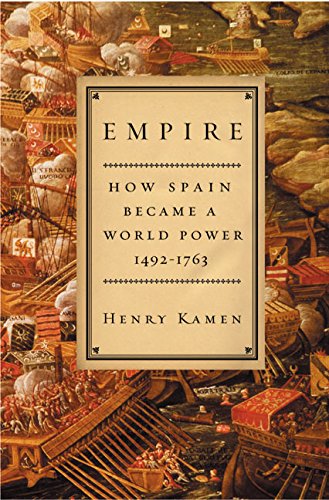
Empire how Spain became a world power, 1492-1763 Henry Kamen.
Detalles de publicación: New York HarperCollins c2003.Edición: 1st American edDescripción: xxviii, [609] p., [16] p. of plates ill., maps 24 cmISBN:- 0060194766 (alk. paper)
- DP164 .K36 2003
Recursos en línea:
| Imagen de cubierta | Tipo de ítem | Biblioteca actual | Biblioteca de origen | Colección | Ubicación en estantería | Signatura topográfica | Materiales especificados | Info Vol | URL | Copia número | Estado | Notas | Fecha de vencimiento | Código de barras | Reserva de ítems | Prioridad de la cola de reserva de ejemplar | Reservas para cursos | |
|---|---|---|---|---|---|---|---|---|---|---|---|---|---|---|---|---|---|---|
| Libro | Biblioteca Encarnación Valdés Colección General bev | 946.03 K153e (Navegar estantería(Abre debajo)) | Disponible | 80000002498635 |
Total de reservas: 0
Descripciones mejoradas de Syndetics:
Over the course of two and a half centuries, Spain established the most extensive empire the world had ever known. But how did a barren, thinly populated country, isolated from the rest of Europe, become the world's first superpower? Henry Kamen's Empire offers a fresh and highly original answer, stressing the role of international business interests rather than military might. The Basques, Aztecs, Chinese and West African people all played a role in the development of the Spanish empire, and it is this vast diversity of resources and people that led to its success.
Kamen not only reinterprets the world of Imperial Spain, but also recreates that dazzling era, from the capture of Moorish Granada and Columbus' first voyage in 1492 to its expansion into Europe, Asia, Africa and the Americas through the 18th century. Challenging, persuasive, and unique in its thesis, Empire explores Spain's complex impact on world history with admirable clarity and intelligence.Henry Kamen is a Fellow of the Royal Historical Society in London and has been Professor of the Higher Council for Scientific Research (CSIC) in Barcelona for the past ten years. He is also Visiting Professor in the University of Chicago's program in Barcelona. He is the author of numerous books, including Philip of Spain and The Spanish Inquisition. He lives in Barcelona."This is a history of large forces moving sometimes of their own accord and by their own logic ... Well written and exactingly researched." -- Kirkus ReviewsOriginally published: Spain's road to empire. London : Penguin, 2002.
Includes bibliographical references (p. 567-576) and index.
Tabla de contenidos provista por Syndetics
- List of Illustrations(p. vi)
- List of Maps(p. x)
- Preface(p. xxi)
- 1 Foundations(p. 3)
- 2 The Early Western Empire(p. 49)
- 3 A New World(p. 95)
- 4 Creating a World Power(p. 151)
- 5 The Pearl of the Orient(p. 197)
- 6 The Frontier(p. 239)
- 7 The Business of World Power(p. 285)
- 8 Identities and the Civilizing Mission(p. 331)
- 9 Shoring Up the Empire (1630-1700)(p. 381)
- 10 Under New Management(p. 439)
- 11 Conclusion: The Silence of Pizarro(p. 487)
- Glossary(p. 513)
- List of Abbreviations(p. 515)
- Notes(p. 517)
- Select Bibliography(p. 567)
- Index(p. 577)