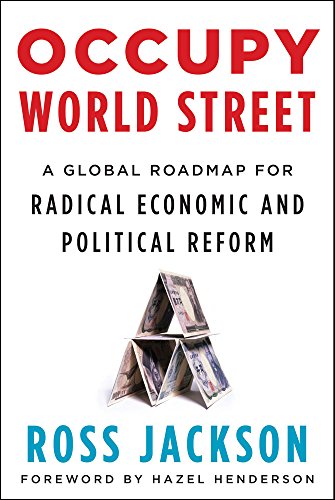

Occupy World Street a global roadmap for radical economic and political reform Ross Jackson ; foreword by Hazel Henderson.
Detalles de publicación: White River Junction, Vt. Chelsea Green Pub. c2012.Descripción: xix, 315 p. ill., map 23 cmISBN:- 9781603583886 (pbk.)
- 1603583882 (pbk.)
- 9781603583893 (epub)
- 1603583890 (epub)
- 338.927 J124o 23
- HC79.E5 J295 2012
| Imagen de cubierta | Tipo de ítem | Biblioteca actual | Biblioteca de origen | Colección | Ubicación en estantería | Signatura topográfica | Materiales especificados | Info Vol | URL | Copia número | Estado | Notas | Fecha de vencimiento | Código de barras | Reserva de ítems | Prioridad de la cola de reserva de ejemplar | Reservas para cursos | |
|---|---|---|---|---|---|---|---|---|---|---|---|---|---|---|---|---|---|---|
| Libro | Biblioteca Encarnación Valdés Colección General bev | 338.927 J124o (Navegar estantería(Abre debajo)) | Disponible | 80000002462078 |
Descripciones mejoradas de Syndetics:
Ordinary citizens the world over have long paid the price for the swashbuckling behavior of the corporate and political elite. We've seen the reigning establishment widen the gap between rich and poor, champion endless growth on a finite planet, wreak havoc on developing nations, and ravage ecosystems in a mad race for natural resources.
Now, as demonstrators worldwide demand change, Occupy World Street offers a sweeping vision of how to reform our global economic and political structures, break away from empire, and build a world of self-determining sovereign states that respect the need for ecological sustainability and uphold human rights.
In this refreshingly detailed plan, Ross Jackson shows how a handful of small nations could take on a leadership role; create new alliances, new governance, and new global institutions; and, in cooperation with grassroots activists, pave the way for other nations to follow suit.
Includes bibliographical references and index.
The assault on nature -- Energy descent -- The collapse of civilizations -- The evolution of economic beliefs -- The neoliberal project -- Financial crises -- The Kennan doctrine -- Who is in charge? -- The emergent worldview -- Learning from nature -- Gaian economics -- Designing a Gaian world -- The Gaian trade organization -- The Gaian clearing union -- The Gaian development bank -- A Gaian world -- The breakaway strategy.
Tabla de contenidos provista por Syndetics
- About the Author(p. viii)
- Foreword(p. ix)
- Acknowledgments(p. xiii)
- Introduction(p. xv)
- Part 1 Planet Under Siege
- 1 The Assault on Nature(p. 3)
- 2 Energy Descent(p. 17)
- 3 The Collapse of Civilizations(p. 33)
- Part 2 Drivers of Destruction
- 4 The Evolution of Economic Beliefs(p. 49)
- 5 The Neoliberal Project(p. 76)
- 6 Financial Crises(p. 103)
- Part 3 The Empire
- 7 The Kennan Doctrine(p. 125)
- 8 Who Is in Charge?(p. 145)
- Part 4 New Values, New Beliefs
- 9 The Emergent Worldview(p. 163)
- 10 Learning from Nature(p. 184)
- 11 Gaian Economics(p. 193)
- Part 5 Toward a Gaian World Order
- 12 Designing a Gaian World(p. 205)
- 13 The Gaian Trade Organization(p. 210)
- 14 The Gaian Clearing Union(p. 224)
- 15 The Gaian Development Bank(p. 242)
- 16 A Gaian World(p. 259)
- Part 6 Getting There
- 17 The Breakaway Strategy(p. 275)
- Afterword(p. 297)
- Notes(p. 298)
- Index(p. 307)
Extracto provisto por Syndetics
Reseñas proporcionadas por Syndetics
Publishers Weekly Review
Jackson, chairman of the Danish-based foundation Gaia Trust and co-editor of Gaian Economics: Living Well Within Planetary Limits, provides a comprehensive and lucidly written history of neoliberal economics and its effects, tracing the inequalities inherent in neoliberal economic planning. Neoliberalism, as Jackson illustrates, isn't an inevitable historical development, but rather an "artificial construct" created by people with a self-serving strategy that neglects the rest of humanity. Jackson presents the fundamental flaws in modern economics, locates the turning point in regulation and economic behavior, and then shows how and why things have devolved to their current state through the actions of the IMF and WTO. He traces a new, emergent worldview, proposing a solution in the form of a Gaian economic system, in which smaller, decentralized, diverse communities with a degree of local democracy form the proposed utopia, in contrast to the branded neoliberal free market of corporate dreams. A return to a simpler, more satisfying, and sustainable lifestyle is both necessary and inevitable, Jackson argues. The book is a how-to, "get serious about survival" guide, laying out a "global governance structure" and providing us with several strategies to try to get there. Hopefully, Jackson's ideas won't fall on dead ears. (Mar.) (c) Copyright PWxyz, LLC. All rights reserved.Notas de autor provistas por Syndetics
Ross Jackson, an expert in international finance and operations research, has long been an innovative leader in both the business and NGO worlds. He is chairman of Gaia Trust, a Danish-based foundation that supports the Global Ecovillage Network and Gaia Education, as well as hundreds of sustainability projects in forty countries. He is also director and owner of Urtekram, Scandinavia's largest wholesale organic-food company, and former chairman of Gaiacorp, foreign-exchange consultants and hedge fund managers. Jackson is the coeditor of When No Means Yes: Danish Visions of a Different Europe and Gaian Economics: Living Well Within Planetary Limits and author of And We ARE Doing It: Building an Ecovillage Future, among other books. He lives in Denmark.