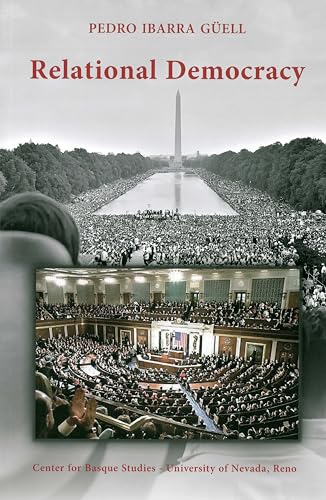

Relational democracy Pedro Ibarra Guell ; translated by Cameron J. Watson.
Series William A. Douglass distinguished scholar series ;v. 1Detalles de publicación: Reno, Nev. Center for Basque Studies, University of Nevada, Reno c2008.Descripción: 253 p. 24 cmISBN:- 9781877802836 (hardcover)
- 321.8 I123r 22
- JC423 .I23 2008
| Imagen de cubierta | Tipo de ítem | Biblioteca actual | Biblioteca de origen | Colección | Ubicación en estantería | Signatura topográfica | Materiales especificados | Info Vol | URL | Copia número | Estado | Notas | Fecha de vencimiento | Código de barras | Reserva de ítems | Prioridad de la cola de reserva de ejemplar | Reservas para cursos | |
|---|---|---|---|---|---|---|---|---|---|---|---|---|---|---|---|---|---|---|
| Libro | Biblioteca Encarnación Valdés Colección General bev | 321.8 I123r (Navegar estantería(Abre debajo)) | Disponible | 80000002375015 |
Descripciones mejoradas de Syndetics:
Democracy is the most important idea underpinning the modern Western political tradition, yet what do we really understand by the term? Do governments really carry out the wishes of the people who elect them? In this work, the first in the William A. Douglass Distinguished Scholar Series, Pedro Ibarra Güell questions conventional approaches to democratic theory that judge democracy by elections alone. Specifically, he argues in favor of a new interpretation of democracy that incorporates not just electoral processes but also an established set of relations between citizens and leaders that facilitate a greater harmony, or concurrence, between popular demands and political decision-making. He contends that such an approach, which he terms relational democracy, is in fact demonstrably more democratic than the purely representative democracy of many current political systems. Yet he is also aware that many claims for greater participatory democracy fall short when it comes to their practical implementation. Therefore, his highly original proposal for relational democracy is grounded in an appreciation of the pitfalls of relying on theory alone, and instead offers what he believes to be a viable and practical alternative to representative democracy. By way of a conclusion, the book applies the basic tenets of the argument in favor of relational democracy to a specific case study, evaluating the nature of democracy in the Basque Country.
Includes bibliographical references and index.
"The author argues in favor of relational democracy, a theory designed to achieve greater concurrence between citizens' wishes and leaders' decisions; he believes this would encourage a more democratic society than those political systems based on representative democracy alone. The author also applies his model of relational democracy to the Basque Country"--Provided by publisher.