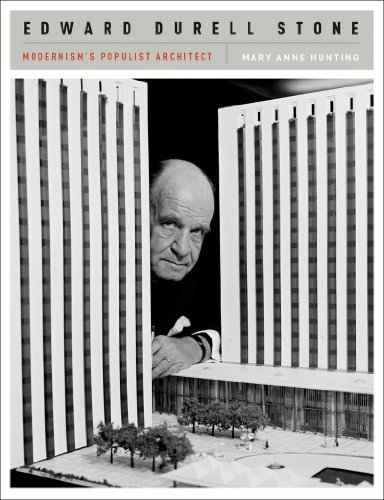

Edward Durell Stone : modernism's populist architect. / Mary Anne Hunting. txt
Idioma: Inglés New York : W.W. Norton & Company , 2012Edición: 1st editionDescripción: 175 p. ill. ;plans. ; 27 cmTipo de contenido:- text
- unmediaded
- volume
- 9780393733013
- 0393733017
- 720.92 23
- NA737.S66 H86 2012
| Imagen de cubierta | Tipo de ítem | Biblioteca actual | Biblioteca de origen | Colección | Ubicación en estantería | Signatura topográfica | Materiales especificados | Info Vol | URL | Copia número | Estado | Notas | Fecha de vencimiento | Código de barras | Reserva de ítems | Prioridad de la cola de reserva de ejemplar | Reservas para cursos | |
|---|---|---|---|---|---|---|---|---|---|---|---|---|---|---|---|---|---|---|
| Libro | CARIBET Biblioteca Arquitectura Colección General CARIBET | General NA737.S66 H86 2012 (Navegar estantería(Abre debajo)) | 1 | Disponible | 91000000047985 |
Descripciones mejoradas de Syndetics:
"Colossus," "visionary," "giant" are superlatives used in the mid-twentieth century to describe Edward Durell Stone (1902-1978), a celebrity architect whose wholly unique modern aesthetic of "new romanticism" played a crucial role in defining middle-class culture.
Framed between the Great Depression and the oil embargo of the early 1970s, the distinguished career of the native Arkansan is represented on four continents, in thirteen foreign countries, and in thirty-two states--his masterpiece the American Embassy chancery (1953-59) in New Delhi, India. Recognized in his prime as one of the nation's most sought-after architects, Stone's vast and prestigious workload brought prosperity on a scale rare in architecture in his time; after the death of Frank Lloyd Wright, some supporters thought Stone seemed destined to take the place of his personal hero and close friend as the great national architect.
But Stone also drew divergent reactions. Such International Style buildings as his Museum of Modern Art (1935-39) in New York City, an austere, unornamented volume, won critical approval; in contrast, his monumental postwar architecture--the John F. Kennedy Center for the Performing Arts (1958-71) in Washington, DC, among the best known--exposed popular tastes by offering a broader definition of Modernism inclusive of decoration.
Enhanced interest in Stone's architecture has been spurred by the reconsideration of a number of his buildings. The former Gallery of Modern Art (1958-64) at 2 Columbus Circle in New York City, which was lost to a near complete makeover, stimulated vigorous and at times contentious discussion that made evident the need for an objective reassessment. His legacy--of giving form to the aspirations of the emerging consumer culture and of reconciling Modernism with the dynamism of the age--is established in Edward Durell Stone: Modernism's Populist Architect .
Include index
Include Bibliography
List of drawings --
Preface --
Acknowledgments --
introduction --
An Artist's path: From pstoral ozarkian to cosmopolitan savant
The international style: pioneering experimentation
embrcing the american impulse
a provocative new aesthetic: new romanticism
arachitecture as commodity
from architectural kitsch to populism
Goo architecture is good business ... for years and years
Framed between the Great Depression and the oil embargo of the early 1970s, the distinguished career of the native Arkansan is represented on four continents, in thirteen foreign countries, and in thirty-two states--his masterpiece the American Embassy chancery (1953-59) in New Delhi, India. Recognized in his prime as one of the nation's most sought-after architects, Stone's vast and prestigious workload brought prosperity on a scale rare in architecture in his time; after the death of Frank Lloyd Wright, some supporters thought Stone seemed destined to take the place of his personal hero and close friend as the great national architect. But Stone also drew divergent reactions. Such International Style buildings as his Museum of Modern Art (1935-39) in New York City, an austere, unornamented volume, won critical approval; in contrast, his monumental postwar architecture--the John F. Kennedy Center for the Performing Arts (1958-71) in Washington, DC, among the best known--exposed popular tastes by offering a broader definition of Modernism inclusive of decoration. Enhanced interest in Stone's architecture has been spurred by the reconsideration of a number of his buildings. The former Gallery of Modern Art (1958-64) at 2 Columbus Circle in New York City, which was lost to a near complete makeover, stimulated vigorous and at times contentious discussion that made evident the need for an objective reassessment. His legacy--of giving form to the aspirations of the emerging consumer culture and of reconciling Modernism with the dynamism of the age--is established in Edward Durell Stone: Modernism's Populist Architect.
"Colossus, visionary, giant are superlatives used at midcentury to describe this celebrity architect whose new romanticism gave form to the aspirations of the emerging consumer culture. This reassessment of his work, including reactions to it and his role in the transformation of Modernism, firmly establishes Edward Durell Stone as a modern master.