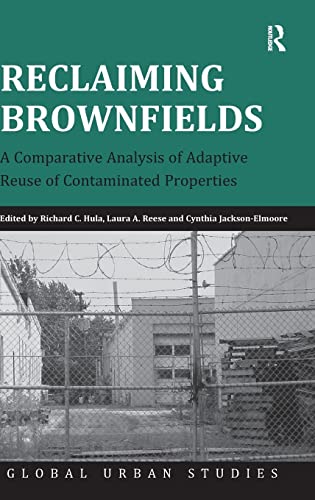

Reclaiming brownfields a comparative analysis of adaptive reuse of contaminated properties edited by Richard C. Hula, Laura A. Reese, and Cynthia Jackson-Elmoore.
Idioma: Inglés England Ashgate Publishing Limited 2012Descripción: xvii, 386 p. ill. 24 cmTipo de contenido:- text
- unmediaded
- volume
- 9781409449584
- 307.3
- HT170 R425 2012
| Imagen de cubierta | Tipo de ítem | Biblioteca actual | Biblioteca de origen | Colección | Ubicación en estantería | Signatura topográfica | Materiales especificados | Info Vol | URL | Copia número | Estado | Notas | Fecha de vencimiento | Código de barras | Reserva de ítems | Prioridad de la cola de reserva de ejemplar | Reservas para cursos | |
|---|---|---|---|---|---|---|---|---|---|---|---|---|---|---|---|---|---|---|
| Libro | CARIBET Biblioteca Arquitectura Colección General CARIBET | General HT170 R425 2012 (Navegar estantería(Abre debajo)) | 2 | Disponible | 91000000046839 |
Descripciones mejoradas de Syndetics:
The environmental legacy of past industrial and agricultural development can simultaneously pose serious threats to human health and impede reuse of contaminated land. The urban landscape around the world is littered with sites contaminated with a variety of toxins produced by past use. Both public and private sector actors are often reluctant to make significant investments in properties that simultaneously pose significant potential human health issues, and may demand complex and very expensive cleanups. The chapters in this volume recognize that land and water contamination are now almost universally acknowledged to be key social, economic, and political issues. How multiple societies have attempted to craft and implement public policy to deal with these issues provides the central focus of the book. The volume is unique in that it provides a global comparative perspective on brownfield policy and examples of its use in a variety of countries.
Index
Bibliography
Contents:
List of Figures vii --
List of tables ix --
List of Contributors xi --
Acknowledgments xix --
Part I : Policy 1 Incentives for Collaboration : State level Brownfield Remediation and Redevelopment Programs Elizabeth A. Lowham 17 --
2 Changing Agendas in State Environmental Policy : Development versus Cleanup in Brownfield Programs Richard C. Hula 37 --
3 Revitalizing Contaminated Land in Italy, the United Kingdom and the United States : A Comparative Perspective Philip Catney, Tiziana Cianflone and Kris Wernstedt 65 --
4 Redevelopment Strategy of Brownfield Sites in the Czech Republic Petra Rydvalova and Miroslav Zizka 89 --
Part II : Implementation and Evaluation --
5 Exploring the Potential for Integrating Community Benefits Agreements into Brownfield Redevelopment Projects Courtney E. Knapp and Justin B. Hollander 131 --
6 The Quantitative and Qualitative Impacts of Brownfield Policies in England Katie Williams 151 --
7 New Urban Communities : Building on Brownfields for America’s Next Generation Mark L. Gillem and Jill A. Schreifer 171 --
8 The Inertia of Environmental Regulatory Enforcement in China : Collusion or Abuse of Authority ? Han Hongyun and Zhao Liange 209 --
Appendices to Chapter 8 --
9 Strategic Land Management in Germany : One Key for Brownfield Cleanup and Sustainable Development Detlef Grimski, Fabian Dosch and Herbert Klapperich 237 --
Part III : Brownfield Case Studies --
10 Fostering Brownfields Development in Rust Belt Cities : A comparison of State Approaches and their Impacts in Cincinnati and Pittsburgh Andrea E. Yang 261 --
11 Institutional Network Management in Brownfield Cleanup and Redevelopment Rob Alexander 289 --
12 From Blighted Brownfields to Healthy and Sustainable Communities : Tracking Performances and Measuring Outcomes Laurel Berman, Christopher A. De Sousa, Terri Linder and David Misky 241 --
13 Michigan Brownfield Redevelopment Innovation : Two Decades of Success Robert A. Jones and William Welsh 371 --
Appendix to Chapter 13 --
Index 383 --
List of Figures:
1.1 Cluster analysis using three algorithms 28 --
4.1 Development of population in the Czech Republic 90 --
4.2 Population on the territory of the Czech Republic 91 --
4.3 Real changes in GDP 94 --
4.4 Industry share on GDP creation 96 --
4.5 Non-utilization of brownfields 97 --
4.6 Solution of brownfield redevelopment 99 --
4.7 Scheme of cooperation 104 --
4.8 Scheme of brownfield redevelopment 107 --
4.9 Structure of demand 113 --
4.10 Process of brownfield redevelopment 114 --
6.1 Previously developed land by type in England 157 --
6.2 Derelict and / or vacant land and buildings in England, annual change in hectares, 2001-2007 158 --
6.3 Land with planning permission or identified for redevelopment in England, annual change in hectares, 2001-2007 159 --
6.4 Amounts of PDL by region and by type 160 --
6.5 Percentage of new dwellings built on PDL, 1989-2008 161 --
6.6 Proportion of dwellings on PDL by region 2003 and 2007 161 --
7.1 Glenwood Park, Atlanta. Main street design 184 --
7.2 Glenwood Park, Atlanta. New urbanist alley design 185 --
7.3 Hercules, CA. Waterfront district 188 --
7.4 Hercules, CA. New urbanist alley design 189 --
7.5 Atlantic Station, Atlanta. New urbanism combined with lifestyle center 193 --
7.6 Atlantic Station, Atlanta. Commercial with upper apartment lofts 195 --
7.7 Atlantic Station, Atlanta. 30-acre parking garage 196 --
7.8 Bay Street, Emeryville, CA. Neotraditional main street 200 --
7.9 Bay Street, Emeryville, CA. Parking design 201 --
8.1 The Chinese environmental protection apparatus 211 --
9.1 Cabernet process 245 --
9.2 Economic components 250 --
10.1 City rankings 263 --
11.1 Network management model 296 --
12.1 3oth street corridor baselines assessment process 329 --
List of Tables:
1.1 Ideal types. Cluster averages across each variable and index used in cluster algorithms 29 --
1.2 Breakdown of indices by cluster 30 --
1.3 Pearson's Correlation Coefficients among cluster profiles 31 --
2.1 CRDC key characteristics of state brownfield programs 42 --
2.2 Rotated component matrix of factor analysis of unweighted CRDC scores 44 --
2.3 State size/wealth and brownfield innovation, FY 1997 52 --
2.4 Level of contamination and brownfield innovation, FY 1997 54 --
2.5 EPA region and brownfield innovation, FY 1997 55 --
2.6 Federal pilot programs and brownfield innovation, FY 1997 56 --
2.7 Partisan political variables and brownfield innovation, FY 1997 57 --
2.8 Summary models predicting brownfield innovation, FY 1997 58 --
3.1 Percentage of respondents selecting as ‘’very important’’ reason 70 --
3.2 Regulatory power, planning system and responsibility in the brownfield remediation and redevelopment processes 77 --
3.3 Obstacles and strengths in the brownfield remediation and redevelopment processes 78 --
4.1 Transformation recession in the former CMEA countries (GDP changes in %) 95 --
4.2 The structure of brownfields according to their original use (in%) 97 --
4.3 Number of brownfields in CZ (estimate in 2004) 98 --
4.4 Number of brownfields in the regions of the Czech Republic 101 --
4.5 Priorities in brownfields redevelopment realization 105 --
4.6 Potential public resources for brownfields redevelopment for the period of 2007-2013 110 --
8.1 Background of environmental administration in China 224 --
10.1 State comparison 270 --
11.1 Phases of brownfield cleanup and redevelopment 294 --
11.2 Common brownfields policy instruments 295 --
11.3 Case selection framework 298 --
11.4 Case descrptions 298 --
11.5 Policy tools by phase and tool target 302 --
12.1 Example : the ENCHIA healthy development measurement tool 318 --
12.2 2005 MVBI issues and indicators 326 --
12.3 Results of ATSDR’s brownfields / land revitalization action model 330 --
13.1 Site inventory 343 --
Appendix 13.1 Michigan brownfield redevelopment 371 --
Tabla de contenidos provista por Syndetics
- Part I Policy
- Incentives for collaboration: state-level brownfield remediation and redevelopment programs
- Changing agendas in state environmental policy: development versus cleanup in brownfield programs
- Revitalizing contaminated land in Italy, the United Kingdom and the United States: a comparative perspective
- Redevelopment strategy of brownfield sites in the Czech Republic
- Part II Implementation and Evaluation
- Exploring the potential for integrating community benefits agreements into brownfield redevelopment projects
- The quantitative and qualitative impacts of brownfield policies in England
- New urban communities: building on brownfields for America's next generation
- The inertia of environmental regulatory enforcement in China: collusion or abuse of authority?
- Appendices to chapter
- Strategic land management in Germany: one key for brownfield cleanup and sustainable development
- Part III Brownfield Case Studies
- Fostering brownfields development in rust belt cities: a comparison of state approaches and their impacts in Cincinnati and Pittsburgh
- Institutional network management in brownfield cleanup and redevelopment
- From blighted brownfields to healthy and sustainable communities: tracking performance and measuring outcomes
- Michigan brownfield redevelopment innovation: two decades of success
- Appendix to chapter 13
- Index