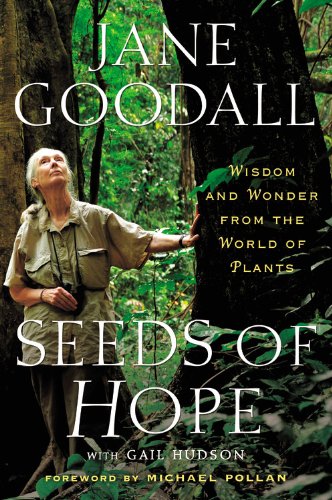

Seeds of hope wisdom and wonder from the world of plants Jane Goodall with Gail Hudson.
Detalles de publicación: New York Grand Central Publishing, Hachette Book Group ©2014.Edición: First editionDescripción: xi, 420 pages illustrations 24 cm Tipo de medio:- 9781455513222 (hardcover)
- 9781611135206 (audiobook)
- 580 G6468s 23
- QK46.5.H85 G66 2013
| Imagen de cubierta | Tipo de ítem | Biblioteca actual | Biblioteca de origen | Colección | Ubicación en estantería | Signatura topográfica | Materiales especificados | Info Vol | URL | Copia número | Estado | Notas | Fecha de vencimiento | Código de barras | Reserva de ítems | Prioridad de la cola de reserva de ejemplar | Reservas para cursos | |
|---|---|---|---|---|---|---|---|---|---|---|---|---|---|---|---|---|---|---|
| Libro | Biblioteca Encarnación Valdés Colección General bev | 580 G6468s (Navegar estantería(Abre debajo)) | Disponible | 80000002515412 |
Descripciones mejoradas de Syndetics:
In her wise new book, Jane Goodall blends her experience in nature with her enthusiasm for botany to give readers a deeper understanding of the world around us. Long before her work with chimpanzees, Goodall's passion for the natural world sprouted in the backyard of her childhood home in England, where she climbed her beech tree and made elderberry wine with her grandmother. 'Seeds of Hope' takes us from England to Goodall's home-away-from-home in Africa, deep inside the Gombe forest, where she and the chimpanzees are enchanted by the fig and plum trees they encounter. She introduces us to botanists around the world, as well as places where hope for plants can be found, such as The Millennium Seed Bank, where one billion seeds are preserved. She shows us the secret world of plants with all their mysteries and potential for healing our bodies as well as Planet Earth. Looking at the world as an adventurer, scientist, and devotee of sustainable foods and gardening - and setting forth simple goals we can all take to protect the plants around us.
"Renowned naturalist and bestselling author Jane Goodall examines the critical role that trees and plants play in our world"--Provided by the publisher
Introduction / by Michael Pollan -- Part One. My Love for the Natural World -- A Childhood Rooted in Nature -- The Kingdom of the Plants -- Trees -- Forests -- Part Two. Hunting, Gathering, and Gardening -- The Plant Hunters -- Botanical Gardens -- Seeds -- Orchids -- Gardens and Gardening -- Part Three. Uses and Abuses of Plants -- Plants That Can Heal -- Plants That Can Harm -- Plantations -- Food Crops -- Genetically Modified Organisms -- Part Four. The Way Forward -- The Future of Agriculture -- Growing Our Own Food -- Saving Forests -- Hope for Nature -- The Will to Live -- Gratitude.
Reseñas proporcionadas por Syndetics
Library Journal Review
Goodall (Reason for Hope) and her frequent coauthor Hudson here cover the use and abuse of plants in food, medicine, clothing, worship, and fuel. The work also examines farming practices, such as large-scale plantation farming of single, profitable plants that destroy natural diversity and contribute to human poverty. While the work at times takes on a gloomy, pessimistic tone, Goodall and Hudson provide examples of individuals and groups attempting to bring about change by working on organic farming; preservation of seeds for future use; conservation of forests, grasslands, and wetlands; and business practices that minimize impact on the environment. Cautionary tales are intermixed with Goodall's reminiscences of a childhood spent in the English countryside and her studies of primates in Africa. The audiobook includes a PDF file of images from the print work. Reader Edita Brychta does an excellent job of telling the tale. -verdict Recommended to all listeners who are interested in expanding their knowledge on environmental issues.-Stephen L. Hupp, West Virginia Univ. Parkersburg Lib. (c) Copyright 2014. Library Journals LLC, a wholly owned subsidiary of Media Source, Inc. No redistribution permitted.CHOICE Review
Primatologist Goodall turns her attention to the myriad facets of the relationship between plants and people in a book that combines history, current conservation issues, and memoir. In attempting to cover such a large topic, Goodall sacrifices depth for breadth but uncovers many interesting corners of the plant world. Part 1 is the most autobiographical, detailing the influences that led to this book. Part 2 contains biographical sketches of plant hunters, a history of famous botanic gardens, and tales of orchids. Part 3 runs the gamut from medicinal plants to plantations to genetically modified organisms (GMOs). Part 4 describes projects undertaken to preserve the natural world. Fifty pages of footnotes, added after plagiarism was uncovered in an initial release, encompass a mix of periodicals, books, and websites. These often seem selected to support Goodall's message rather than resulting from a thorough review of existing research. Particularly in the chapter on GMOs, her passion for her subject is admirable, but the thoroughness of her review of the research is not. Laypeople who enjoyed her previous books, particularly Hope for Animals and Their World (CH, Feb'10, 47-3165), may enjoy this similarly conservation-themed book. Summing Up: Recommended. With reservations. General readers. --Christin Helen Chenard, Plymouth State UniversityBooklist Review
*Starred Review* Though Goodall is known everywhere as the chimpanzee expert who transformed our understanding of primates and ourselves, it comes as no surprise that her profound love of nature and vigorous global activism extend to the plant kingdom. Goodall begins this tribute to the glory of plants and trees and protest against their endangerment with memories of her grandmother's English country home, where her best friend was a large, cradling beech. She also shares her reverence for the forests of Gombe that nurture chimpanzees. In this far-ranging, gracefully impassioned book, Goodall, aided by frequent coauthor Hudson, shares her fascination with the beingness of plants, from the miracles of seeds to photosynthesis and astonishing strategies of seed dispersal, pollination, defense, and communication. She writes of her mystical experiences with trees, obsessive and daring plant hunters, orchid fever, and the deep psychological benefits of gardening. Goodall celebrates the long history of medicinal plants and decries corporate biopiracy and exposes the horrendous human suffering and environmental damage wrought by today's cotton industry and the disastrous consequences of genetically modified crops. Appalled by the ongoing destruction of forests, Goodall finds seeds of hope in those who work to protect the green world, upon which we are utterly dependent. A crucial and commanding summons to care and act by one of nature's most heroic champions.--Seaman, Donna Copyright 2010 BooklistNotas de autor provistas por Syndetics
Jane Goodall, 1934 - Jane Goodall, a well-respected English zoologist, is famous for her fieldwork with chimpanzees in Africa. An early interest in African wild animals and the opportunity, at age 18, to stay on a friend's farm in Kenya, led her to Dr. Louis Leakey; then curator of the National Museum of Natural History in Nairobi. Almost immediately Leakey hired Goodall as his assistant secretary, and she was soon accompanying Leakey and his wife on their expeditions.Following Leakey's suggestion that a field study of some of the higher primates would be a major contribution to the understanding of animal behavior, she began studying the chimpanzees of the Gombe Stream Research Center in Tanganyika (now Tanzania) in 1960. Although she had no undergraduate degree, Goodall earned a Ph.D. from Cambridge University in 1965, based on her first five years of research at the Gombe Center. After more than 20 years of extensive study and direct contact with wild chimpanzees in their natural habitat, Goodall continues to research, teach, and write about primate behavior today.
(Bowker Author Biography)