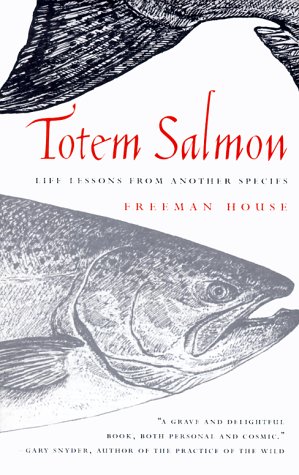
Part lyrical true-life adventure, part social and philosophical manifesto, TOTEM SALMON tells of a watershed community that worked for two decades to save one of the last purely native stocks of salmon in California.
Includes bibliographical references (p. 219-228).
Tabla de contenidos provista por Syndetics
Acknowledgments and Apologies(p. xi)
1 In Salmon's Water(p. 1)
2 Ghosts and Presences(p. 18)
3 Mountains in Motion(p. 32)
4 Rites of Regulation(p. 54)
5 The Clients of Science(p. 76)
6 At the Heart of Creation(p. 94)
7 In Place(p. 116)
8 The Happiness of the State(p. 135)
9 The Watershed(p. 151)
10 Substantial and Genuine Virtue(p. 175)
Epilogue: The Capacity to Become Human(p. 201)
Notes(p. 219)
Reseñas proporcionadas por Syndetics
Library Journal Review
House, a former commercial salmon fisherman and cofounder of two watershed restoration groups in Northern California, presents a personal tale of self-discovery as he recounts the efforts of the Mattole River Valley community to save wild salmon in the region through various habitat restoration activities. While many excellent books on the plight of salmon are already availablee.g., Upstream: Salmon & Society in the Pacific Northwest (National Academy, 1996) is a thorough and well-indexed reference to salmon ecology and fisheries, and Judith Roches First Fish, First People: Salmon Tales of the North Pacific Rim (Univ. of Washington, 1998) presents Native American rituals and folklore relating to salmonTotem Salmon meets a different need as an eloquent combination of history, biology, and politics. Well researched and informative, it is also a delight to read. An appropriate addition to both public and academic libraries.Barbara Butler, Oregon Inst. of Marine Biology, Univ. of Oregon, Charleston (c) Copyright 2010. Library Journals LLC, a wholly owned subsidiary of Media Source, Inc. No redistribution permitted.
Publishers Weekly Review
Although this is his first book, House displays a talent for lyrical writing combined with an ability to present information clearly. In the early 1980s, House became involved with several residents who were concerned with preserving the King Salmon, a fish native to the Mattole River, which runs through the westernmost watershed in California. He explains how the salmon have just one chance at reproduction. The female salmon swims upstream and builds her nest for depositing eggs, which are then fertilized after the male releases his sperm. This natural process has been thwarted over decades by an unregulated logging industry, whose companies built roads that contributed to the landslides that destroyed the equilibrium of the watershed, pouring rock, soil and debris into the river. House, a former commercial fisherman, and other activists began by building weirs that trapped the salmon. After House realized that their dedicated group could not, singlehandedly, save the salmon or the river, he built a coalition of residents committed to restoring the damaged river and its banks. House details how longtime community residents and more recent arrivals learned to compromise around a common goal. His inspired and well-written account of environmental activism is a terrific introduction to an ethic he calls "bioregionalism." (May) (c) Copyright PWxyz, LLC. All rights reserved
Booklist Review
Wild salmon, once so abundant that they supported much of Pacific Northwest culture, are now vanishing and being replaced by human-raised fish. House and other locals strove to save one strain of salmon in one northern California river. They encountered logging companies and farmers who refused to believe that what they did for their livelihood had anything to do with the salmon's decline. They encountered state fish and game department officials who refused to believe amateurs could succeed where they, the professionals, had not. House occasionally waxes overly poetic, yet he well communicates his and his companions' understanding that small ecological victories are accomplished by getting up at midnight, finding a wild salmon or two in their traps, fertilizing the eggs on their own, and then waiting as long as four years to see whether their efforts have succeeded. Rather than a book enthralled with the beauty of nature, this is a book about spending long days and nights with little or no pay to make one's corner of the world a little bit better. --Jon Kartman
Notas de autor provistas por Syndetics
Freeman House, a former commercial salmon fisherman, is cofounder of the Mattole Watershed Salmon Support Group and of the Mattole Restoration Council. He lives in Petroha in the Mattole River valley of northwestern California, and this is his first book.
Totem salmon
APA
House F., . (1999). Totem salmon: life lessons from another species. Boston: Beacon Press.
Chicago
House Freeman, . 1999. Totem salmon: life lessons from another species. Boston: Beacon Press.
Harvard
House F., . (1999). Totem salmon: life lessons from another species. Boston: Beacon Press.
MLA
House Freeman, . Totem salmon: life lessons from another species. Boston: Beacon Press. 1999.