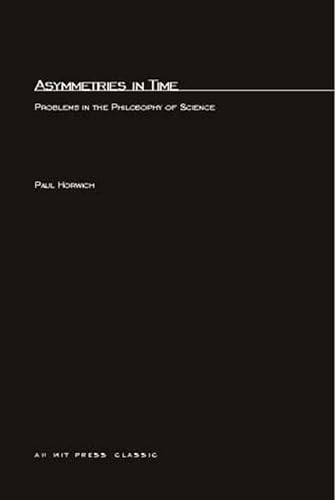

Asymmetries in time problems in the philosophy of science Paul Horwich.
Detalles de publicación: Cambridge, Mass. MIT Press c1987.Descripción: xiii, 218 p. ill. 24 cmISBN:- 0262580888 (pbk.)
- 0262081644
- 501 19
- Q175 .H796 1987
| Imagen de cubierta | Tipo de ítem | Biblioteca actual | Biblioteca de origen | Colección | Ubicación en estantería | Signatura topográfica | Materiales especificados | Info Vol | URL | Copia número | Estado | Notas | Fecha de vencimiento | Código de barras | Reserva de ítems | Prioridad de la cola de reserva de ejemplar | Reservas para cursos | |
|---|---|---|---|---|---|---|---|---|---|---|---|---|---|---|---|---|---|---|
| Libro | Biblioteca Encarnación Valdés Colección General bev | 501 H824a (Navegar estantería(Abre debajo)) | Disponible | 80000001192031 |
Descripciones mejoradas de Syndetics:
Time is generally thought to be one of the more mysterious ingredients of the universe. In this intriguing book, Paul Horwich makes precise and explicit the interrelationships between time and a large number of philosophically important notions. Ideas of temporal order and priority interact in subtle and convoluted ways with the deepest elements in our network of basic concepts. Confronting this conceptual jigsaw puzzle, Horwich notes that there are glaring differences in how we regard the past and future directions of time. For example, we can influence the future but not the past, and can easily gain knowledge of the past but not of the future. Moreover we see a profusion of decay processes but little spontaneous generation of order; time appears to "flow" in one privileged direction, not the other; and we tend to explain phenomena in terms of antecedent circumstances, rather than subsequent ones. Horwich explains such time asymmetries and examines their bearing on the nature of time itself. Asymmetries in Time covers many notoriously difficult problems in the philosophy of science: causation, knowledge, entropy, explanation, time travel, rational choice (including Newcomb's problem), laws of nature, and counterfactual implication-and gives a unified treatment of these matters. The book covers an unusually broad range of topics in a lucid and nontechnical way and includes alternative points of view in the philosophical literature.
"A Bradford book."
Includes index.
Bibliography: p. [209]-214.
Tabla de contenidos provista por Syndetics
- Preface(p. xi)
- 1 Asymmetries(p. 1)
- 2 Direction(p. 15)
- 3 Anisotropy(p. 37)
- 4 Entropy(p. 59)
- 5 Knowledge(p. 77)
- 6 Backward Causation(p. 91)
- 7 Time Travel(p. 111)
- 8 Causation(p. 129)
- 9 Explanation(p. 147)
- 10 Counterfactuals(p. 157)
- 11 Decision(p. 177)
- 12 Conclusion(p. 199)
- Bibliography(p. 209)
- Index(p. 215)