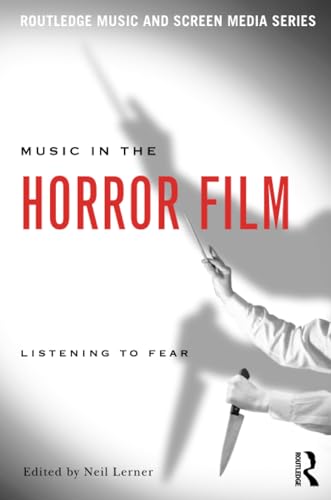

Music in the horror film listening to fear edited by Neil Lerner.
Series Detalles de publicación: New York Routledge 2010.Descripción: xi, 240 p. ill., music 23 cmISBN:- 9780415992039 (pbk.)
- 0415992036 (pbk.)
- 781.542 M9872 22
- ML2075 .M879 2010
| Imagen de cubierta | Tipo de ítem | Biblioteca actual | Biblioteca de origen | Colección | Ubicación en estantería | Signatura topográfica | Materiales especificados | Info Vol | URL | Copia número | Estado | Notas | Fecha de vencimiento | Código de barras | Reserva de ítems | Prioridad de la cola de reserva de ejemplar | Reservas para cursos | |
|---|---|---|---|---|---|---|---|---|---|---|---|---|---|---|---|---|---|---|
| Libro | Biblioteca Encarnación Valdés Sala de Música | 781.542 M9872 (Navegar estantería(Abre debajo)) | Disponible | 80000002463522 |
Descripciones mejoradas de Syndetics:
Music in Horror Film is a collection of essays that examine the effects of music and its ability to provoke or intensify fear in this particular genre of film. Frightening images and ideas can be made even more intense when accompanied with frightening musical sounds, and music in horror film frequently makes its audience feel threatened and uncomfortable through its sudden stinger chords and other shock effects. The essays in this collection address the presence of music in horror films and their potency within them. With contributions from scholars across the disciplines of music and film studies, these essays delve into blockbusters like The Exorcist, The Shining, and The Sixth Sense together with lesser known but still important films like Carnival of Souls and The Last House on the Left. By leading us with the ear to hear these films in new ways, these essays allow us to see horror films with fresh eyes.
Includes bibliographical references and index.
Carnival of souls and the organs of horror / Julie Brown -- Mischief afoot : supernatural horror-comedies and the Diabolus in musica / Janet K. Halfyard -- The monster and the music box : children and the soundtrack of horror / Stan Link -- The strange case of Rouben Mamoulian's sound stew : the uncanny soundtrack in Dr. Jekyll and Mr. Hyde (1931) / Neil Lerner -- Voices that lie within : the heard and unheard in Psycho / Ross J. Fenimore -- Pop goes the horror score : left alone in The last house on the left / Joe Tompkins -- Ramblin' men and piano men : crises of music and masculinity in The exorcist / Claire Sisco King -- Rehearing The shining : musical undercurrents in the Overlook Hotel / David J. Code -- Hearing deep seated fears : John Carpenter's The fog (1980) / K.J. Donnelly -- Music and the adult ideal in A nightmare on Elm Street / James Buhler -- The beauty of horror : Kilar, Coppola, and Dracula / James Deaville -- Quieting the ghosts in The sixth sense and The others / Lloyd Whitesell.
Tabla de contenidos provista por Syndetics
- Series Foreword(p. vii)
- Perface: Listening to Fear/Listening with Fear(p. viii)
- Acknowledgment(p. xii)
- 1 Carnival of Souls and the Organs of Horror(p. 1)
- 2 Mischief Afoot: Supernatural Horror-comedies and the Diabolus in Musica(p. 21)
- 3 The Monster and the Music Box: Children and the Soundtrack of Horror(p. 38)
- 4 The Strange Case of Rouben Mamoulian's Sound Stew: The Uncanny Soundtrack in Dr. Jekyll and Mr. Hyde (1931)(p. 55)
- 5 Voice That Lie Within: The Heard and Unheard in Psycho(p. 80)
- 6 Pop Goes the Horror Score: Left Alone in The Last House on the Left(p. 98)
- 7 Ramblin' Men and Piano Men: Crises of Music and Masculinity in The Exorcist(p. 114)
- 8 Rehearing The Shining: Musical Undercurrents in the Overlook Hotel(p. 133)
- 9 Hearing Deep Seated Fears: John Carpenter's The Fog (1980)(p. 152)
- 10 Music and the Adult Ideal in A Nightmare on Elm Street(p. 168)
- 11 The Beauty of Horror: Kilar, Coppola, and Dracula(p. 187)
- 12 Quieting the Ghosts in The Sixth Sense and The Others(p. 206)
- List of Contributors(p. 225)
- Index(p. 228)