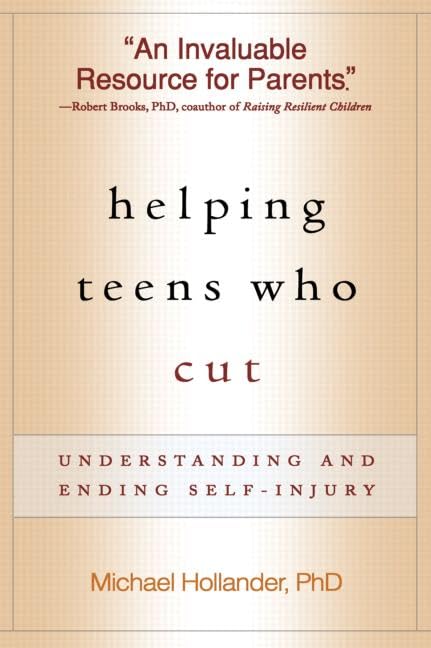

Helping teens who cut understanding and ending self-injury Michael Hollander.
Detalles de publicación: New York Guilford Press c2008.Descripción: x, 214 p. ill. 23 cmISBN:- 9781593857059 (hbk. : alk. paper)
- 9781593854263 (pbk. : alk. paper)
- 618.92/8582 22
- RJ506.S44 H635 2008
| Imagen de cubierta | Tipo de ítem | Biblioteca actual | Biblioteca de origen | Colección | Ubicación en estantería | Signatura topográfica | Materiales especificados | Info Vol | URL | Copia número | Estado | Notas | Fecha de vencimiento | Código de barras | Reserva de ítems | Prioridad de la cola de reserva de ejemplar | Reservas para cursos | |
|---|---|---|---|---|---|---|---|---|---|---|---|---|---|---|---|---|---|---|
| Libro | Biblioteca Encarnación Valdés Colección General bev | 618.928582 H7372h 2008 (Navegar estantería(Abre debajo)) | Disponible | 80000002452079 |
Descripciones mejoradas de Syndetics:
Discovering that your teen "cuts" is absolutely terrifying. Is your teen contemplating suicide? How can you talk to him or her about this frightening problem without making it worse or driving a wedge between you? Dr. Michael Hollander is a leading authority on self-injury and dialectical behavior therapy (DBT). In this compassionate, straightforward book, Dr. Hollander spells out the facts about cutting--and what to do to make it stop. Vivid stories illustrate how out-of-control emotions lead some teens to hurt themselves, and how proven treatments such as DBT can help. You'll learn concrete strategies for parenting your emotionally vulnerable teen, building his or her skills for coping and problem solving, dealing with crises, and finding an effective therapist or treatment program.
Winner--American Journal of Nursing Book of the Year Award
Includes bibliographical references and index.
Fact versus fiction : bringing self-injury into the light -- What sets the stage for self-injury? -- How does hurting themselves make some kids feel better? -- DBT : the right therapy for your teen -- Making the most of DBT -- Resetting the stage : how to help your teen restore emotion to its proper place -- Writing a better script : new ways to discourage self-injury -- Taking care of yourself to take care of your teen -- How to speak with siblings, friends, and the school about your child's troubles.
Tabla de contenidos provista por Syndetics
- Preface
- Introduction: Kids Who Deliberately Hurt Themselves
- I Understanding Self-Injury
- 1 Fact versus Fiction: Bringing Self-Injury into the Light
- 2 What Sets the Stage for Self-Injury?
- 3 How Does Hurting Themselves Make Some Kids Feel Better?
- 4 DBT: The Right Therapy for Your Teen
- II Helping Your Teen in Treatment and at Home
- 5 Making the Most of DBT
- 6 Resetting the Stage: How to Help Your Teen Restore Emotion to Its Proper Place
- 7 Writing a Better Script: New Ways to Discourage Self-Injury
- 8 Taking Care of Yourself to Take Care of Your Teen
- 9 How to Speak with Siblings, Friends, and the School about Your Child's Troubles
- Appendix A Effectiveness of Adolescent Intensive Dialectical Behavior Therapy Program
- Appendix B Intensive Treatment Programs Resources"