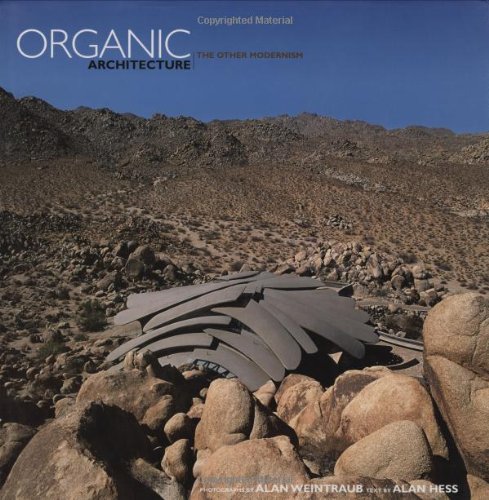
Imagen de portada de Amazon
Imagen de Amazon.com
Imagen de cubierta Syndetics
Portada de Syndetics
Imagen de OpenLibrary

Organic architecture : the other modernism. / text by Alan Hess ; photographs by Alan Weintraub. txt

Por: Colaborador(es): Layton, Utah : Gibbs Smith , 2006Edición: 1st edDescripción: 275 p. ill. ;col. ;photo. ; 26 cmTipo de contenido:
  • text
Tipo de medio:
  • unmediaded
Tipo de soporte:
  • volume
ISBN:
  • 9781586858575
  • 1586858572
Tema(s): Clasificación CDD:
  • 728.37 22
Clasificación LoC:
  • NA7208 H47 2006
Contenidos:
Introduction -- 1900-1920 -- Frank Lloyd Wright / Roberts House, 1908, River Forest Illinois -- Walter Burley Griffin / Melson House, 1912, Mason City, Iowa -- Walter Burley Griffin / Blythe House, 1913, Mason City, Iowa -- Purcell and Elmslie / Purcell-Cutts House, 1913, Minneapolis, Minnesota -- 2. 1920-1940 -- Frank Lloyd Wright / Storer House, 1923, Los Angeles, California -- Lloyd Wright - Sowden House, 1926, Los Angeles, California -- Alden Dow / Hanson House, 1934, Midland, Michigan -- Paul Schweikher / Schweikher House, 1937, Schaumburg, Illinois -- 3. 1940-1990 -- Bruce Goff / Ford House, 1947, Aurora, Illinois -- Frank Lloyd Wright / Mossberg House, 1948, South Bend, Indiana -- Karl Kamrath / Kamrath House, 1951, Houston, Texas -- Sim Bruce Richards / Richards House, 1953, San Diego, California -- Bruce Goff / Pollock-Warriner House, 1957, Oklahoma City, Oklahoma -- John Lautner / Silvertop, 1959, Los Angeles, California -- Eric Lloyd Wright / Pole House, 1960, Los Angeles, California -- Charles Haertling / Willard-Shapiro House, 1961, Boulder, Colorado -- Lloyd Wright / Bowler House, 1964, Palos Verdes, California -- Fay Jones / Pine Knoll, 1964, Little Rock, Arkansas -- Fay Jones / Stoneflower, 1965, Eden Isle, Arkansas -- Charles Haertling / Brenton House, 1969, Boulder, Colorado -- Alfred Browning Parker / Woodsong, 1978, Coconut Grove, Florida -- John Lautner / Segel House, 1979, Malibu, California -- Aaron Green / Green House, 1993, Philo, California -- 4. 1990-present Mickey Muennig / Partington Ridge House II, 1989, Big Sur, California -- Bart Prince / Sun Valley House, 1992, Sun Valley, Idaho -- Bart Prince / Skilken House, 1999, Columbus, Ohio -- Wallace Cunningham / Crescent House, 2004, San Diego, California -- Helena Arahuete / Roscoe House, 2004, Vacaville, California -- Ken Kellogg / Desert House, 2004, Joshua Tree, California --
Resumen: "Organic Architecture: The Other Modernism illuminates the broad brush stroke of Organic residential architecture throughout the panorama of twentieth-century Modernism. A wide-ranging style that defies definition, Organic buildings are notable in their curves and colors, as well as their exuberant, opulent, and at times extravagant complexity of line, form, texture, structure, and color. Organized chronologically, beginning in 1880 and ending with the present, each chapter explores the contributions of Organic architects in depth. With riveting historical context, including the movement's foundation, evolution, and major events, noted author Alan Hess shows why the organic movement has remained a strong, deep-running current in culture and design. Some key Organic architects explored in this book include: Louis Sullivan Frank Furness Frank Lloyd Wright Bruce Goff Charles Haertling John Lautner Walter Burley Griffin Mickey Muennig R.M. Schindler" A century of Organic architecture has given the world an opulent, exuberant, often defiant variety of houses based on the patterns and forms of nature. Frank Lloyd Wright, the best known of the Organic architects, blended his houses into spectacular natural settings using stone and natural wood. In addition to presenting a thorough evaluation of Frank Lloyd Wright, Organic Architecture: The Other Modernism also presents the wide range of architects who went far beyond Wright to turn Organic architecture into an ongoing school of Modern design. The natural environment of their chosen sites often shaped the designs of Organic architects. They drew inspiration from the sun and winds, the stone and trees, the views and lessons of the natural world. Architect Bruce Goff created delicate flower-like structures out of high-tech materials; John Lautner used concrete to create great wave-like homes with free-flowing spaces; Fay Jones designed ethereal wood constructions that echo the forests of his native Arkansas. They and the other architects represented in this book constitute a deep and enduring stream of Modern design. For most of the twentieth century, Organic architects battled the steel, boxy architecture of the Bauhaus for primacy in the world of Modern architecture. It was a struggle of Nature versus Machine. Rooted in a pioneering attitude of self-reliance and rugged individualism, the often uncompromising, often cantankerous Organic designers frequently found themselves outside the architectural establishment-they indeed were "the other Modernism." And yet they thrived. Popular shelter magazines celebrated their unconventional, often futuristic buildings. For a public bored with glass-box architecture, the dream of a home of warm natural wood, stone, and curving organic surfaces was widely appealing. This volume reveals the full story of Modern architecture based on the Organic design principles. The revived enthusiasm for Mid-Century Modernism over the last decade has only begun to scratch the surface of the full range of superb design and architecture after 1940. Organic design was, in fact, a big part of avant-garde design in that period. Beginning with the popular Prairie style in the Midwest around 1900, the Organic Architecture movement had its successes and failures as cycles of taste evolved. Reborn in 1935 with Frank Lloyd Wright's famous design for Fallingwater in western Pennsylvania, a generation of architects, which included Alfred Browning Parker, Charles Haertling, and Alden Dow, created a lively variety of Organic houses from Florida to Illinois, Texas to Colorado, Arizona to California. Today, the irrepressible forms of Organic design are alive and well in a new generation of architects featured in this book. Organic Architecture is the story of a sometimes stubborn, sometimes transcendental struggle to create a modern habitation for humans in touch with nature by pushing back the frontier of what is possible. Organic architecture's longevity and its ongoing influence continue to exert a strong pull on the direction of Modern architecture.
Valoración
    Valoración media: 0.0 (0 votos)
Existencias
Imagen de cubierta Tipo de ítem Biblioteca actual Biblioteca de origen Colección Ubicación en estantería Signatura topográfica Materiales especificados Info Vol URL Copia número Estado Notas Fecha de vencimiento Código de barras Reserva de ítems Prioridad de la cola de reserva de ejemplar Reservas para cursos
Libro CARIBET Biblioteca Arquitectura Colección General CARIBET General NA7208 H47 2006 (Navegar estantería(Abre debajo)) 1 Disponible 91000000019851
Total de reservas: 0

Descripciones mejoradas de Syndetics:

Organic Architecture: The Other Modernism illuminates the broad brush stroke of Organic residential architecture throughout the panorama of twentieth-century Modernism. A wide-ranging style that defies definition, Organic buildings are notable in their curves and colors, as well as their exuberant, opulent, and at times,extravagant complexity of line, form, texture, structure, and color.

Include index

Include bibliography

Introduction --
1900-1920 --
Frank Lloyd Wright / Roberts House, 1908, River Forest Illinois --
Walter Burley Griffin / Melson House, 1912, Mason City, Iowa --
Walter Burley Griffin / Blythe House, 1913, Mason City, Iowa --
Purcell and Elmslie / Purcell-Cutts House, 1913, Minneapolis, Minnesota --
2. 1920-1940 --
Frank Lloyd Wright / Storer House, 1923, Los Angeles, California --
Lloyd Wright - Sowden House, 1926, Los Angeles, California --
Alden Dow / Hanson House, 1934, Midland, Michigan --
Paul Schweikher / Schweikher House, 1937, Schaumburg, Illinois --
3. 1940-1990 --
Bruce Goff / Ford House, 1947, Aurora, Illinois --
Frank Lloyd Wright / Mossberg House, 1948, South Bend, Indiana --
Karl Kamrath / Kamrath House, 1951, Houston, Texas --
Sim Bruce Richards / Richards House, 1953, San Diego, California --
Bruce Goff / Pollock-Warriner House, 1957, Oklahoma City, Oklahoma --
John Lautner / Silvertop, 1959, Los Angeles, California --
Eric Lloyd Wright / Pole House, 1960, Los Angeles, California --
Charles Haertling / Willard-Shapiro House, 1961, Boulder, Colorado --
Lloyd Wright / Bowler House, 1964, Palos Verdes, California --
Fay Jones / Pine Knoll, 1964, Little Rock, Arkansas --
Fay Jones / Stoneflower, 1965, Eden Isle, Arkansas --
Charles Haertling / Brenton House, 1969, Boulder, Colorado --
Alfred Browning Parker / Woodsong, 1978, Coconut Grove, Florida --
John Lautner / Segel House, 1979, Malibu, California --
Aaron Green / Green House, 1993, Philo, California --
4. 1990-present
Mickey Muennig / Partington Ridge House II, 1989, Big Sur, California --
Bart Prince / Sun Valley House, 1992, Sun Valley, Idaho --
Bart Prince / Skilken House, 1999, Columbus, Ohio --
Wallace Cunningham / Crescent House, 2004, San Diego, California --
Helena Arahuete / Roscoe House, 2004, Vacaville, California --
Ken Kellogg / Desert House, 2004, Joshua Tree, California --

"Organic Architecture: The Other Modernism illuminates the broad brush stroke of Organic residential architecture throughout the panorama of twentieth-century Modernism. A wide-ranging style that defies definition, Organic buildings are notable in their curves and colors, as well as their exuberant, opulent, and at times extravagant complexity of line, form, texture, structure, and color. Organized chronologically, beginning in 1880 and ending with the present, each chapter explores the contributions of Organic architects in depth. With riveting historical context, including the movement's foundation, evolution, and major events, noted author Alan Hess shows why the organic movement has remained a strong, deep-running current in culture and design. Some key Organic architects explored in this book include: Louis Sullivan Frank Furness Frank Lloyd Wright Bruce Goff Charles Haertling John Lautner Walter Burley Griffin Mickey Muennig R.M. Schindler"
A century of Organic architecture has given the world an opulent, exuberant, often defiant variety of houses based on the patterns and forms of nature. Frank Lloyd Wright, the best known of the Organic architects, blended his houses into spectacular natural settings using stone and natural wood. In addition to presenting a thorough evaluation of Frank Lloyd Wright, Organic Architecture: The Other Modernism also presents the wide range of architects who went far beyond Wright to turn Organic architecture into an ongoing school of Modern design.
The natural environment of their chosen sites often shaped the designs of Organic architects. They drew inspiration from the sun and winds, the stone and trees, the views and lessons of the natural world. Architect Bruce Goff created delicate flower-like structures out of high-tech materials; John Lautner used concrete to create great wave-like homes with free-flowing spaces; Fay Jones designed ethereal wood constructions that echo the forests of his native Arkansas. They and the other architects represented in this book constitute a deep and enduring stream of Modern design.
For most of the twentieth century, Organic architects battled the steel, boxy architecture of the Bauhaus for primacy in the world of Modern architecture. It was a struggle of Nature versus Machine. Rooted in a pioneering attitude of self-reliance and rugged individualism, the often uncompromising, often cantankerous Organic designers frequently found themselves outside the architectural establishment-they indeed were "the other Modernism." And yet they thrived. Popular shelter magazines celebrated their unconventional, often futuristic buildings. For a public bored with glass-box architecture, the dream of a home of warm natural wood, stone, and curving organic surfaces was widely appealing.
This volume reveals the full story of Modern architecture based on the Organic design principles. The revived enthusiasm for Mid-Century Modernism over the last decade has only begun to scratch the surface of the full range of superb design and architecture after 1940. Organic design was, in fact, a big part of avant-garde design in that period.
Beginning with the popular Prairie style in the Midwest around 1900, the Organic Architecture movement had its successes and failures as cycles of taste evolved. Reborn in 1935 with Frank Lloyd Wright's famous design for Fallingwater in western Pennsylvania, a generation of architects, which included Alfred Browning Parker, Charles Haertling, and Alden Dow, created a lively variety of Organic houses from Florida to Illinois, Texas to Colorado, Arizona to California. Today, the irrepressible forms of Organic design are alive and well in a new generation of architects featured in this book.
Organic Architecture is the story of a sometimes stubborn, sometimes transcendental struggle to create a modern habitation for humans in touch with nature by pushing back the frontier of what is possible. Organic architecture's longevity and its ongoing influence continue to exert a strong pull on the direction of Modern architecture.

Tabla de contenidos provista por Syndetics

  • Introduction(p. 6)
  • Chapter 1 1900-1920(p. 12)
  • Chapter 2 1920-1940(p. 38)
  • Chapter 3 1940-1990(p. 76)
  • Chapter 4 1990-Present(p. 186)
  • Acknowledgments(p. 272)
  • Bibliography(p. 273)
  • Reference List(p. 273)
  • Index(p. 274)

Extracto provisto por Syndetics

It is this book's intention to illuminate the broad brush stroke of Organic residential architecture in America throughout the panorama of twentieth-century Modernism. Organic architecture is a style wide ranging enough to defy easy definition, yet vivid enough for people to know it when they see it. It reached a high point in the mid-twentieth century, but it has roots much deeper in American culture than the European Bauhaus architectural style that combined technology, craftsmanship, and aesthetics. Despite being marginalized at times by the tastemakers and professional magazines, Organic architecture has remained a strong, deep running current in American culture and design. There are, of course, Organic office buildings (the Price Tower in Bartlesville, Oklahoma, by Wright), coffee shops (Pann's in Los Angeles, California, by Armét and Davis), churches (Sea Ranch Chapel in Sea Ranch, California, by James Hubbell), as well as other building types, but for the sake of clarity and comparison the focus of this book is on residences. Excerpted from Organic Architecture: The Other Modernism by Alan Hess All rights reserved by the original copyright owners. Excerpts are provided for display purposes only and may not be reproduced, reprinted or distributed without the written permission of the publisher.

Notas de autor provistas por Syndetics

Alan Hess is an architect and historian who has written nine books documenting the architectural history of the West's suburban metropolises (including Frank Lloyd Wright: The Houses; The Ranch House; Viva Las Vegas; and The Architecture of John Lautner). He has served as architecture critic for the San Jose Mercury News since 1986. He studied at UCLA's Graduate School of Architecture and Urban Planning, and has been active in the preservation of roadside and post-War architecture, qualifying the nation's oldest McDonald's drive-in, the 1947 Bullock's Pasadena department store, the 1956 Valley Ho Motor Inn in Scottsdale, among others, for the National Register of Historic Places. He received a 1997 Honor Award from the National Trust for Historic Preservation for his efforts to preserve the McDonald's. Hess has taught at the Southern California Institute of Architecture (SciArc) and UCLA. He lives in Irvine, California. Alan Weintraub is a widely published architectural photographer whose books include Frank Lloyd Wright: The Houses; Lloyd Wright: The Architecture of FLW, Jr.; The Architecture of John Lautner; Oscar Niemeyer: Houses; Rancho Deluxe: Rustic Dreams and Real Western Living, as well as an ongoing work on the modern residential architecture of Brazil.
Compartir
logopucpr-y-vive

Contáctanos

¡Queremos saber de ti!

Tel. 787.841.2000 Ext. 1801

bibliotecavaldes@pucpr.edu

⁣Búscanos en las redes

© 2026 Desarrollado por Ignite Online • All Rights Reserved • Powered by Koha.