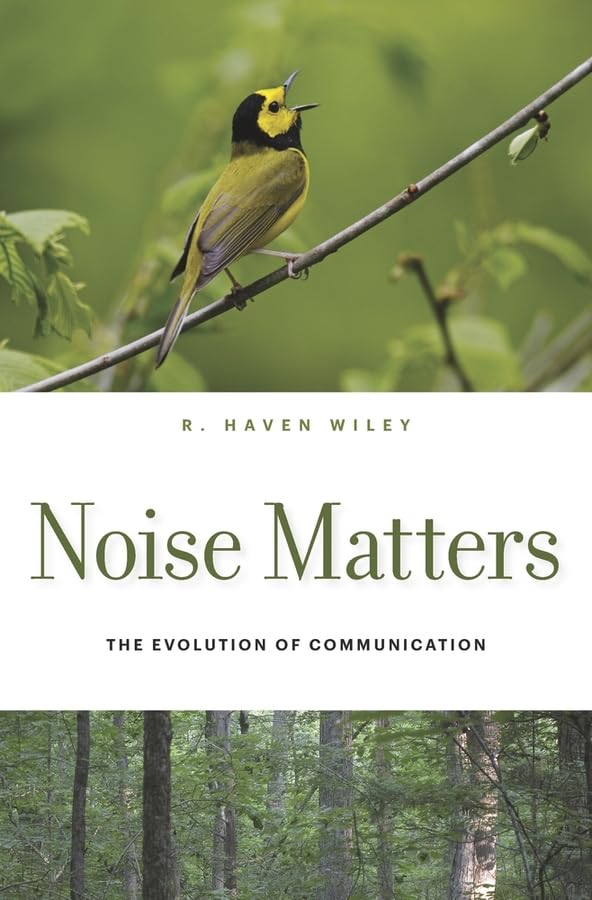

Noise matters [electronic resource] the evolution of communication R. Haven Wiley.
Idioma: Español Editor: Cambridge, Massachusetts Harvard University Press [2015]Descripción: 1 online resource (xi, 502 pages) illustrations 25 cm Tipo de medio:- 9780674744127 (alk. paper)
- 9780674287044 (electronic)
- 612.8/5 23
- QP465 .W55 2015eb
| Imagen de cubierta | Tipo de ítem | Biblioteca actual | Biblioteca de origen | Colección | Ubicación en estantería | Signatura topográfica | Materiales especificados | Info Vol | URL | Copia número | Estado | Notas | Fecha de vencimiento | Código de barras | Reserva de ítems | Prioridad de la cola de reserva de ejemplar | Reservas para cursos | |
|---|---|---|---|---|---|---|---|---|---|---|---|---|---|---|---|---|---|---|
| Libro electrónico | Biblioteca de Mayagüez Acceso en línea | QP465 .W55 2015eb (Navegar estantería(Abre debajo)) | Disponible | 50000003263018 |
Descripciones mejoradas de Syndetics:
Noise, as we usually think of it, is background sound that interferes with our ability to hear more interesting sounds. In general terms, though, it is anything that interferes with the reception of signals of any sort. It includes extraneous energy in the environment, degradation of signals in transit, and spontaneous random activity in receivers and signalers. Whatever the cause, the consequence of noise is error by receivers, and these errors are the key to understanding how noise shapes the evolution of communication.
Noise Matters breaks new ground in the scientific understanding of how communication evolves in the presence of noise. Combining insights of signal detection theory with evidence from decades of his own original research, Haven Wiley explains the profound effects of noise on the evolution of communication. The coevolution of signalers and receivers does not result in ideal, noise-free communication, Wiley finds. Instead, signalers and receivers evolve to a joint equilibrium in which communication is effective but never error-free. Noise is inescapable in the evolution of communication.
Wiley's comprehensive approach considers communication on many different levels of biological organization, from cells to individual organisms, including humans. Social interactions, such as honesty, mate choice, and cooperation, are reassessed in the light of noisy communication. The final sections demonstrate that noise even affects how we think about human language, science, subjectivity, and freedom. Noise Matters thus contributes to understanding the behavior of animals, including ourselves.
Includes bibliographical references (pages 413-490) and index.
eigm 02/2016
Tabla de contenidos provista por Syndetics
- List of Figures(p. ix)
- Introduction(p. 1)
- Part 1 Noise and Ways to Reduce It(p. 7)
- 1 Noise and Signals Introduced(p. 9)
- 2 Producing Acoustic Signals in Noise(p. 18)
- 3 Receiving Acoustic Signals in Noise(p. 36)
- 4 Transmission of Acoustic Signals(p. 61)
- 5 Adaptations to Noise in Different Environments(p. 85)
- 6 Reducing Noise, Enhancing Performance(p. 104)
- Part 2 Evolution of Signalers and Receivers(p. 127)
- 7 Signals, Receivers, and Evolution(p. 131)
- 8 Optimal Receivers and Signalers(p. 155)
- 9 Payoffs for Participants(p. 184)
- 10 Joint Optima for Signalers and Receivers(p. 209)
- 11 Evaluation and Extension of the Model(p. 241)
- Part 3 Altered Perspectives(p. 269)
- 12 Honesty in Communication(p. 273)
- 13 Sexual Selection as Communication(p. 284)
- 14 Cooperation by Communication(p. 303)
- 15 Complex Societies(p. 322)
- 16 Molecular Signals(p. 345)
- Part 4 Far Horizons(p. 355)
- 17 Human Communication(p. 357)
- 18 Truth in Language(p. 375)
- 19 Subjectivity(p. 384)
- 20 Verification(p. 395)
- Conclusion(p. 411)
- Bibliographic and Other Notes(p. 413)
- Acknowledgments(p. 491)
- Index(p. 493)