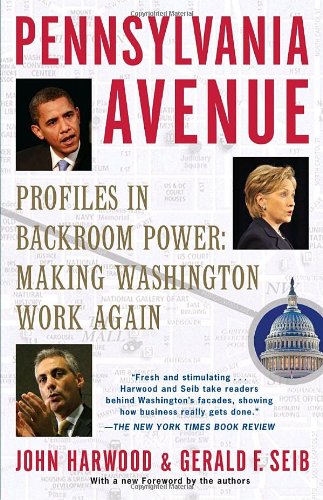
Imagen de portada de Amazon
Imagen de Amazon.com
Imagen de cubierta Syndetics
Portada de Syndetics
Imagen de OpenLibrary

Pennsylvania Avenue profiles in backroom power John Harwood and Gerald Seib.

Por: Colaborador(es): Detalles de publicación: New York Random House c2008.Edición: First editionDescripción: viii, 260 pages, [16] pages of plates illustrations 24 centimetersISBN:
  • 9780812976588
  • 9781400065547 (acid-free paper)
Tema(s): Clasificación CDD:
  • 320.973092/2 22
Clasificación LoC:
  • JK1726 .H39 2008
Recursos en línea:
Valoración
    Valoración media: 0.0 (0 votos)
Existencias
Imagen de cubierta Tipo de ítem Biblioteca actual Biblioteca de origen Colección Ubicación en estantería Signatura topográfica Materiales especificados Info Vol URL Copia número Estado Notas Fecha de vencimiento Código de barras Reserva de ítems Prioridad de la cola de reserva de ejemplar Reservas para cursos
Libro Biblioteca de Mayagüez Colección General mb JK1726 .H39 2008 (Navegar estantería(Abre debajo)) Disponible 50000003243200
Total de reservas: 0

Descripciones mejoradas de Syndetics:

Prizewinning journalists John Harwood and Gerald F. Seib show how today's Washington power game really works. With unprecedented access to capital insiders and with deep understanding of the unspoken rules of the political road, the authors illuminate what it takes to succeed in the high-stakes game of governing and provide insights and examples for how President Obama might affect real change in Washington. Through stories of party strategists, moneymen, policy-makers, fixers, socialites, lobbyists, spinners, and deal-makers, many of whom now have prominent positions in the Obama administration, Harwood and Seib explore the great political transformations that have altered the relationship between Americans and their government. They showcase both D.C. veterans of the game and the up-and-coming new breed of power brokers who have ushered Capitol Hill into a new age Featuring a compelling new Foreword on how Barack Obama might find success, Pennsylvania Avenue shows how our government really functions and reveals the insiders who make things happen.

Includes bibliographical references (pages [241]-247) and index.

Extracto provisto por Syndetics

Chapter One GRIDLOCK ON AMERICA'S MAIN STREET Pennsylvania Avenue, the most celebrated mile of pavement in America, stretches northwest from the U.S. Capitol to the White House, along a path cleared through the Washington swamp two hundred years ago. Every important chapter of American history has played out, in one fashion or another, on Pennsylvania Avenue. Pennsylvania Avenue is the capital's best address, the street of status, where the powerful work, and meet, and where the ambitious come to get things done. From the days when it was little more than a muddy path, the Avenue has been populated by smart people, men and women full of passion and drive and strong beliefs, many of them well meaning. Over the span of American history, the powerful have come together here to accomplish great things--to free the oppressed, to win great battles, to launch great public works, to comfort the downtrodden. The people of Pennsylvania Avenue can be vain, greedy, downright nasty as well. Sometimes the Avenue is where they manage to stop things from getting done. Interspersed with the moments of great glory are those occasions when fear, mistrust, or simple disagreements run out of control to produce confrontation and gridlock on Pennsylvania Avenue. In recent years, such occasions have become more and more numerous, to the point where, simply put, Pennsylvania Avenue doesn't work very well these days. For a complex set of reasons, it has become an avenue divided--divided by party, ideology, money, technology--so that even the best of intentions these days often produce the worst of results. To some extent, this complex of forces is well known to those who watch the nation's political machinations through the pages of newspapers and magazines or the shouting heads that have come to dominate political talk shows. What's less well known is the existence of a new kind of power broker on Pennsylvania Avenue, backroom power players who confront these forces and who strive to vault over them and, indeed, sometimes even succeed in doing so--in making Washington work. Many of these people are new to the national scene, having moved into the power structure thanks to the political upheavals of the last two decades. Over that time, the old establishment in Washington has been pushed aside, starting with Ronald Reagan's conservative sweep into Washington in 1980, followed by the Bill Clinton years, the Newt Gingrich revolution in the House in 1994, and the Democratic comeback of 2006. The capital's old wiring has been ripped out, and replaced. It is the lot of today's power players to have assumed positions of import at a time when, by all accounts, it has become harder and harder to get things done in the nation's capital. Some of these backroom power brokers have mastered the new rules of the road on Pennsylvania Avenue, and perhaps profited from them; others have figured out how to get things done despite Washington gridlock, by breaking away from the traffic patterns that have produced that gridlock. What all of these powerful people on Pennsylvania Avenue have figured out, amid great conflict along that 1.2-mile stretch of road, is a way to make their voices heard. This is a book about some of those people on Pennsylvania Avenue, people who are rarely seen, often unknown. Through these profiles in backroom power, we mean to show how a new network operates in Washington today, and by a new set of rules. ••• But first a story, one that shows some of the changes that have transformed Washington, and some of the forces that have created gridlock on America's Main Street. This story unfolded in February 2006, with a furor like that of one of those summer thunderstorms that periodically sweep across the nation's capital, seeming to arise o Excerpted from Pennsylvania Avenue: Profiles in Backroom - Making Washington Work Again by Gerald F. Seib, John Harwood All rights reserved by the original copyright owners. Excerpts are provided for display purposes only and may not be reproduced, reprinted or distributed without the written permission of the publisher.

Notas de autor provistas por Syndetics

John Harwood is the chief Washington correspondent for CNBC and a political writer for The New York Times . Harwood began his career in 1978 at the St. Petersburg Times , where he served as state capital correspondent, Washington correspondent, and political editor. In 1989 Harwood was awarded a Nieman fellowship at Harvard University. He subsequently spent sixteen years at The Wall Street Journal beginning in 1991, covering the White House, Congress, and national politics. In addition to CNBC, Harwood offers political analysis on MSNBC, NBC Nightly News, Meet the Press , and PBS' Washington Week . He lives in Silver Spring, Maryland, with his wife and their three daughters.

Gerald F. Seib is an assistant managing editor and the executive Washington editor of The Wall Street Journal. He writes the paper's "Capital Journal" column and is a regular commentator on Washington affairs for CNBC and Fox Business Network. Seib is the recipient of numerous honors, including the Merriman Smith Award, the Aldo Beckman Award, the Gerald R. Ford Journalism Prize, Georgetown University's Edward Weintal Prize for his coverage of the Gulf War, and the William Allen White Award of the University of Kansas. Along with Harwood, Seib was part of the Wall Street Journal team that won the 2002 Pulitzer Prize in the breaking news category for its coverage of the September 11 terrorist attacks. He lives in Chevy Chase, Maryland, with his wife and three sons.


From the Hardcover edition.
Compartir
logopucpr-y-vive

Contáctanos

¡Queremos saber de ti!

Tel. 787.841.2000 Ext. 1801

bibliotecavaldes@pucpr.edu

⁣Búscanos en las redes

© 2026 Desarrollado por Ignite Online • All Rights Reserved • Powered by Koha.