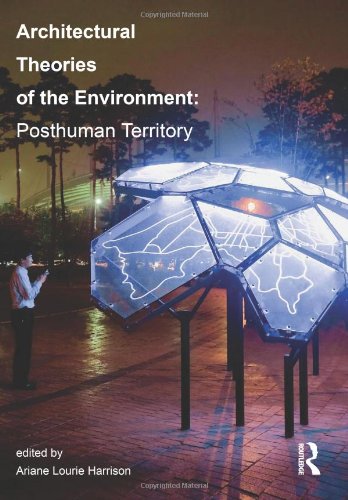

Architectural theories of the environment posthuman territory [edited by] Ariane Lourie Harrison. txt
Idioma: Alemán New york Routledge 2012Descripción: pg.326 24cmTipo de contenido:- text
- unmediated
- volume
- 9780415506182 (hardback)
- 9780415506199 (pb)
- 720/.47 23
- NA2542.35 A65 2012
- ARC000000 | ARC001000 | ARC018000
| Imagen de cubierta | Tipo de ítem | Biblioteca actual | Biblioteca de origen | Colección | Ubicación en estantería | Signatura topográfica | Materiales especificados | Info Vol | URL | Copia número | Estado | Notas | Fecha de vencimiento | Código de barras | Reserva de ítems | Prioridad de la cola de reserva de ejemplar | Reservas para cursos | |
|---|---|---|---|---|---|---|---|---|---|---|---|---|---|---|---|---|---|---|
| Libro | CARIBET Biblioteca Arquitectura Colección General CARIBET | General NA2542.35 A65 2012 (Navegar estantería(Abre debajo)) | 1 | Disponible | 91000000032557 |
Descripciones mejoradas de Syndetics:
As architects and designers, we struggle to reconcile ever increasing environmental, humanitarian, and technological demands placed on our projects. Our new geological era, the Anthropocene, marks humans as the largest environmental force on the planet and suggests that conventional anthropocentric approaches to design must accommodate a more complex understanding of the interrelationship between architecture and environment
Here, for the first time, editor Ariane Lourie Harrison collects the essays of architects, theorists, and sustainable designers that together provide a framework for a posthuman understanding of the design environment. An introductory essay defines the key terms, concepts, and precedents for a posthuman approach to architecture, and nine fully illustrated case studies of buildings from around the globe demonstrate how issues raised in posthuman theory provide rich terrain for contemporary architecture, making theory concrete. By assembling a range of voices across different fields, from urban geography to critical theory to design practitioners, this anthology offers a resource for design professionals, educators, and students seeking to grapple the ecological mandate of our current period.
Case studies include work by Arakawa and Gins, Arons en Gelauff, Casagrande, The Living, Minifie van Schaik, R & Sie (n), SCAPE, Studio Gang, and xDesign.
Essayists include Gilles Clément, Matthew Gandy, Francesco Gonzáles de Canales, Elizabeth Grosz, Simon Guy, Seth Harrison, N. Katherine Hayles, Ursula Heise, Catherine Ingraham, Bruno Latour, William J. Mitchell, Matteo Pasquinelli, Erik Swyngedouw, Sarah Whatmore, Jennifer Wolch, Cary Wolfe, and Albena Yaneva
Includes index.
"Humans are the largest environmental force on the planet, making this a new geologic era: The Anthropocene. As architects and designers, we struggle to reconcile the ever increasing environmental, humanitarian, and technological demands placed on our projects. Here, for the first time, editor Ariane Lourie Harrison collects the essays of architects, theorists, and sustainable designers that together provide a framework to help you develop your own guidelines to approaching your work. Each introduction defines a key term, such as biopolitics, animalization, and sociotechnical model, to increase your design vocabulary and highlight themes from the readings. Nine case studies from five countries demonstrate these concepts, so that you can see theory made concrete"--
Tabla de contenidos provista por Syndetics
- Introduction: Charting Posthuman Territory
- Part 1 Posthuman Subjects
- Unfinished Work: From Cyborg to Cognisphere
- 2 Post Animal Life
- 3 The Next Subject
- 4 Approaching a New Biotope
- 5 The Biosphere of Machines: Enter the Parasite
- Case Studies: Arakawa and Gins, Bioscleave House, East Hampton, NY, 2000-2008
- Arons en Gelauff, The Plussenburgh, Rotterdam, The Netherlands, 2001-2006
- R&Sie (n), I'm Lost in Paris, Paris, France, 2008
- Part 2 Posthuman Assemblies
- 6 Give Me a Gun and I Will Make All Buildings Move: An ANT's View of Architecture
- 7 Lose the Building: Form and System in Contemporary Architecture
- 8 Pragmatic Ecologies
- 9 Futures, Cities, and Architecture
- 10 Against Program
- 11 Metabolic Urbanization: The Making of Cyborg Cities
- Case Studies: Minifie von Shaik, Australian Wildlife Heath Center, Melbourne, Australia, 2006
- The Living, Living Light Pavilion, Peace Park, Seoul, South Korea, 2009
- Studio Gang Architects, Ford Calumet Environmental Center, Calumet, Illinois, competition 2004, Millennium Reserve Initiative 2011
- Part 3 Posthuman Territory
- 12 Zones of indistinction: Bio-political Contestations in the Urban Arena
- 13 Anima Urbis
- 14 Hybrid Cartographies for a Relational Ethics
- 15 The Emergent Alternative
- 16 Risk, Globalization and the Cosmopolitan Imaginary
- Case Studies: The Living and Nathalie Jermaijencko, Amphibious Architecture, East River, New York, 2009
- SCAPE, Oyster-tecture Project, 2010
- Pilot in Brooklyn, NY, 2012
- Marco Casagrande and C-Lab, Ruin Academy, Taipei, Taiwan, 2010-present
Notas de autor provistas por Syndetics
Ariane Lourie Harrison is a lecturer, School of Architecture, Yale University, and a principal of Harrison Atelier.