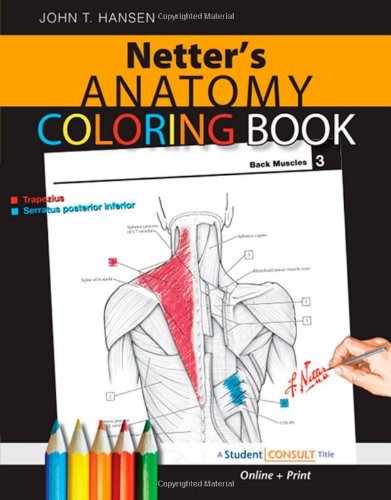

Netter's anatomy coloring book John T. Hansen ; artists, Frank H. Netter, Carlos A.G. Machado.
Detalles de publicación: Philadelphia Saunders/Elsevier c2010.Edición: 1st edDescripción: 1 v. ill. 28 cmISBN:- 9781416047025 (pbk.)
- 612.00222 H2493n 22
- QM25 .H357 2010
| Imagen de cubierta | Tipo de ítem | Biblioteca actual | Biblioteca de origen | Colección | Ubicación en estantería | Signatura topográfica | Materiales especificados | Info Vol | URL | Copia número | Estado | Notas | Fecha de vencimiento | Código de barras | Reserva de ítems | Prioridad de la cola de reserva de ejemplar | Reservas para cursos | |
|---|---|---|---|---|---|---|---|---|---|---|---|---|---|---|---|---|---|---|
| Libro | Biblioteca Encarnación Valdés Colección General bev | 612.00222 H2493n (Navegar estantería(Abre debajo)) | Disponible | 80000002505587 |
Descripciones mejoradas de Syndetics:
Now you can learn and master anatomy with ease, while having fun, through the unique approach of Netter's Anatomy Coloring Book, by John T. Hansen, PhD. Using this interactive coloring workbook, you can trace arteries, veins, and nerves through their courses and bifurcations...reinforce your understanding of muscle origins and insertions from multiple views and dissection layers...and develop a better understanding of the integration of individual organs in the workings of each body system throughout the human form. Online access to Student Consult-where you'll find the complete contents of the book and much more-further enhances your study and exponentially boosts your reference power. Whether you are taking an anatomy course or just curious about how the body works, let the art of Netter guide you! Provides multiple views, magnifications, and dissection layers that strengthen your understanding of 3-D anatomical relationships. Presents each topic in two-page spreads-with Netter anatomical illustrations accompanied by high-yield information-that gives context to the structures. Features illustrations small enough for quick coloring, but large enough to provide you with important details. Offers tips for coloring key structures that emphasize how a coloring exercise can reinforce learning. Uses Key Points to cover functional and clinical relevance and relationships. Contains tables that review muscle attachments, innervation, action, and blood supply. Features Clinical Notes which highlight the importance of anatomy in medicine. Includes online access to Student Consult where you can search the complete contents of the book, print additional copies of the coloring pages, view completed coloring pages for reference, access Integration Links to bonus content in other Student Consult titles...and much more...to further enhance your study and exponentially boost your reference power.
Tabla de contenidos provista por Syndetics
- Chapter 1 Orientation and Introduction
- 1.1 Terminology
- 1.2 Body Planes and Terms of Relationship
- 1.3 Movements
- 1.4 The Cell
- 1.5 Epithelial Tissues
- 1.6 Connective Tissues
- 1.7 Skeleton
- 1.8 Joints
- 1.9 Synovial Joints
- 1.10 Muscle
- 1.11 Nervous System
- 1.12 Skin (Integument)
- 1.13 Body Cavities
- Chapter 2 Skeletal System
- 2.1 Bone Structure and Classification
- 2.2 External Features of the Skull
- 2.3 Internal Features of the Skull
- 2.4 Mandible and Temporomandibular Joint
- 2.5 Vertebral Column
- 2.6 Cervical and Thoracic Vertebrae
- 2.7 Lumbar, Sacral and Coccygeal Vertebrae
- 2.8 Thoracic Cage
- 2.9 Joints and Ligaments of the Spine
- 2.10 Pectoral Girdle and Arm
- 2.11 Shoulder Joint
- 2.12 Forearm and Elbow Joint
- 2.13 Wrist and Hand
- 2.14 Wrist and Finger Joints and Movements
- 2.15 Pelvic Girdle
- 2.16 Hip Joint
- 2.17 Thigh and Leg Bones
- 2.18 Knee Joint
- 2.19 Bones of the Ankle and Foot
- 2.20 Ankle and Foot Joints
- Chapter 3 Muscular System
- 3.1 Muscles of Facial Expression
- 3.2 Muscles of Mastication
- 3.3 Extraocular Muscles
- 3.4 Muscles of the Tongue and Palate
- 3.5 Muscles of the Pharynx and Swallowing
- 3.6 Intrinsic Muscles of the Larynx and Phonation
- 3.7 Muscles of the Neck
- 3.8 Prevertebral Muscles
- 3.9 Superficial and Intermediate Back Muscles
- 3.10 Deep (Intrinsic) Back Muscles
- 3.11 Thoracic Wall Muscles
- 3.12 Anterior Abdominal Wall Muscles
- 3.13 Muscles of the Male Inguinal Region
- 3.14 Muscles of the Posterior Abdominal Wall
- 3.15 Muscles of the Pelvis
- 3.16 Muscles of the Perineum
- 3.17 Posterior Shoulder Muscles
- 3.18 Anterior Shoulder Muscles
- 3.19 Arm Muscles
- 3.20 Pronation and Supination of the Radioulnar Joints
- 3.21 Anterior Forearm Muscles
- 3.22 Posterior Forearm Muscles
- 3.23 Intrinsic Hand Muscles
- 3.24 Summary of Upper Limb Muscles
- 3.25 Gluteal Muscles
- 3.26 Posterior Thigh Muscles
- 3.27 Anterior Thigh Muscles
- 3.28 Medial Thigh Muscles
- 3.29 Anterior and Lateral Leg Muscles
- 3.30 Posterior Leg Muscles
- 3.31 Intrinsic Foot Muscles
- 3.32 Summary of Lower Limb Muscles
- Chapter 4 Nervous System
- 4.1 Neuronal Structure
- 4.2 Glial Cells
- 4.3 Types of Synapses
- 4.4 Cerebrum
- 4.5 Cortical Connections
- 4.6 Midsagittal and Basal Brain Anatomy
- 4.7 Basal Ganglia
- 4.8 Limbic System
- 4.9 Hippocampus
- 4.10 Thalamus
- 4.11 Hypothalamus
- 4.12 Cerebellum
- 4.13 Spinal Cord I
- 4.14 Spinal Cord II
- 4.15 Spinal and Peripheral Nerves
- 4.16 Dermatomes
- 4.17 Brain Ventricles
- 4.18 Subarachnoid Space
- 4.19 Sympathetic Division of the ANS
- 4.20 Parasympathetic Division of the ANS
- 4.21 Enteric Nervous System
- 4.22 Cranial Nerves
- 4.23 Visual System I
- 4.24 Visual System II
- 4.25 Auditory and Vestibular Systems I
- 4.26 Auditory and Vestibular Systems II
- 4.27 Taste and Olfaction
- 4.28 Cervical Plexus
- 4.29 Brachial Plexus
- 4.30 Lumbar Plexus
- 4.31 Sacral Plexus
- Chapter 5 Cardiovascular System
- 5.1 Composition of Blood
- 5.2 General Organization
- 5.3 Heart I
- 5.4 Heart II
- 5.5 Heart III
- 5.6 Heart IV
- 5.7 Features of Arteries, Capillaries and Veins
- 5.8 Head and Neck Arteries
- 5.9 Arteries of the Brain
- 5.10 Veins of the Head and Neck
- 5.11 Arteries of the Upper Limb
- 5.12 Arteries of the Lower Limb
- 5.13 The Thoracic and Abdominal Aorta
- 5.14 Arteries of the Gastrointestinal Tract
- 5.15 Arteries of the Pelvis and Perineum
- 5.16 Veins of the Thorax
- 5.17 Veins of the Abdominopelvic Cavity
- 5.18 Portocaval Anastomoses
- 5.19 Veins of the Upper Limb
- 5.20 Veins of the Lower Limb
- Chapter 6 Lymphatic System
- 6.1 General Organization of the Lymphatic System
- 6.2 Innate Immunity
- 6.3 Adaptive Immunity