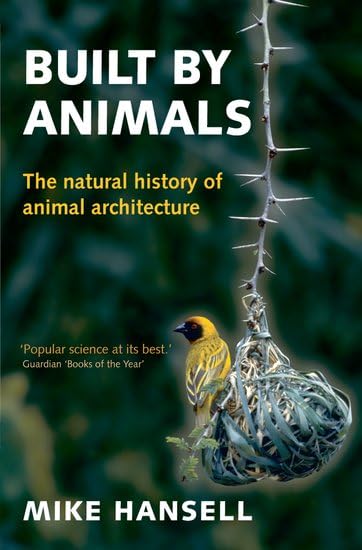

Built by animals the natural history of animal architecture Mike Hansell.
Idioma: Español Detalles de publicación: Oxford New York Oxford University Press 2007.Descripción: viii, 268 p. ill. 23 cmISBN:- 9780199205578
- 0199205566 (hbk.)
- 591.564 22
- QL756 .H357 2007
| Imagen de cubierta | Tipo de ítem | Biblioteca actual | Biblioteca de origen | Colección | Ubicación en estantería | Signatura topográfica | Materiales especificados | Info Vol | URL | Copia número | Estado | Notas | Fecha de vencimiento | Código de barras | Reserva de ítems | Prioridad de la cola de reserva de ejemplar | Reservas para cursos | |
|---|---|---|---|---|---|---|---|---|---|---|---|---|---|---|---|---|---|---|
| Libro | CARIBET Biblioteca Arquitectura Colección General CARIBET | QL756.H357 2009 (Navegar estantería(Abre debajo)) | Disponible | 91000000018689 |
Descripciones mejoradas de Syndetics:
From termite mounds that in relative terms are three times as tall as a skyscraper, to the elaborate nests of social birds and the deadly traps of spiders, the constructions of the animal world can amaze and at times humble our own engineering and technology. But how do creatures with such small brains build these complex structures? What drives them to do it? Which skills are innate and which learned? Here, Mike Hansell looks at the extraordinary structures that animals build - whether homes, traps, or courtship displays - and reveals the biology behind their behaviour. He shows how small-brained animals achieve complex feats in a small-brained way, by repeating many simple actions and using highly evolved self-secreted materials. On the other hand, the building feats or tool use of large-brained animals, such as humans or chimps, require significantly more complex and costly behaviour. We look at wasp's nests, leaf-cutting ants, caddisflies and amoebae, and even the extraordinary bower bird, who seduces his mate with a decorated pile of twigs, baubles, feathers and berries. Hansell explores how animal structures evolved over time, how insect societies emerge, how animals can alter their wider habitat, and even whether some animals have an aesthetic sense.
Includes bibliographical references (p. 252-257) and index.
Tabla de contenidos provista por Syndetics
- List of Figures(p. vi)
- List of Plates(p. vii)
- Preface(p. ix)
- 1 The Builders(p. 1)
- 2 Builders Change the World(p. 26)
- 3 You Don't Need Brains to be a Builder(p. 58)
- 4 Who's in Charge Round Here?(p. 92)
- 5 From One Nest to Another(p. 121)
- 6 Two Routes Lead to Trap Building(p. 147)
- 7 The Magic of the Tool Users(p. 180)
- 8 Beautiful Bowers?(p. 216)
- Notes and References(p. 252)
- Index(p. 258)