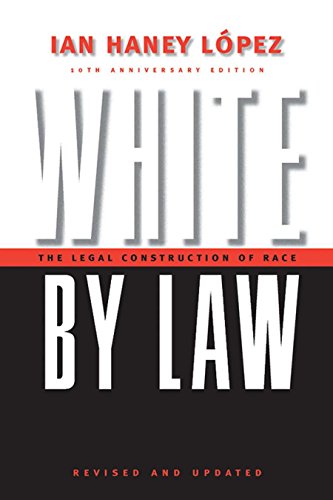
Imagen de portada de Amazon
Imagen de Amazon.com
Imagen de cubierta Syndetics
Portada de Syndetics
Imagen de OpenLibrary

White by law the legal construction of race.

Por: Series Critical AmericaDetalles de publicación: New York New York University Press 1996.Descripción: xiv, 296 p. 24 cmISBN:
  • 0814750990 (acid-free paper)
Tema(s): Clasificación LoC:
  • KF4755 .H36 1996
Contenidos:
Note on whiteness -- White lines -- Racial restrictions in the law of citizenship --The prerequisite cases -- Ozawa and Thind -- The legal constructions of race -- White race-consciousness -- The value to whites of whiteness -- Appendix A. The racial prerequisite cases -- Appendix B.Excerpts from selected prerequite cases.
Valoración
    Valoración media: 0.0 (0 votos)
Existencias
Imagen de cubierta Tipo de ítem Biblioteca actual Biblioteca de origen Colección Ubicación en estantería Signatura topográfica Materiales especificados Info Vol URL Copia número Estado Notas Fecha de vencimiento Código de barras Reserva de ítems Prioridad de la cola de reserva de ejemplar Reservas para cursos
Libro Biblioteca de Derecho Mons. Fremiot Torres Oliver Colección General biblioteca derecho KF 4755 b.H36 1996 (Navegar estantería(Abre debajo)) Disponible 70000000588504
Total de reservas: 0

Descripciones mejoradas de Syndetics:

Insightful look at how legal definitions of race and racism perpetuate racial inequality

Lily white. White knights. The white dove of peace. White lie, white list, white magic. Our language and our culture are suffused, often subconsciously, with positive images of whiteness. Whiteness is so inextricably linked with the status quo that few whites, when asked, even identify themselves as such. And yet when asked what they would have to be paid to live as a black person, whites give figures running into the millions of dollars per year, suggesting just how valuable whiteness is in American society.Exploring the social, and specifically legal origins, of white racial identity, Ian F. Haney Lopez here examines cases in America's past that have been instrumental in forming contemporary conceptions of race, law, and whiteness. In 1790, Congress limited naturalization to white persons. This racial prerequisite for citizenship remained in force for over a century and a half, enduring until 1952. In a series of important cases, including two heard by the United States Supreme Court, judges around the country decided and defined who was white enough to become American.

White by Law traces the reasoning employed by the courts in their efforts to justify the whiteness of some and the non- whiteness of others. Did light skin make a Japanese person white? Were Syrians white because they hailed geographically from the birthplace of Christ? Haney Lopez reveals the criteria that were used, often arbitrarily, to determine whiteness, and thus citizenship: skin color, facial features, national origin, language, culture, ancestry, scientific opinion, and, most importantly, popular opinion. Having defined the social and legal origins of whiteness, White by Law turns its attention to white identity today and concludes by calling upon whites to acknowledge and renounce their privileged racial identity.

Includes bibliographical references (p. 261-278) and index.

Note on whiteness -- White lines -- Racial restrictions in the law of citizenship --The prerequisite cases -- Ozawa and Thind -- The legal constructions of race -- White race-consciousness -- The value to whites of whiteness -- Appendix A. The racial prerequisite cases -- Appendix B.Excerpts from selected prerequite cases.

Reseñas proporcionadas por Syndetics

Library Journal Review

Words carry social connotations. Some, like "lily white," have positive connotations. With this sense of "whiteness" as his thesis, Lopez (law, Univ. of Wisconsin) writes of the law's recognition of a white racial identity. He focuses on a series of cases, from 1878 to 1944, known as the "racial prerequisite cases." In those cases, state and federal courts sought to define characteristics of "whiteness" necessary to qualify an immigrant for naturalization as a U.S. citizen. Lopez concludes that the basis of today's racial inequality is to be found in the privileged status accorded to white Americans because of this legally sanctioned white racial identity. Sure to be controversial, this book will find a deserved place in academic libraries. The general reader might be advised to turn to Andrew Hacker's Two Nations (LJ 3/15/92), John Hope Franklin's The Color Line (LJ 3/1/93), and Cornel West's Race Matters (LJ 3/15/93).‘Jerry E. Stephens, U.S. Court of Appeals Lib., Oklahoma City (c) Copyright 2010. Library Journals LLC, a wholly owned subsidiary of Media Source, Inc. No redistribution permitted.

Publishers Weekly Review

In this study, narrowly academic yet intriguing, López, who teaches law at the University of Wisconsin, examines early-20th-century cases in which courts sought to determine who qualified as white for the purposes of citizenship and naturalization. His conclusion: whiteness is ``a complex, falsely homogenizing term.'' For example, he shows how courts issued contradictory decisions regarding the whiteness of groups such as Syrians, Armenians and Asian Indians; some followed scientific evidence, while most ultimately relied on ``common knowledge,'' thus finding many reasons‘including culture and political sophistication‘to reject foreigners who might be Caucasian. This leads the author to argue, a bit thinly, that whites must pursue a ``self-deconstructive'' race consciousness to pursue racial justice. Thus, whites must recognize the racial aspects of their privileged identity and daily engage in ``choosing against Whiteness''; one example would be to resist racist slurs, even to the point of claiming a nonwhite racial identity when hearing them. (Feb.) (c) Copyright PWxyz, LLC. All rights reserved

CHOICE Review

Haney Lopez argues that race is a social construct defined as "historically contingent social systems of meaning that attach to elements of morphology and ancestry." He demonstrates how law has contributed to societal definitions of whiteness by examining heretofore obscure cases of the 1920s in which the Supreme Court upheld requirements of "whiteness" for naturalization. The book is remarkable for sheer information value but draws its analytic power from the emphasis on whiteness to make sense of racial oppression, thus complementing critical race theorists (e.g., Patricia Williams, The Alchemy of Race and Rights, 1991; Derrick Bell, And We Are Not Saved, 1987; and Faces at the Bottom of the Well, CH, Feb'93) and challenging those arguing race is biologically determined (e.g., Charles Murray and Richard J. Herrnstein, The Bell Curve, CH, May'95). The book informs debates about affirmative action, immigration policy, and the like whose concern is race consciousness. Haney Lopez convincingly demonstrates that the US is ideologically white not by accident but by design. The prerequisite cases unfortunately become increasingly peripheral to the analysis. Still, a provocative and worthwhile volume, highly recommended for graduate students and faculty. L. Bowen John Carroll University
Compartir
logopucpr-y-vive

Contáctanos

¡Queremos saber de ti!

Tel. 787.841.2000 Ext. 1801

bibliotecavaldes@pucpr.edu

⁣Búscanos en las redes

© 2026 Desarrollado por Ignite Online • All Rights Reserved • Powered by Koha.