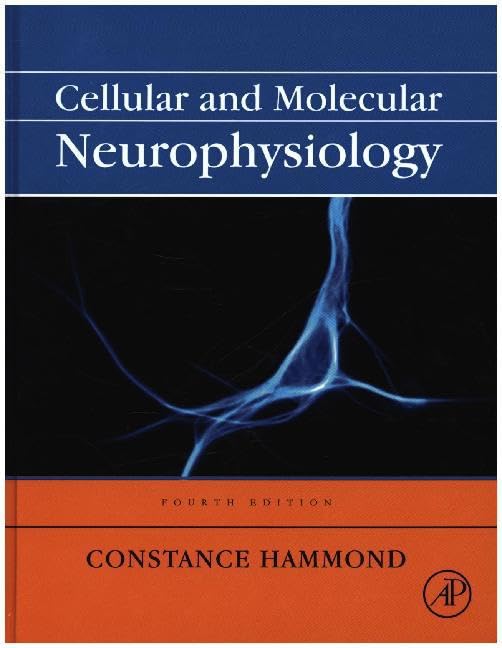

Cellular and molecular neurophysiology Constance Hammond.
Detalles de publicación: Boston, MA Elsevier ©2015.Edición: Fourth editionDescripción: ix, 433 pages illustrations 29 cm Tipo de medio:- 9780123970329
- QP356.2 .H366 2015
| Imagen de cubierta | Tipo de ítem | Biblioteca actual | Biblioteca de origen | Colección | Ubicación en estantería | Signatura topográfica | Materiales especificados | Info Vol | URL | Copia número | Estado | Notas | Fecha de vencimiento | Código de barras | Reserva de ítems | Prioridad de la cola de reserva de ejemplar | Reservas para cursos | |
|---|---|---|---|---|---|---|---|---|---|---|---|---|---|---|---|---|---|---|
| Libro | Biblioteca Encarnación Valdés Colección General bev | 573.848 H225c4 (Navegar estantería(Abre debajo)) | Disponible | 80000002552100 |
Descripciones mejoradas de Syndetics:
Cellular and Molecular Neurophysiology, Fourth Edition, is the only up-to-date textbook on the market that focuses on the molecular and cellular physiology of neurons and synapses. Hypothesis-driven rather than a dry presentation of the facts, the book promotes a real understanding of the function of nerve cells that is useful for practicing neurophysiologists and students in a graduate-level course on the topic alike.
This new edition explains the molecular properties and functions of excitable cells in detail and teaches students how to construct and conduct intelligent research experiments. The content is firmly based on numerous experiments performed by top experts in the field
This book will be a useful resource for neurophysiologists, neurobiologists, neurologists, and students taking graduate-level courses on neurophysiology.
Includes bibliographical references at the end of each chapters and index.
Tabla de contenidos provista por Syndetics
- Part I Neurons: Excitable and Secretory Cells That Establish Synapses
- 1 Neurons
- 2 Neuron - Glial Cell Cooperation
- 3 Ionic Gradients, Membrane Potential and Ionic Currents
- 4 The Voltage-Gated Channels of Na+ Action Potentials
- 5 The Voltage-Gated Channels of Ca+2 Action Potentials: Generalization
- 6 The Chemical Synapses
- 7 Neurotransmitter Release
- Part II Ionotropic and Metabotropic Receptors in Synaptic Transmission and Sensory Transduction
- 8 The Ionotropic Nicotinic Acetycholine Receptors
- 9 The Ionotropic GABAA Receptor
- 10 The Ionotropic Glutamate Receptors
- 11 The Metabotropic GABAB Receptors
- 12 The Metabotropic Glutamate Receptors
- Part III Somato-Dendritic Processing and Plasticity of Postsynaptic Potentials
- 13 Somato-Dendritic Processing of Postsynaptic Potentials I: Passive Properties of Dendrites
- 14 Subliminal Voltage-Gated Currents of the Somato-Dendritic Membrane
- 15 Somato-Dendritic Processing of Postsynaptic Potentials II: Role of Subthreshold Depolarizing Voltage-Gated Currents
- 16 Somato-Dendritic Processing of Postsynaptic Potentials III: Role of High Voltage-Activated Depolarizing Currents
- 17 Firing Patterns of Neurons
- 18 Synaptic Plasticity
- Part IV The Adult Hippocampal Network
- 19 The Adult Hippocampal Network
- 20 Maturation of the Hippocampal Network
Notas de autor provistas por Syndetics
Constance Hammond is an INSERM director of research at the Mediterranean Institute of Neurobiology. A renowned Parkinson's disease investigator, in 2012 she became a Chevalier of the L#65533;gion d'Honneur in recognition for her services to scientific communication. Studying biology at the University of Pierre and Marie Curie and the Ecole Normale Sup#65533;rieure in Paris she completed her thesis in neurosciences at the Marey Institute in Paris, directed by Prof. D. Albe-Fessard. Guided by her curiosity and her constant desire to learn, she changed lab and research domains several times. With the knowledge of other systems and the mastering of other techniques she finally came back to her first and preferred subject of research; the role of the subthalamic nucleus in the basal ganglia system in health and Parkinson's disease.After many years of lecturing neurobiology to biology and psychology students it became apparent that students were in need of a book to help understand the basic principles of cell electrophysiology. Discussions with Philippe Ascher convinced her that the best way to approach the subject was to explain ionic currents and potential changes in terms of single channels and unitary currents, describing pioneering neurobiological experiments. This first book "Neurobiologie Cellulaire" (written in French with her colleague Dani#65533;le Tritsch) appeared in 1990. Its immediate success inspired her to completely revise the book content and publish it in English giving it to a larger audience; Appearing in 1996 the fist edition of "Cellular and Molecular Neuroscience" was born.