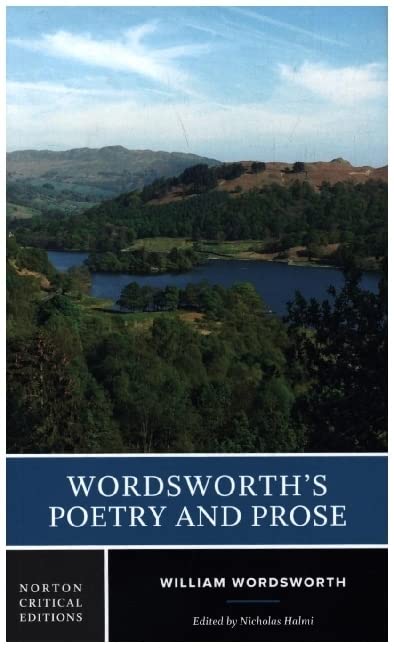

Wordsworth's poetry and prose authoritative texts, criticism selected and edited by Nicholas Halmi, University of Oxford.
Series A Norton critical editionDetalles de publicación: New York W. W. Norton & Company ©2014.Edición: First editionDescripción: xxix, 761 pages 24 cm Tipo de medio:- 9780393924787 (pbk.)
- 821.7 W925w 23
- PR5853 .H35 2013
| Imagen de cubierta | Tipo de ítem | Biblioteca actual | Biblioteca de origen | Colección | Ubicación en estantería | Signatura topográfica | Materiales especificados | Info Vol | URL | Copia número | Estado | Notas | Fecha de vencimiento | Código de barras | Reserva de ítems | Prioridad de la cola de reserva de ejemplar | Reservas para cursos | |
|---|---|---|---|---|---|---|---|---|---|---|---|---|---|---|---|---|---|---|
| Libro | Biblioteca Encarnación Valdés Colección General bev | 821.7 W925w (Navegar estantería(Abre debajo)) | Disponible | 80000002510058 |
Descripciones mejoradas de Syndetics:
This Norton Critical Edition presents a generous selection of William Wordworth's poetry (including the thirteen-book Prelude of 1805) and prose works along with supporting materials for in-depth study. Together, the Norton Critical Editions of Wordsworth's Poetry and Prose and The Prelude: 1799, 1805, 1850 are the essential texts for studying this author.
Wordsworth's Poetry and Prose includes a large selection of texts chronologically arranged, thereby allowing readers to trace the author's evolving interests and ideas. An insightful general introduction and textual introduction precede the texts, each of which is fully annotated. Illustrative materials include maps, manuscript pages, and title pages.
"Criticism" collects thirty responses to Wordsworth's poetry and prose spanning three centuries by British and American authors. Contributors include Samuel Taylor Coleridge, Percy Bysshe Shelley, Felicia Hemans, Ralph Waldo Emerson, Lucy Newlyn, Stephen Gill, Neil Fraistat, Mary Jacobus, Nicholas Roe, M. H. Abrams, Karen Swann, Michael O'Neill, and Geoffrey Hartman, among others.
The volume also includes a Chronology, a Biographical Register, a Selected Bibliography, and an Index of Titles and First Lines of Poems.
Includes bibliographical references and index.
Notas de autor provistas por Syndetics
William Wordsworth, 1770 - 1850 Born April 7, 1770 in the "Lake Country" of northern England, the great English poet William Wordsworth, son of a prominent aristocrat, was orphaned at an early age. He attended boarding school in Hawkesmead and, after an undistinguished career at Cambridge, he spent a year in revolutionary France, before returning to England a penniless radical. Wordsworth later received honorary degrees from the University of Durham and Oxford University. He is best known for his work "The Prelude", which was published after his death.For five years, Wordsworth and his sister Dorothy lived very frugally in rural England, where they met Samuel Taylor Coleridge. "Lyrical Ballads", published anonymously in 1798, led off with Coleridge's "Ancient Mariner" and ended with Wordsworth's "Tintern Abbey". Between these two masterworks are at least a dozen other great poems. "Lyrical Ballads" is often said to mark the beginning of the English romantic revolution. A second, augmented edition in 1800 was prefaced by one of the great manifestos in world literature, an essay that called for natural language in poetry, subject matter dealing with ordinary men and women, a return to emotions and imagination, and a conception of poetry as pleasure and prophecy. Together with Robert Southey, these three were known as the "Lake Poets", the elite of English poetry.
Before he was 30, Wordsworth had begun the supreme work of his life, The Prelude, an immensely long autobiographical work on "The Growth of the Poet's Mind," a theme unprecedented in poetry. Although first finished in 1805, The Prelude was never published in Wordsworth's lifetime. Between 1797 and 1807, he produced a steady stream of magnificent works, but little of his work over the last four decades of his life matters greatly. "The Excursion", a poem of epic length, was considered by Hazlitt and Keats to be among the wonders of the age.
After "Lyrical Ballads", Wordsworth turned to his own life, his spiritual and poetical development, as his major theme. More than anyone else, he dealt with mysterious affinities between nature and humanity. Poems like the "Ode on the Intimations of Immortality" have a mystical power quite independent of any particular creed, and simple lyrics like "The Solitary Reaper" produced amazingly powerful effects with the simplest materials. Wordsworth also revived the sonnet and is one of the greatest masters of that form. Wordsworth is one of the giants of English poetry and criticism, his work ranging from the almost childishly simple to the philosophically profound.
Wordsworth married Mary Hutchinson in 1802 and in 1813, obtained a sinecure as distributor of stamps for Westmoreland. At this stage of his life, Wordsworth's political beliefs had strayed from liberal to staunchly conservative. His last works were published around 1835, a few trickled in as the years went on, but the bulk of his writing had slowed. In 1842 he was awarded a government pension and in 1843 became the Poet Laureate of England, after the post was vacated by his friend Coleridge. Wordsworth wrote over 523 sonnets in the course of his lifetime.
Wordsworth died at Rydal Mount on April 23, 1850. He is buried in Grasme Curchyard. He was 80 years old.
(Bowker Author Biography)