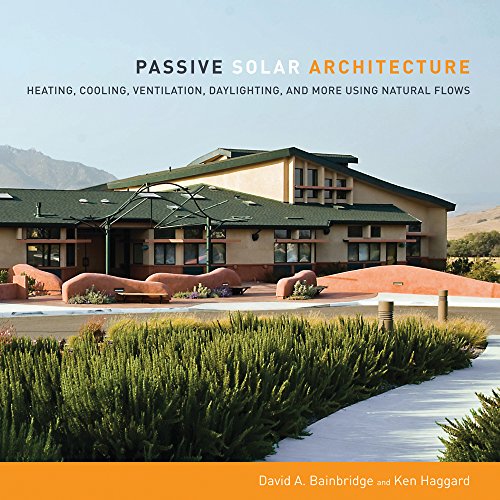

Passive solar architecture heating, cooling, ventilation, daylighting and more using natural flows David Bainbridge and Ken Haggard.
Idioma: Alemán Detalles de publicación: White River Junction, Vt. Chelsea Green Pub. c2011.Descripción: x, 294 p. ill., maps (chiefly col.) 27 cmISBN:- 9781603582964
- 690/.8370472 22
- TH7413 .B345 2011
| Imagen de cubierta | Tipo de ítem | Biblioteca actual | Biblioteca de origen | Colección | Ubicación en estantería | Signatura topográfica | Materiales especificados | Info Vol | URL | Copia número | Estado | Notas | Fecha de vencimiento | Código de barras | Reserva de ítems | Prioridad de la cola de reserva de ejemplar | Reservas para cursos | |
|---|---|---|---|---|---|---|---|---|---|---|---|---|---|---|---|---|---|---|
| Libro | CARIBET Biblioteca Arquitectura Colección General CARIBET | TH7413 .B345 2011 (Navegar estantería(Abre debajo)) | Disponible | 91000000033027 |
Descripciones mejoradas de Syndetics:
New buildings can be designed to be solar oriented, naturally heated and cooled, naturally lit and ventilated, and made with renewable, sustainable materials--no matter the location or climate.
In this comprehensive overview of passive solar design, two of America's solar pioneers give homeowners, architects, designers, and builders the keys to successfully harnessing the sun and maximizing climate resources for heating, cooling, ventilation, and daylighting.
Bainbridge and Haggard draw upon examples from their own experiences, as well as those of others, of more than three decades to offer both overarching principles as well as the details and formulas needed to successfully design a more comfortable, healthy, and secure place in which to live, laugh, dance, and be comfortable. Even if the power goes off.
Passive Solar Architecture also discusses "greener" and more-sustainable building materials and how to use them, and explores the historical roots of green design that have made possible buildings that produce more energy and other resources than they use.
Include Index
Extracto provisto por Syndetics
Reseñas proporcionadas por Syndetics
CHOICE Review
"Buildings matter ... poorly designed, built and maintained buildings are a common cause of human suffering, illness and death," begins Passive Solar Architecture by Bainbridge (consultant; formerly, Marshall Goldsmith School of Management) and Haggard (architect; formerly, California Polytechnic). The first chapter discusses a wide range of economic and planetary issues, including triple bottom line accounting, the significance of place, designing with climate, and the costs of designing and building differently for human comfort. It provides an important springboard for subsequent chapters. These well-illustrated (color, b/w, photographs, graphics), well-written main chapters include "Sustainable Buildings," "Passive Heating," "Passive Cooling and Ventilation," "Natural Lighting," and "Harvesting On-site Resources" (e.g., rainwater harvesting, landscape regeneration). The book ends with two chapters on design and practical appendixes. Throughout the work, the authors speak to the broad issues and opportunities of sustainability, interweaving technical illustrations and discussions on passive design and engineering that address the need and the opportunity for our species to live without consuming vast quantities of scarce resources. It is a valuable compendium of the science, techniques, and tools concerned with built and natural human habitats, and an excellent companion to The Whole Building Handbook by V. Bokalders and M. Block (CH, Sep'10, 48-0086). Summing Up: Highly recommended. All readership levels. L. B. Sickels formerly, Frank Lloyd Wright FoundationNotas de autor provistas por Syndetics
David A. Bainbridge first worked on community design, passive solar heating and cooling, building codes, and solar rights at the innovative design firm Living Systems. He described his first water-wall solar home and the Village Homes solar subdivision in Solar House Designs in 1978. Founder of the Passive Solar Institute, and recipient of the ASES Passive Pioneer Award in 2004, Bainbridge consults on a wide range of residential and commercial projects and has completed several solar projects on his own homes, as well as co-authoring The Straw Bale House (with Athena Swentzell Steen and Bill Steen), and Passive Solar Architecture (with Ken Haggard). He is currently Associate Professor of Sustainable Management at the Marshall Goldsmith School of Management. He lives in San Diego, California.
Ken Haggard, formerly an architecture professor at California Polytechnic, is an architect and principal in the San Luis Sustainability Group. Since the late sixties, Haggard has designed more than 200 solar buildings, from homes to large commercial and institutional buildings-as well as the first permitted straw bale building in California. An active member of the American and International Solar Energy Societies, he received the Passive Pioneer Award from ASES in 1999 and was made a fellow of ASES in 2000. His office and home-in Santa Margarita, California-are passive solar, off grid, and straw bale.