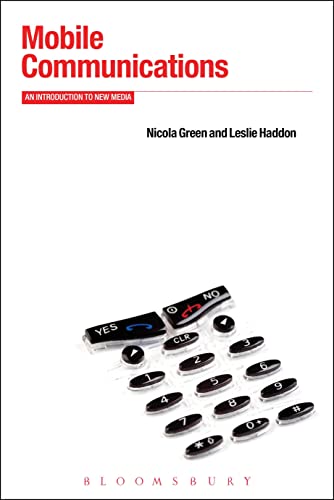

Mobile communications an introduction to new media Nicolas Gree, Leslie Haddon.
Detalles de publicación: New York Berg Publishers c2009.Edición: English editionDescripción: vii,190 p. 23 cmISBN:- 9781845208141
| Imagen de cubierta | Tipo de ítem | Biblioteca actual | Biblioteca de origen | Colección | Ubicación en estantería | Signatura topográfica | Materiales especificados | Info Vol | URL | Copia número | Estado | Notas | Fecha de vencimiento | Código de barras | Reserva de ítems | Prioridad de la cola de reserva de ejemplar | Reservas para cursos | |
|---|---|---|---|---|---|---|---|---|---|---|---|---|---|---|---|---|---|---|
| Libro | Biblioteca de Mayagüez Colección General mb | HM 851 .H33 2009 (Navegar estantería(Abre debajo)) | Disponible | 50000003199618 |
Descripciones mejoradas de Syndetics:
The mobile phone has achieved a global presence faster than any other form of information and communication technology. A global multi-billion dollar industry, this small, mundane device is now an intrinsic part of our everyday life.
This communications medium has had an immense social and cultural impact and continues to evolve. Talking, texting, photographing, videoing, connecting to a network of other media - the cellphone now seems essential. But, beyond the ways in which it has actively restructured our daily lives, the mobile has changed our sense of ourselves and the way we see the world. The relationship between public and private space, how we view time and space, how we rely on and negotiate social networks - all are increasingly centred on this small piece of technology.
Mobile Communications presents a succinct, challenging, and accessible overview of the transformations and challenges presented by this most personal, yet most overlooked technology.
Includes bibliographical references and index.
EIGM 04/2010
Tabla de contenidos provista por Syndetics
- 1 Introduction(p. 1)
- Perspectives on Technologies and ICTs(p. 3)
- Innovations and Visions(p. 3)
- Socially Relevant Groups(p. 5)
- The Experience of Technologies(p. 6)
- Domestication(p. 7)
- Reflection: The Meaning of Products(p. 8)
- The New Mobilities(p. 8)
- A History of Mobile Communications Research(p. 9)
- An Emerging Research Field(p. 9)
- Emerging Research Themes(p. 11)
- An Outline of the Following Chapters(p. 13)
- 2 History and Industry(p. 17)
- A Brief History of Mobile Communications Technologies(p. 18)
- Consumption Histories(p. 29)
- 3 The Relationships Between Technologies(p. 33)
- ICT Use: Evolution or Revolution?(p. 34)
- Mobile Technologies and Choices in Communications(p. 36)
- A Case Study in Communications Choices: Texting(p. 42)
- Origins and Trajectories: The Early History of an Innovation(p. 43)
- The Domestication of Texting?(p. 44)
- Social Consequences of Texting(p. 46)
- 4 Public and Private Spaces(p. 51)
- Mobilities and the Transformation of the Public and Private Spheres(p. 52)
- Negotiating the Mobile Public and Private(p. 55)
- Cross-Cultural Norms and Personal Space(p. 63)
- The Regulation of Mobile Phone Behaviours(p. 68)
- 5 Time(p. 73)
- Time, ICTs and Mobile Communications(p. 73)
- Time and Mobile Communications(p. 76)
- Mobile Phones and the Changing Organization of Time(p. 78)
- Mobile Communications and the Experience of Time(p. 82)
- The Experience of Meeting: A Case Study(p. 84)
- 6 Social Networks and Peer Relationships(p. 87)
- Communities, Social Capital, Social Networks and ICTs(p. 88)
- The Strength of Mobile Ties(p. 91)
- Young People and Social Networks(p. 96)
- Status and Cultural Value(p. 98)
- Group Identification and Differentiation(p. 100)
- The Management of Availability(p. 101)
- 7 Power Relations(p. 107)
- Dimensions of Power(p. 108)
- Power and the Social Shaping of ICTs(p. 110)
- Power and the Social Shaping of Mobile Phones(p. 112)
- Mobile Phones, Children and Their Parents(p. 116)
- Ownership(p. 118)
- Children's Use and Parental Monitoring(p. 120)
- The Negotiation of Independence(p. 121)
- Peer Relations and Organizational Networks(p. 122)
- 8 Mobile Images: The Cameraphone(p. 127)
- Introduction of the Camera Phone(p. 128)
- Youth and Mobile Images: Content, Sharing, Posting(p. 133)
- Issues Related to Images: A British Case Study(p. 136)
- Media Producers and Changes in Photography(p. 140)
- 9 Applying Frameworks, Going Forward(p. 145)
- The Mobile Internet and Mobile Television(p. 146)
- Analysing Emerging Technology(p. 147)
- Going Forward(p. 152)
- Annotated Guide to Further Reading(p. 153)
- Questions and Exercises(p. 159)
- Notes(p. 165)
- Bibliography(p. 169)
- Index(p. 187)
Notas de autor provistas por Syndetics
Nicola Green is Senior Lecturer in New Media and New Technologies in the Department of Sociology, University of Surrey. Leslie Haddon is Researcher and Associate Lecturer in the Department of Media and Communications, London School of Economics and Political Sciences.Berg New Media Series edited by Leslie Haddon and Nicola Green