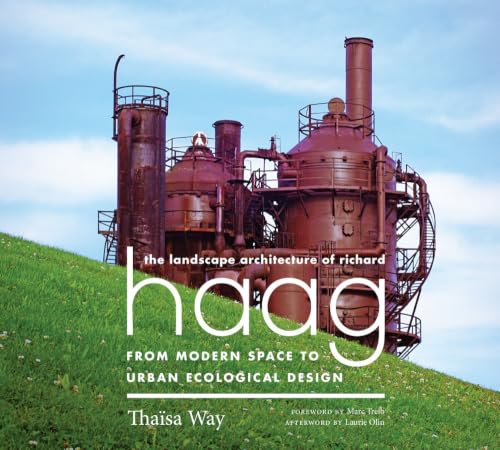

The landscape architecture of Richard Haag from modern space to urban ecological design Thaïsa Way ; foreword by Marc Treib ; afterword by Laurie Olin.
Idioma: Inglés Detalles de publicación: Seattle University of Washington Press [2015]Descripción: 232p.. ill. 25cmISBN:- 9780295994482
- 712.092 B 23
- SB470.H33 W39 2015
| Imagen de cubierta | Tipo de ítem | Biblioteca actual | Biblioteca de origen | Colección | Ubicación en estantería | Signatura topográfica | Materiales especificados | Info Vol | URL | Copia número | Estado | Notas | Fecha de vencimiento | Código de barras | Reserva de ítems | Prioridad de la cola de reserva de ejemplar | Reservas para cursos | |
|---|---|---|---|---|---|---|---|---|---|---|---|---|---|---|---|---|---|---|
| Libro | CARIBET Biblioteca Arquitectura Colección General CARIBET | SB470.H33W39 2015 (Navegar estantería(Abre debajo)) | Disponible | 91000000044305 |
Descripciones mejoradas de Syndetics:
Richard Haag is best known for his rehabilitation of Gas Works Park in Seattle and for a series of remarkable gardens at the Bloedel Reserve on Bainbridge Island. He reshaped the field of landscape architecture as a designer, teacher, and activist. In 1964, Haag founded the landscape architecture department at the University of Washington, and his innovative work contributed to the increasingly significant design approach known as urban ecological design, which encourages thinking beyond the boundaries of gardens and parks to consider the broader roles that landscapes play within urban ecosystems, such as storm water drainage and wildlife habitat.
Gas Works Park is studied in every survey of twentieth-century landscape architecture as a modern work that challenged the tenets of modernism by engaging a toxic site and celebrating an industrial past. Haag's work with ecologists and soil scientists in his landscape remediation and reclamation projects opened new areas of inquiry into the adaptive reuse of post-industrial sites.
Thaïsa Way places Haag's work within the context of changes in the practice of landscape architecture over the past five decades in the Pacific Northwest and nationally. The book should be of interest to specialists as well as to readers who are interested in the changes in urban landscapes inspired by Haag's work.
Includes bibliographical references and index.
Reseñas proporcionadas por Syndetics
CHOICE Review
Haag's most famous work is Gas Works Park, Seattle (1975), on the shore of Lake Union. He transformed a waste industrial field into a park and painted the towers as a gigantic sculpture. His activist approach to the city's urban development received national attention. Way (landscape architecture, Univ. Washington) presents many of Haag's plans, drawings, projects (built and unbuilt), regional plans, recreation schemes, highway projects, and designs for college campuses, libraries, parks, and garden projects public and private. The range of his "urban ecological design" is represented in good illustrations. Born in 1923, he spent his childhood in his father's garden center in Kentucky. Later education and travel throughout the US are detailed. The influence of Japanese travel, 1953-1955, pervades his work to this day. In 1956, he opened a practice in San Francisco; he then went to the University of Washington, Seattle, to create a landscape architecture degree program. At 90, he is still practicing. Detailed notes to sources and an afterword by a former student and colleague. This very detailed work is most useful for professionals. The book brings new attention to Pacific Northwest landscape design. Summing Up: Recommended. Upper-division undergraduates and above. --William L. Whitwell, Hollins CollegeNotas de autor provistas por Syndetics
Thaïsa Way is associate professor of landscape architecture at the University of Washington. She is the author of Unbounded Practices: Women, Landscape Architecture, and Early Twentieth Century Design .