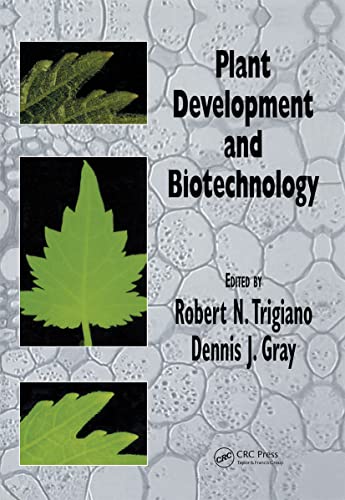

Plant development and biotechnology edited by Robert N. Trigiano, Dennis J. Gray.
Detalles de publicación: Boca Raton CRC Press c2005.Descripción: 358 p. ill., 26 cmISBN:- 0849316146 (alk. paper)
- 571.5382 P7131 22
- QK725 .P562 2005
| Imagen de cubierta | Tipo de ítem | Biblioteca actual | Biblioteca de origen | Colección | Ubicación en estantería | Signatura topográfica | Materiales especificados | Info Vol | URL | Copia número | Estado | Notas | Fecha de vencimiento | Código de barras | Reserva de ítems | Prioridad de la cola de reserva de ejemplar | Reservas para cursos | |
|---|---|---|---|---|---|---|---|---|---|---|---|---|---|---|---|---|---|---|
| Libro | Biblioteca Encarnación Valdés Colección General bev | 571.5382 P7131 (Navegar estantería(Abre debajo)) | Disponible | 80000002409749 |
Descripciones mejoradas de Syndetics:
Biotechnology revolutionized traditional plant breeding programs. This rapid change produced new discussions on techniques and opportunities for commerce, as well as a fear of the unknown. Plant Development and Biotechnology addresses the major issues of the field, with chapters on broad topics written by specialists. The book applies an informal style that addresses the major aspects of development and biotechnology with minimal references, without sacrificing information or accuracy.
Divided into five primary parts, this volume explores how the field emerged from its early theoretical base to the technical discipline of today. It also covers progress being made with genetically engineered plants, providing a snapshot of the field's controversial present. Part III discusses methods for preparing media, creating solutions and dilutions, and accomplishing sterile culture work. It investigates common methods for visualizing and documenting studies, and quantifying responses of tissue culture in research.
Part IV delivers the essential foundation of plant tissue culture, introducing the three types of commonly used culture regeneration systems. Part V integrates propagation techniques with other methodologies for the modification and manipulation of germplasm.
Part VI concludes with special sections. Subjects include in vitro plant pathology, recent research into genetic and phenotypic variation, the mechanics of commercial plant production, and the importance of clean cultures and problems associated with maintaining in vitro cultures. The final chapter analyzes entrepreneurship in the field and outlines the do's and don'ts to consider when launching an enterprise.
Includes bibliographical references and index.
Reseñas proporcionadas por Syndetics
CHOICE Review
This book was designed to supplement the authors' Plant Tissue Culture Concepts and Laboratory Exercises (2nd ed., 2000). In addition to the editors, 35 scientists have contributed chapters on culture technology. After the introduction and historical review, sections are devoted to methodology, plant propagation, crop improvement, and special topics. The book offers a review of the controversies surrounding genetically modified plants. Many readers will be interested in the material on commercial production of micropropagated plantlets. One chapter concerns the software and databases for sequencing nucleic acids and proteins. The final chapter outlines problems associated with setting up a biotechnology company. This book is a pleasure to read, and fledgling plant biotechnicians should be familiar with it. ^BSumming Up: Recommended. Upper-division undergraduates through researchers/faculty. L. W. Roberts emeritus, University of IdahoNotas de autor provistas por Syndetics
Robert N. Trigiano, Ph.D., is professor of ornamental plant biotechnology and plant pathology in the Department of Entomology and Plant Pathology at the University of Tennessee Agricultural Experiment Station at KnoxvilleDennis J. Gray, Ph.D., is a member of the University of Florida/IFAS Horticulture Department. He directs the plant biotechnology program at the Mid-Florida Research and Education Center