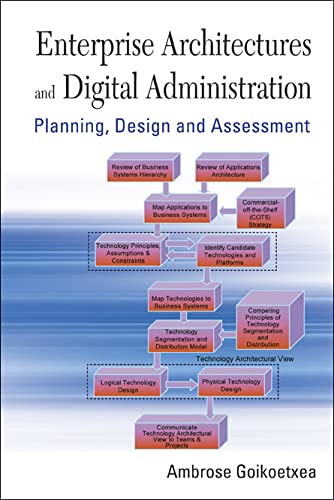

Enterprise Architectures and Digital Administration : planning, design and assessment. / Ambrose Goikoetxea. txt
Singapore : Word Scientific Publishing , 2007Descripción: xxviii, 485 p. ill. ; 24 cm. 2 CD-ROMs (4 3/4 in.)Tipo de contenido:- text
- unmediaded
- volume
- 9789812700278
- 9812700277
- 9789812700285
- 9812700285
- 658.4/038011 22
- HD30.213 G65 2007
| Imagen de cubierta | Tipo de ítem | Biblioteca actual | Biblioteca de origen | Colección | Ubicación en estantería | Signatura topográfica | Materiales especificados | Info Vol | URL | Copia número | Estado | Notas | Fecha de vencimiento | Código de barras | Reserva de ítems | Prioridad de la cola de reserva de ejemplar | Reservas para cursos | |
|---|---|---|---|---|---|---|---|---|---|---|---|---|---|---|---|---|---|---|
| Libro | CARIBET Biblioteca Arquitectura Colección General CARIBET | General HD30.213 G65 2007 (Navegar estantería(Abre debajo)) | 1 | Disponible | 91000000001032 |
Descripciones mejoradas de Syndetics:
"This is the first book that addresses all three main activities in improving business and technology decisions: the planning design and assessment of enterprise architectures (EAs) Emphasis is on medium and large-size organizations in the private sector (such as banks, airlines and auto industries) and the public sector (such as federal agencies, local government organizations and military services in the Department of Defense). The book addresses the challenges faced by EA builders through an organized presentation of the issues and a step-by-step approach. The material is based on real-life EA project experience and lessons learned over a decade working in multiple-contractor, multiple-discipline teams, and multiple-agency environments."--BOOK JACKET.
CD-ROMs include System Architect and Enterprise Architect software; software accessible for 30 days after installation.
Includes bibliographic references (p. 453-472) and index.
Contents:
Acknowledgements vii --
Preface ix --
Acronyms xv --
1 Introduction --
1.1. A New Era of Enterprise Architecture (EA) Planning 1 --
1.2. What is an Enterprise Architecture? 2 --
1.3. What is an Enterprise Architecture Framework? 3 --
1.4. What is EA Planning? 4 --
1.5. Who is Doing EA Planning Today? 5 --
1.6. Why Organizations Are Doing EA Planning? 5 --
1.7. The Zachman Architectural Framework 6 --
1.8. Multiple Architectural Views 6 --
1.9. Objectives of this Book 7 --
1.10. EA Vision and Concept 9 --
1.11. EA Representation 9 --
1.12. EA Design Teams and Work Products 10 --
1.13. EA Measurement 11 --
1.14. Multiple Criteria 13 --
1.15. How this Book is Organized 13 --
2 Motivation and Impetus for Enterprise Architectures : Government, Federal, and Commercial Sectors --
2.1 Introduction 21 --
2.2 Organization of this Chapter 21 --
2.3 Benefis of an Enterprise Architecture 22 --
2.4 EA Development in the Federal Agencies 23 --
2.5 Clinger-Cohen Act of 1996 24 --
2.6 OMB Circular A-130 26 --
2.7 Federal Entrise Architecture Framework (FEAF) of 1999 29 --
2.8 US Treasury Enterprise Architecture Framework (TEAF) 29 --
2.9 Enterprise Architecture Framework (EAF) 30 --
2.10 Technical Architecture Framework for Information Management (TAFIM) 30 --
2.11 Command, Control, Communications, Computers, Intiligence, Surveillance, and Reconnaissance (CAISR) Architecture Framework 33 --
2.12 The Open Group's Architectural Framework (TOGAF) 34 --
2.13 OMB Reference Models 34 --
2.14 Conclusion 35 --
2.15. Exercises 36 --
3 The Business Processes Architectural View --
3.1. What is a Business Process? 39 --
3.2. How this Chapter is Organized 40 --
3.3. Global Airline Services - An Illustrative Example 41 --
3.4 Vision and Strategy 44 --
3.5 Business Processes 45 --
3.6 System Requirements 49 --
3.7 Business Process Principles 50 --
3.8 Business Process Assumptions 51 --
3..9 Business Modeling Toolsets in the Market 52 --
3.10 Selection of an EA Toolset 52 --
3.11 Conclusions 54 --
3.12 Exercises 55 --
4 The Business Systems Architectural View --
4.1 What is a Business System? 59 --
4.2 Why Business Systems? 61 --
4.3 How this Chapter is Organized 61 --
4.5 Business Systems Hierarchical Tree - Example Continued 62 --
4.6. Interfaces 64 --
4.7 Technical Reference Model (TRM) 69 --
4.8 DoD Technical Reference Model 70 --
4.9 U.S. Customs Service Technical Reference Model 74 --
4.10 Assignment of Business Systems to Projects 75 --
4.11 Conclusions 77 --
4.12 Exercises 78 --
5 The Data Architectural View
5.1. Introduction 79 --
5.2 What is the Data Architectural View? 80 --
5.3 How this Chapter is Organized 82 --
5.4 A Methodological Approach to the Data Architectural View 83 --
5.5 Data Ownership and Stewardship 103 --
5.6 Relationship of the Data Architectural View to the other Architectural Views 103 --
5.7. Conclusion 104 --
5.8 Exercises 78 --
6 The Applications Architectural View 107 --
6.1 What is a Software Application? 107 --
6.2 How this Chapter is Organized 109 --
6.3. A Methodology for Construction of the Applications Architectural View 109 --
6.4 Alignment of Applications Architectural View 124 --
6.5 Software Engineering Standards 124 --
6.6 Representation of Software Design 128 --
6.7 Conclusion 128 --
6.8 Exercises 129 --
7 The Unified Modeting Language (UML) in Software Design --
7.1. Introduction 133 --
7.2. How this Chapter is Organized 134 --
7.3. Origins of and Ungoing efforts in UML 134 --
7.4 Basic of the Unified Modeling Language (UML) 135 --
7.5 The Software Life Cycle 136 --
7.6 Basics of UML 139 --
7.7 An Ilustrative Example on the Use of UML 146 --
7.8 Conclusions 153 --
7.9 Exercises 155 --
8 The Technology Architectural View --
8.1 What is a Technology? 159 --
8.2. What is a Technology Architectural View? 160 --
8.3. How this Chapter is Organized 161 --
8.4. A Methodology for Building the Technology Architectural View 161 --
Step 1: Review of Business Systems Hierarchy 164 --
Step 2: Review of Applications Architecture 165 --
Step 3: Commercially-off-the-Shelf (COTS) Software Strategy 167 --
Step 4: Mapping of Applications to Business Systems 172 --
Step 5: Technology Principles, Assumptions, and Constraints 172 --
Step 6: Identify Candidate Technologies and Platforms 174 --
Step 7: Mapping of Technologies to Business Systems 175 --
Step 8: Competing Principles of the Technology Architectural View 175 --
Step 9: Technology Segmentation and Distribution Model 177 --
Step 10: Logical Technology Architecture Design 178 --
Step 11: Physical Technology Architecture Design 180 --
Step 12 : Communicate the Technology Architectural View 181 --
8.5 Conclusions 182 --
9 Distributed Database Design with Multiple Criteria --
9.1 Introduction 185 --
9.2 Database Segment Development 186 --
9.3 How this Chapter is Organized 187 --
9.4 Statement of the Problem 187 --
9.5 Methodological Approach 189 --
9.6 Problem 1 : One to Many Database Segmentation 190 --
9.7 Problem 2 : Many to One Database Segmentation 195 --
9.8 Multiple Criteria 198 --
9.9 Conclusions 202 --
10 Performance and Capacity Based Architecture Planning : Concepts, Principles, and Measurement Tools --
10.1 Introduction 2054 205 --
10.2 Objectives of this Chapter 206 --
10.3 How this Chapter is organizad 207 --
10.4 EPCEM Approach to Life Cycle EA Planning 207 --
10.5 General EA System Performance Evaluation Approach 212 --
10.6 Use of Business Modeling and Performance Simulation Tools 217 --
10.7 Measurements and Analysis 220 --
10.8 Illustrative Example - What Needs to be Modeled 221 --
10.9. Testing and Simulation in a Virtual Lab Environment 225 --
10.10 Web Load Generation for Simulation and Performance Analysis 227 --
10.11 C&P Measurement Tools 227 --
10.12 C&P Roles and Responsibilities 229 --
10.13. Conclusions and Recommendations 230 --
11 Disaster Recovery Planning --
11.1. Introduction --
11.2. How this Chapter is Organized 233 --
11.3. What is Disaster Recovery Planning? 235 --
11.4. Developing a Disaster Recovery Plan 236 --
11.5. DR Requirements 237 --
11.6. Basic Elements of a Contingency Plan 238 --
11.7. Basics of Intra-Site Data Failover 239 --
11.8. Basics of Inter-site Failover 240 --
11.9. RAID Technology for Data Backup 241 --
11.10. Disaster Readiness 247 --
11.11 IT Audit Checklist 249 --
11.12. Cost-Availability Trade-Offs 251 --
11.13 Global Services Airline, An Example 252 --
11.14 Conclusions 254 --
11.15 Exercises 256 --
12 The Open Group's Architectural Framework (TOGAF) --
12.1 Introduction 257 --
12.2 Organization of this Chapter 258 --
12.3 Technical Architecture Framework for Information Management (TAFIM) 259 --
12.4 Emergence of TOGAF Technical Reference Model (TRM) 260 --
12.6 Standards Information Base (SIB) 260 --
12.7 Architectural Development Method (ADM) 261 --
12.8 An Illustrative Example - A Manufacturing Environment 265 --
12.8.1 Phase A: Initiation and Framework 267 --
12.8.2 Phase B: Baseline Description 272 --
12.8.3 Phase C: Target Architecture 275 --
12.8.4 Phase D: Opportunities and Solutions 275 --
12.8.5 Phase E: Project Initiation and Migration Planning 280 --
12.9 Conclusion 284 --
13 The Department of Defense Architecture Framework (DODAF) --
13.1 Introduction 285 --
13.2 Organization of this Chapter 286 --
13.3 Structure of the DOAF 287 --
13.4 Guiding Principles of the DODAF Philosophy 288 --
13.5 The Six Step Architecture Description Process 288 --
13.6 A Set of Automated Tools 289 --
13.7 Description of the Product Types (i.e., Work Products) 291 --
13.7.1 Overview and Summary Information (AV - 1) 295 --
13.7.2 Integrated Dictionary (AV-2) 295 --
13.7.3 High Level Operational Concept Graphic (OV-1) 296 --
13.7.4 Operational Node Connectivity Descrption (OV-2) 297 --
13.7.5 Operational Information Exchange Matrix (OV-3) 298 --
13.7.6 Command Relationships Chart (OV-4) 298 --
13.7.7 Activity Model (OV-5) 300 --
13.7.8 Systems Interface Description (SV-1) --
13.7.9 Systems Communications Descrptions (SV-2) 301 --
13.7.10 Technical Architecture Profile (TV-1) 303 --
13.7.11 Standards Techonology Forecast (TV - 2) 303 --
13.8 Comparison of DODAF with Zachman's Framework 304 --
13.9 Comparison of DODAF with the Federal Enterprise Architecture Framework 308 --
13.10 Comparison of DODAF with Spewak's Enterprise Architecture Planning 309 --
13.11 Conclusions 311 --
13.12 Exercises 312 --
14 Colombia's SENA Enterprise Architecture: A First EA Design and Roadmap --
14.1 Introduction 315 --
14.2 How this Chapter is Organized 316 --
14.3 SENA Background 316 --
14.4 Architecture Requirements 317 --
14.5 SENA's Organization and EA Stakcholders 318 --
14.6 SENA's Proposed Target Arquitectura 318 --
14.6.1. The Organizational Architectural View 323 --
14.6.2. The Information Architectural View 325 --
14.6.3. The Infrastructures Architectural View 326 --
14.6.4. The Functional Architectural View (Business Processes and Systems) 329 --
15 Multiple Criteria for EA Framework Selection and/or Tailoring: Or What is the Best EA Framework for Your Customer? --
15.1. Introduction 333 --
15.2. How this Chapter is Organized 334 --
15.3. Alternate Architectural Frameworks 334 --
15.3.1. The Zachman EA Framework 335 --
15.3.2. Reference Model for Open Distributed Processing (RM-ODP) 335 --
15.3.3. IBM's Architectural Description Standard (ADS) 338 --
15.3.4. 15.3.5. The Spewak EA Framework 340 --
15.3.5 Generalized Enterprise-Reference Architecture and Methodology (GERAM) 342 --
15.3.6. The Open Group Architecture Framework (TOGAF) 344 --
15.3.7. DoD's C4ISR Architectural Framework (DODAF) 345 --
15.3.8. The Cap Gemini Integrated Architecture Framework (IAF) 347 --
15.3.9. Federal Enterprise Architecture Framework (FEAF) 349 --
15.4. A Definition of a Best Enterprise Architecture 351 --
15.5. Categories of EA Knowledge 352 --
15.6. EA Selection Methodology 352 --
15.7 Conclusions 356 --
15.8 Exercises 357 --
16 Multiple Criteria for Enterprise Architecture (EA) Evaluation and Assessment --
16.1 Introduction 361 --
16.2 How this Chapter is Organized 361 --
16.3 Literature Review 362 --
16.4 The Uses and Benegits of EA Indicators & Metrics in the Enterprise 363 --
16.5 High Level Criteria for EA Evaluation 363 --
16.6 OMB's EA Reference Models and EA Indicators 365 --
16.7 GAO's EA Maturity Model and Findings 369 --
16.8 A Proposed Extension of the GAO EA Maturity Model 372 --
16.9 Global Market and Technology Drivers of EA Measurement Needs 373 --
16.10 An EA Compliance Checklist 374 --
16.11 Conclusions 375 --
17 e-Business, e-Government, e-Commerce, and Digital Administration --
17.1 Introduction 377 --
17.2 How this Chapter is Organized 378 --
17.3 Drivers of e-Something 378 --
17.4 The New Technologies of Information and Communication (TICs) 379 --
17.5 TIC Supported Services 380 --
17.6 e-Government 381 --
17.7 e-Democracy 382 --
17.8 A Systems Technology Architecture for e-Commerce 388 --
17.9 Who is Paying for the New Technologies 389 --
18 Lessons Learned in EA Planning, Design. and Development --
18.1 Introduction 395 --
18.2 How this Chapter is Organized 395 --
18.3 EA Lessons Learned 395 --
18.4 Conclusions 402 --
19 EA Implementation, Compliance, and Governance Stategies : A Road Map to EA Success --
19.1 Introduction 403 --
19.2 How this Chapter is Organized 403 --
19.3 Success Factors in Building an EA 404 --
19.4 EA Engineering, How to Do it Right 404 --
19.5 Organizational Change (OC) 408 --
19.6 Institutional EA Governance 409 --
19.7 EA Compliance 410 --
19.8 Securing Support from your EA Skakeholders Community 410 --
20 A Mathematical Foundation for Enterprise Architecture Design --
20.1 Why a Mathematical Foundation for EA Design? 415 --
20.2 How this Chapter is Organized 416 --
20.3 EA Mathematical Representation 417 --
20.4 Integrated, Multiple Architectural Design Views 427 --
20.5 Pareto Efficent Design Frontier 431 --
20.5.1 Example in Aircraft Design 431 --
20.5.2 Example in Database Design 433 --
20.6 Reaching for the EA Pareto Frontier with Multiple Design Teams, New EA Model for Future Research 440 --
20.7 Conclusions 440 --
Glossary 443 --
Bibliography 453 --
Appendix 473 --
Index 477 --
Tabla de contenidos provista por Syndetics
- Acknowledgements(p. vii)
- Preface(p. ix)
- Acronyms(p. xv)
- 1 Introduction(p. 1)
- 1.1 A New Era of Enterprise Architecture (EA) Planning(p. 1)
- 1.2 What is an Enterprise Architecture?(p. 2)
- 1.3 What is an Enterprise Architecture Framework?(p. 3)
- 1.4 What is EA Planning?(p. 4)
- 1.5 Who is Doing EA Planning Today?(p. 5)
- 1.6 Why Organizations Are Doing EA Planning?(p. 5)
- 1.7 The Zachman Architectural Framework(p. 6)
- 1.8 Multiple Architectural Views(p. 6)
- 1.9 Objectives of this Book(p. 7)
- 1.10 EA Vision and Concept(p. 9)
- 1.11 EA Representation(p. 9)
- 1.12 EA Design Teams and Work Products(p. 10)
- 1.13 EA Measurement(p. 11)
- 1.14 Multiple Criteria(p. 13)
- 1.15 How this Book is Organized(p. 13)
- 2 Motivation and Impetus for Enterprise Architectures: Government, Federal, and Commercial Sectors(p. 21)
- 2.1 Introduction(p. 21)
- 2.2 Organization of this Chapter(p. 22)
- 2.3 Benefits of an Enterprise Architecture(p. 22)
- 2.4 EA Development in the Federal Agencies(p. 23)
- 2.5 Clinger-Cohen Act of 1996(p. 24)
- 2.6 OMB Circular A-130(p. 26)
- 2.7 Federal Enterprise Architecture Framework (FEAF) of 1999(p. 29)
- 2.8 US Treasury Enterprise Architecture Framework (TEAF)(p. 29)
- 2.9 Enterprise Architecture Framework (EAF)(p. 30)
- 2.10 Technical Architecture Framework for Information Management (TAFIM)(p. 30)
- 2.11 Command, Control, Communications, Computers, Intelligence, Surveillance, and Reconnaissance (C4ISR) Architecture Framework(p. 33)
- 2.12 The Open Group's Architectural Framework (TOGAF)(p. 34)
- 2.13 OMB Reference Models(p. 34)
- 2.14 Conclusion(p. 35)
- 2.15 Exercises(p. 36)
- 3 The Business Processes Architectural View(p. 39)
- 3.1 What is a Business Process?(p. 39)
- 3.2 How this Chapter is Organized(p. 40)
- 3.3 Global Airline Services - An Illustrative Example(p. 41)
- 3.4 Vision and Strategy(p. 44)
- 3.5 Business Processes(p. 45)
- 3.6 System Requirements(p. 49)
- 3.7 Business Process Principles(p. 50)
- 3.8 Business Process Assumptions(p. 51)
- 3.9 Business Modeling Toolsets in the Market(p. 52)
- 3.10 Selection of an EA Toolset(p. 52)
- 3.11 Conclusions(p. 54)
- 3.12 Exercises(p. 55)
- 4 The Business Systems Architectural View(p. 59)
- 4.1 What is a Business System?(p. 59)
- 4.2 Why Business Systems?(p. 61)
- 4.3 How this Chapter is Organized(p. 61)
- 4.5 Business Systems Hierarchical Tree - Example Continued(p. 62)
- 4.6 Interfaces(p. 64)
- 4.7 Technical Reference Model (TRM)(p. 69)
- 4.8 DoD Technical Reference Model(p. 70)
- 4.9 U.S. Customs Service Technical Reference Model(p. 74)
- 4.10 Assignment of Business Systems to Projects(p. 75)
- 4.11 Conclusions(p. 77)
- 4.12 Exercises(p. 78)
- 5 The Data Architectural View(p. 79)
- 5.1 Introduction(p. 79)
- 5.2 What is the Data Architectural View?(p. 80)
- 5.3 How this Chapter is Organized(p. 82)
- 5.4 A Methodological Approach to the Data Architectural View(p. 83)
- 5.5 Data Ownership and Stewardship(p. 103)
- 5.6 Relationship of the Data Architectural View to the other Architectural Views(p. 103)
- 5.7 Conclusion(p. 104)
- 5.8 Exercises(p. 105)
- 6 The Applications Architectural View(p. 107)
- 6.1 What is a Software Application?(p. 107)
- 6.2 How this Chapter is Organized(p. 109)
- 6.3 A Methodology for Construction of the Applications Architectural View(p. 109)
- 6.4 Alignment of Applications Architectural View(p. 124)
- 6.5 Software Engineering Standards(p. 124)
- 6.6 Representation of Software Design(p. 128)
- 6.7 Conclusion(p. 128)
- 6.8 Exercises(p. 129)
- 7 The Unified Modeling Language (UML) in Software Design(p. 133)
- 7.1 Introduction(p. 133)
- 7.2 How this Chapter is Organized(p. 134)
- 7.3 Origins of and Ungoing efforts in UML(p. 134)
- 7.4 Basics of the Unified Modeling Language (UML)(p. 135)
- 7.5 The Software Life Cycle(p. 136)
- 7.6 Basics of UML(p. 139)
- 7.7 An Illustrative Example on the Use of UML(p. 146)
- 7.8 Conclusions(p. 153)
- 7.9 Exercises(p. 155)
- 8 The Technology Architectural View(p. 159)
- 8.1 What is a Technology?(p. 159)
- 8.2 What is a Technology Architectural View?(p. 160)
- 8.3 How this Chapter is Organized(p. 161)
- 8.4 A Methodology for Building the Technology Architectural View(p. 161)
- Step 1 Review of Business Systems Hierarchy(p. 164)
- Step 2 Review of Applications Architecture(p. 165)
- Step 3 Commercially-off-the-Shelf(COTS) Software Strategy(p. 167)
- Step 4 Mapping of Applications to Business Systems(p. 172)
- Step 5 Technology Principles, Assumptions, and Constraints(p. 172)
- Step 6 Identify Candidate Technologies and Platforms(p. 174)
- Step 7 Mapping of Technologies to Business Systems(p. 175)
- Step 8 Competing Principles of the Technology Architectural View(p. 175)
- Step 9 Technology Segmentation and Distribution Model(p. 177)
- Step 10 Logical Technology Architecture Design(p. 178)
- Step 11 Physical Technology Architecture Design(p. 180)
- Step 12 Communicate the Technology Architectural View(p. 181)
- 8.5 Conclusions(p. 182)
- 9 Distributed Database Design with Multiple Criteria(p. 185)
- 9.1 Introduction(p. 185)
- 9.2 Database Segment Development(p. 186)
- 9.3 How this Chapter is Organized(p. 187)
- 9.4 Statement of the Problem(p. 187)
- 9.5 Methodological Approach(p. 189)
- 9.6 Problem 1: One-to-Many Database Segmentation(p. 190)
- 9.7 Problem 2: Many-to-One Database Segmentation(p. 195)
- 9.8 Multiple Criteria(p. 198)
- 9.9 Conclusions(p. 202)
- 10 Performance and Capacity-Based Architecture Planning: Concepts, Principles, and Measurement Tools(p. 205)
- 10.1 Introduction(p. 205)
- 10.2 Objectives of this Chapter(p. 206)
- 10.3 How this Chapter is organizad(p. 207)
- 10.4 EPCEM Approach to Life Cycle EA Planning(p. 207)
- 10.5 General EA System Performance Evaluation Approach(p. 212)
- 10.6 Use of Business Modeling and Performance Simulation Tools(p. 217)
- 10.7 Measurements and Analysis(p. 220)
- 10.8 Illustrative Example - What Needs to be Modeled(p. 221)
- 10.9 Testing and Simulation in a Virtual Lab Environment(p. 225)
- 10.10 Web Load Generation for Simulation and Performance Analysis(p. 227)
- 10.11 C&P Measurement Tools(p. 227)
- 10.12 C&P Roles and Responsibilities(p. 229)
- 10.13 Conclusions and Recommendations(p. 230)
- 11 Disaster Recovery Planning(p. 233)
- 11.1 Introduction(p. 233)
- 11.2 How this Chapter is Organized(p. 235)
- 11.3 What is Disaster Recovery Planning?(p. 235)
- 11.4 Developing a Disaster Recovery Plan(p. 236)
- 11.5 DR Requirements(p. 237)
- 11.6 Basic Elements of a Contingency Plan(p. 238)
- 11.7 Basics of Intra-Site Data Failover(p. 239)
- 11.8 Basics of Inter-site Failover(p. 240)
- 11.9 RAID Technology for Data Backup(p. 241)
- 11.10 Disaster Readiness(p. 247)
- 11.11 IT Audit Checklist(p. 249)
- 11.12 Cost-Availability Trade-Offs(p. 251)
- 11.13 Global Services Airline, An Example(p. 252)
- 11.14 Conclusions(p. 254)
- 11.15 Exercises(p. 256)
- 12 The Open Group's Architectural Framework (TOGAF)(p. 257)
- 12.1 Introduction(p. 257)
- 12.2 Organization of this Chapter(p. 258)
- 12.3 Technical Architecture Framework for Information Management (TAFIM)(p. 258)
- 12.4 Emergence of TOGAF(p. 259)
- 12.5 Technical Reference Model (TRM)(p. 260)
- 12.6 Standards Information Base (SIB)(p. 260)
- 12.7 Architectural Development Method (ADM)(p. 261)
- 12.8 An Illustrative Example - A Manufacturing Environment(p. 265)
- 12.8.1 Phase A: Initiation and Framework(p. 267)
- 12.8.2 Phase B: Baseline Description(p. 272)
- 12.8.3 Phase C: Target Architecture(p. 275)
- 12.8.4 Phase D: Opportunities and Solutions(p. 275)
- 12.8.5 Phase E: Project Initiation and Migration Planning(p. 280)
- 12.9 Conclusion(p. 284)
- 13 The Department of Defense Architecture Framework (DODAF)(p. 285)
- 13.1 Introduction(p. 285)
- 13.2 Organization of this Chapter(p. 286)
- 13.3 Structure of the DODAF(p. 287)
- 13.4 Guiding Principles of the DODAF Philosophy(p. 288)
- 13.5 The Six-Step Architecture Description Process(p. 288)
- 13.6 A Set of Automated Tools(p. 289)
- 13.7 Description of the Product Types (i.e., Work Products)(p. 291)
- 13.7.1 Overview and Summary Information (AV-1)(p. 295)
- 13.7.2 Integrated Dictionary (AV-2)(p. 295)
- 13.7.3 High-Level Operational Concept Graphic (OV-1)(p. 296)
- 13.7.4 Operational Node Connectivity Description (OV-2)(p. 297)
- 13.7.5 Operational Information Exchange Matrix (OV-3)(p. 298)
- 13.7.6 Command Relationships Chart (OV-4)(p. 298)
- 13.7.7 Activity Model (OV-5)(p. 300)
- 13.7.8 Systems Interface Description (SV-1)(p. 300)
- 13.7.9 Systems Communications Description (SV-2)(p. 301)
- 13.7.10 Technical Architecture Profile (TV-1)(p. 303)
- 13.7.11 Standards Technology Forecast (TV-2)(p. 303)
- 13.8 Comparison of DODAF with Zachman's Framework(p. 304)
- 13.9 Comparison of DODAF with the Federal Enterprise Architecture Framework(p. 308)
- 13.10 Comparison of DODAF with Spewak's Enterprise Architecture Planning(p. 309)
- 13.11 Conclusions(p. 311)
- 13.12 Exercises(p. 312)
- 14 Colombia's SENA Enterprise Architecture: A First EA Design and Roadmap(p. 315)
- 14.1 Introduction(p. 315)
- 14.2 How this Chapter is Organized(p. 316)
- 14.3 SENA Background(p. 315)
- 14.4 Architecture Requirements(p. 317)
- 14.5 SENA's Organization and EA Stakeholders(p. 318)
- 14.6 SENA's Proposed Target Arquitectura(p. 318)
- 14.6.1 The Organizational Architectural View(p. 323)
- 14.6.2 The Information Architectural View(p. 325)
- 14.6.3 The Infrastructures Architectural View(p. 326)
- 14.6.4 The Functional Architectural View (Business Processes and Systems)(p. 329)
- 15 Multiple Criteria for EA Framework Selection and/or Tailoring: Or What is the Best EA Framework for Your Customer?(p. 333)
- 15.1 Introduction(p. 333)
- 15.2 How this Chapter is Organized(p. 334)
- 15.3 Alternate Architectural Frameworks(p. 334)
- 15.3.1 The Zachman EA Framework(p. 335)
- 15.3.2 Reference Model for Open Distributed Processing (RM-ODP)(p. 335)
- 15.3.3 IBM's Architectural Description Standard (ADS)(p. 338)
- 15.3.4 The Spewak EA Framework(p. 340)
- 15.3.5 Generalized Enterprise-Reference Architecture and Methodology (GERAM)(p. 342)
- 15.3.6 The Open Group Architecture Framework (TOGAF)(p. 344)
- 15.3.7 DoD's C4ISR Architectural Framework (DODAF)(p. 345)
- 15.3.8 The Cap Gemini Integrated Architecture Framework (IAF)(p. 347)
- 15.3.9 Federal Enterprise Architecture Framework (FEAF)(p. 349)
- 15.4 A Definition of a Best Enterprise Architecture(p. 351)
- 15.5 Categories of EA Knowledge(p. 352)
- 15.6 EA Selection Methodology(p. 352)
- 15.7 Conclusions(p. 356)
- 15.8 Exercises(p. 357)
- 16 Multiple Criteria for Enterprise Architecture (EA) Evaluation and Assessment(p. 361)
- 16.1 Introduction(p. 361)
- 16.2 How this Chapter is Organized(p. 361)
- 16.3 Literature Review(p. 362)
- 16.4 The Use and Benefits of EA Indicators & Metrics in the Enterprise(p. 363)
- 16.5 High-Level Criteria for EA Evaluation(p. 363)
- 16.6 OMB's EA Reference Models and EA Indicators(p. 365)
- 16.7 GAO's EA Maturity Model and Findings(p. 369)
- 16.8 A Proposed Extension of the GAOEA Maturity Model(p. 372)
- 16.9 Global Market and Technology Drivers of EA Measurement Needs(p. 373)
- 16.10 An EA Compliance Checklist(p. 374)
- 16.11 Conclusions(p. 375)
- 17 e-Business, e-Government, e-Commerce, and Digital Administration(p. 377)
- 17.1 Introduction(p. 377)
- 17.2 How this Chapter is Organized(p. 378)
- 17.3 Drivers of e-Something(p. 378)
- 17.4 The New Technologies of Information and Communication (TICs)(p. 379)
- 17.5 TIC-Supported Services(p. 380)
- 17.6 e-Government(p. 381)
- 17.7 e-Democracy(p. 382)
- 17.8 A Systems Technology Architecture for e-Commerce(p. 388)
- 17.9 Who is Paying for the New Technologies(p. 389)
- 18 Lessons Learned in EA Planning, Design, and Development(p. 395)
- 18.1 Introduction(p. 395)
- 18.2 How this Chapter is Organized(p. 395)
- 18.3 EA Lessons Learned(p. 395)
- 18.4 Conclusions(p. 402)
- 19 EA Implementation, Compliance, and Governance Strategies: A Road Map to EA Success(p. 403)
- 19.1 Introduction(p. 403)
- 19.2 How this Chapter is Organized(p. 403)
- 19.3 Success Factors in Building an EA(p. 404)
- 19.4 EA Engineering, How to Do it Right(p. 404)
- 19.5 Organizational Change (OC)(p. 408)
- 19.6 Institutional EA Governance(p. 409)
- 19.7 EA Compliance(p. 410)
- 19.8 Securing Support from your EA Stakeholders Community(p. 410)
- 20 A Mathematical Foundation for Enterprise Architecture Design(p. 415)
- 20.1 Why a Mathematical Foundation for EA Design?(p. 415)
- 20.2 How this Chapter is Organized(p. 416)
- 20.3 EA Mathematical Representation(p. 417)
- 20.4 Integrated, Multiple Architectural Design Views(p. 427)
- 20.5 Pareto Efficient Design Frontier(p. 431)
- 20.5.1 Example in Aircraft Design(p. 431)
- 20.5.2 Example in Database Design(p. 433)
- 20.6 Reaching for the EA Pareto Frontier with Multiple Design Teams, New EA Model for Future Research(p. 436)
- 20.7 Conclusions(p. 440)
- Glossary(p. 443)
- Bibliography(p. 453)
- Appendix(p. 473)
- Index(p. 477)