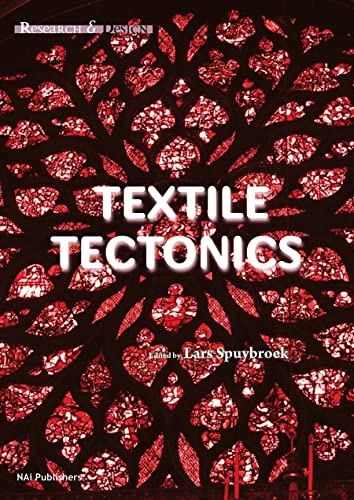

Textile tectonics / edited by Lars Spuybroek. txt
Series Rotterdam : NAi Publishers , 2011Descripción: 218 p. col. ill. 26 cmTipo de contenido:- text
- unmediaded
- volume
- 9789056628024
- 746
- NA2750 T485 2011
| Imagen de cubierta | Tipo de ítem | Biblioteca actual | Biblioteca de origen | Colección | Ubicación en estantería | Signatura topográfica | Materiales especificados | Info Vol | URL | Copia número | Estado | Notas | Fecha de vencimiento | Código de barras | Reserva de ítems | Prioridad de la cola de reserva de ejemplar | Reservas para cursos | |
|---|---|---|---|---|---|---|---|---|---|---|---|---|---|---|---|---|---|---|
| Libro | CARIBET Biblioteca Arquitectura Colección General CARIBET | General NA2750 T485 2011 (Navegar estantería(Abre debajo)) | 1 | Disponible | 91000000024182 |
Descripciones mejoradas de Syndetics:
Until recently, thanks to the unforgiving geometric rigors of modernism, biomorphism in design and architecture was seen a purely decorative feature--as in Art Nouveau, for example. Textile Techtonics turns this idea on its head, offering a glimpse into the future of architectural design, in which the veins of leaves, formations of foam, Celtic knotwork and even hair braiding can be transformed into breathtaking and viable structures through the wonders of digital design technology. For the celebrated architect and researcher Lars Spuybroek, such natural, ornamental and folkloristic pattern could entirely replace standardized geometric design to determine the structural basis and aesthetic character of tomorrow's buildings. Here, Spuybroek presents both a theoretical framework and an inspiring taxonomy of patterns and structures, followed by more than 100 illustrated designs for skyscrapers and fa ades based on organizational principles ranging from rose windows to knitting patterns.
Includes bibliographical references (p. 41).
Figure-configuration taxonomies -- Gothic rose windows & traceries -- Leaf venation -- Foam regular to irregular -- Packing-cracking -- Braiding hairdo's -- Celtic knotwork crosses -- Haeckels radiolaria revisited -- Textiles towers & textile façades -- Textile towers -- Radiolaria tower / Jonathan Aprati, Valerie Bolen, Jin Cong Hong & Kim Wadelton -- Wool thread tower / Matt Erwin & Adam Sauer -- Braiding tower / Cameron Bishop & Mara Neumann -- Gothic tower / Sookie Kim & Rae Smith -- Foam tower / Geoffrey Braiman & Dave Beil -- Textile façades -- Crystallized colors / Derek Tao-Han Liu -- Tectonic networking / Adrienne Froemelt & Paul Meyer -- Interlaced / Katherine Giraldo & Atreya Safari & Be Thach -- Fissure / Jacob Porter & Darryl Zuk -- Radiolaria / Tasnouva Habib & Yasin Bulhan -- Gothic / Jennifer Reinhardt.
Textile tectonics" reveals how natural, ornamental and folkloristic patterns - from the veins of leaves to Gothic rose windows, from foam formations to traditional styles of hair braiding and from Celtic knotwork to knitting patterns - can be digitally elaborated into breathtaking, programmable and architecturally viable structures. Internationally renowned architect and researcher Lars Spuybroek has been investigating the relationships between art, architecture and information technology. His students in the Georgia Institute of Technolgy, School of Architecture have contributed their projects in this second book in research and design.
Tabla de contenidos provista por Syndetics
- Introduction: Textile Tectonics(p. 6)
- The Digital Nature of Gothic(p. 8)
- Figure-Configuration Taxonomies
- Gothic Rose Windows & Traceries(p. 44)
- Leaf Venation(p. 56)
- Foam Regular to Irregular(p. 62)
- Packing-Cracking(p. 74)
- Braiding Hairdo's(p. 84)
- Celtic Knotwork Crosses(p. 90)
- Haeckel's Radiolaria Revisited(p. 96)
- Textile Towers & Textile Façades(p. 108)
- Textile Towers
- Radiolaria Tower(p. 110)
- Wool Thread Tower(p. 126)
- Braiding Tower(p. 142)
- Gothic Tower(p. 158)
- Foam Tower(p. 174)
- Textile Façades
- Crystallized Colors(p. 190)
- Tectonic Networking(p. 194)
- Interlaced(p. 200)
- Fissure(p. 204)
- Radiolaria(p. 208)
- Gothic(p. 212)
- Acknowledgments(p. 216)