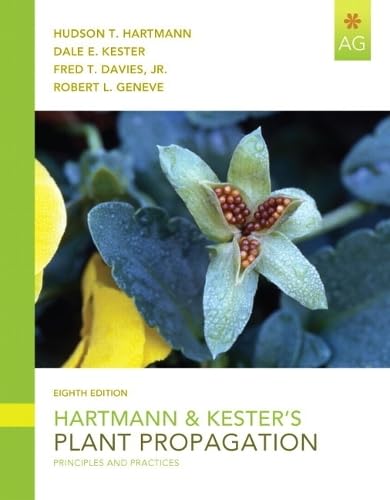
Imagen de portada de Amazon
Imagen de Amazon.com
Imagen de cubierta Syndetics
Portada de Syndetics
Imagen de OpenLibrary

Hartmann and Kester<U+2019>s plant propagation principles and practice Fred T. Davies, Robert L. Geneve, Dale E. Kester.

Por: Colaborador(es): Detalles de publicación: Boston Prentice Hall c2011.Edición: 8th edDescripción: 915 p. ill. 2011ISBN:
  • 9780135014493 (alk. paper)
Otro título:
  • Plant propagation
Tema(s):
Valoración
    Valoración media: 0.0 (0 votos)
Existencias
Imagen de cubierta Tipo de ítem Biblioteca actual Biblioteca de origen Colección Ubicación en estantería Signatura topográfica Materiales especificados Info Vol URL Copia número Estado Notas Fecha de vencimiento Código de barras Reserva de ítems Prioridad de la cola de reserva de ejemplar Reservas para cursos
Libro Biblioteca Mons. Iñaki Mallona (Arecibo) Colección General ab 631.53 H333p8 (Navegar estantería(Abre debajo)) Disponible 60000010126131
Total de reservas: 0

Descripciones mejoradas de Syndetics:

The world standard for plant propagation and horticulture for over 50 years, Hartmann and Kester's Plant Propagation continues to be the field's most complete, up-to-date text on plant propagation. It now contains color figures throughout, promoting learning and making it an even more useful working text and reference. It also contains extensive updates reflecting the latest commercial techniques and understanding of propagation biology. Like previous editions, it is organized into paired chapters on principles and practices, so it can easily be adapted for teaching courses that cover only practical topics, and for courses that also cover conceptual issues.

Includes bibliographical references and index.

Tabla de contenidos provista por Syndetics

  • 1 How Plant Propagation Evolved In Human Society
  • 2 Biology of Plant Propagation
  • 3 The Propagation Environment
  • Part II Seed Propagation
  • 4 Seed Development
  • 5 Principles and Practices of Seed Selection
  • 6 Techniques of Seed Production and Handling
  • 7 Principles of Propagation from Seeds
  • 8 Techniques of Propagation by Seed
  • Part III Vegetative Propagation
  • 9 Principles of Propagation by Cuttings
  • 10 Techniques of Propagation by Cuttings
  • 11 Principles of Grafting and Budding
  • 12 Techniques of Grafting
  • 13 Techniques of Budding
  • 14 Layering and Its Natural Modifications
  • 15 Propagation by Specialized Stems and Roots
  • 16 Principles and Practices of Clonal Selection
  • Part IV Cell and Tissue Culture Propagation
  • 17 Principles of Tissue Culture and Micropropagation
  • 18 Techniques for Micropropagation
  • Part V Propagation of Selected Plant Species
  • 19 Propagation Methods and Rootstocks for Fruit and Nut Species
  • 20 Propagation of Ornamental Trees, Shrubs, and Woody Vines
  • 21 Propagation of Selected Annuals and Herbaceous Perennials Used As Ornamentals
  • Subject Index
  • Plant Index, Scientific Names
  • Plant Index, Common Names

Extracto provisto por Syndetics

The seventh edition of Plant Propagation: Principles and Practices continues the gradual reorganization and distribution in subject matter among the three active co-authors and the updating of biological concepts that underlie the practical application of the existing plant propagation technology. The first edition in 1959 contains the following excerpt: "The study of plant propagation involves three different aspects. These may be considered as objectives in any course of study involving the propagation of plants. First of all, plant propagation requires a knowledge of mechanical manipulations and technical skills whose mastery requires a certain amount of practice and experience. This would include such things as how to bud or graft or how to make cuttings, etc. This is the art of propagation. Secondly, successful plant propagation requires knowledge of plant growth and structure. This is the science of propagation. Some of this information can be learned empirically by working with the plants themselves, but it should be supplemented, if possible, with information gained from formal courses in botany, horticulture, plant physiology, and genetics. Such knowledge aids propagators in understanding why they do the things they do. It also makes it possible for them to better perform the practices. A third important requirement of successful plant propagation is a knowledge of specific kinds of plants and the particular methods by which those plants must be propagated. To a large extent the method must be geared to the requirements of the particular kind of plant being propagated." In preparing the seventh edition 42 years later we have maintained those same three objectives and, as much as possible, presented them in separate identified chapters as principles and practices although the order has changed somewhat. During the different editions, the amount of material has increased astronomically and the limits of scientific concepts and applicability have expanded beyond the wildest forecasts in 1959. Instead of simply piling more information onto previous information, we have tried to integrate new science and technology into the evolving pattern that characterizes the range from traditional to the present combination of science and technology. First of all, we must recognize the revolutionary impact of biotechnology not only upon the concepts of biology but also its practical applications in the propagation industry. We have had a long enough history to see the historical continuity in the evolution of human progress and scientific advancement. Chapter 1 has remained intact as a historical account of how propagation activities have been a primary backdrop for human progress leading up to our present era. Chapter 2 has been almost completely rewritten to synthesize a comprehensive view of propagation from the standpoint of the gene and the epigenetic control of development. Biotechnology is introduced as three separate branches: (a) cell and tissue culture technology, (b) gene marker technology, and (c) recombinant gene technology. Cell and tissue culture technology, which includes all aseptic aspects of the culture of protoplasts, cells, tissues, shoot tips, embryos, etc., was introduced in the first edition by a section on embryo culture which expanded into a full chapter by the third edition. From there the subject was treated in dual chapters of principles and practices. In this edition, this section has remained intact but is reorganized and partly rewritten. This technology has not only found its place in commercial propagation but is an essential aspect of current genetic engineering. DNA marker-based technology is now coming into its own to directly identify cultivars and to study taxonomic relationships. The ability to sequence genes and to manipulate them in the laboratory has created an essentially new field of biology known as genomics which will have an increasing impact of propagation. After many years in the laboratory, recombinant DNA technology is now having an impact on human activities. Propagators will be increasingly faced with both its promise and its controversy. The topic is introduced in Chapter 2. The production of transgenic cultivars is described for seeds in Chapter 5 (Seed Selection) and for vegetatively propagated cultivars in Chapter 16 (Clones). However, students will need to go elsewhere for a comprehensive text on genetic engineering. The engineering, computerization, and mechanization to control the propagation environment has continued to be a major aspect of the industry and of previous editions. Chapter 3 continues the integration of concepts and application. Seed propagation has made major advances in both the understanding of seed biology and the technology of seedling production. These chapters have remained largely intact but considerable rewriting and reorganization has taken place. Chapter 5 has been almost completely reorganized, integrating the concepts of selection for annual and perennial plants together into a comprehensive analysis. Chapters on vegetative propagation (cuttings, grafting, budding, layering, specialized roots and stems) follow next in sequence continuing the dual emphasis on principles and practices. The history of research on root initiation is reviewed. The chapter on clonal propagation has been expanded into a comprehensive analysis of the concept of clones as taxonomic units in perennial crops, including their origin in horticulture and forestry and the potential for improvement through transgenic cultivars. Sources of variability (environmental, epigenetic, genetic, and pathogenic) in clonal propagation systems are described as well as their control in plant production systems. Emphasis is placed on selection and maintenance of sources that are genetically pure, true to type, and pathogen free. One change that may be noted by previous users is renaming the title to: Hartmann and Kester's Plant Propagation: Principles and Practices. This is intended to maintain the identity with the original text initially created and maintained by the two original authors through four editions, an identity recognized by thousands of horticultural students. We also recognize the need to increase the case by which students can identify key concepts and terminology of propagation. Each chapter opens with an introductory statement and specific objectives. We are using in-depth text boxes to separate more advanced topics or to highlight specific key terminology. Whenever a new term is introduced (shown in bold print), the definition is added in the margin of that page to produce a glossary of terms. An added feature to the seventh edition is a student CD supplement that includes expanded definitions and images for over 200 terms used in plant propagation. The CD is packaged free in the back of each new text and provides an interactive supplement to the text that allows students to see additional color images, animations, tutorials, and video clips related to propagation. Additionally, a student support Web site is available at www.prenhall.com/hartmann . The Web site includes sample exam questions, giving students the opportunity to test their understanding of important course material. An Instructor's Manual is available as an aid for using the text to teach plant propagation. It includes chapter overviews with sample test questions. The Instructor's Manual is available by contacting your local Prentice Hall representative. We have added a number of new illustrations this time, including many replacements in Chapter 2. We have begun to include many Web sites as references within the text. The web will continue to be an expanding resource. In preparing the seventh edition of this book, we have depended upon the assistance of authorities in the various fields of propagation and related subjects. They gave their time most generously in reading sections of the manuscript and offering suggestions. We especially wish to thank: Sekar Arulsekar, Bill Barnes, Carol Baskin, D. Kim Black, Jack Buxton, Abhai Dandekar, John Day, Richard Durham, Kevin M. Fenning, Tom Gradziel, Jim Kamas, Ron Perry, Bill Proebsting, Larry Rupp, Jeff Sibley, John Tristan, Lawrence Virkaitis, Keith Warren, 'Philip Wilson, and Richard Zimmerman. The responsibility, however, for the final version of the edition is that of the authors. We need to acknowledge the passing of individuals associated with this text. We dedicate this edition again to Dr. Hudson T. Hartmann. Also we note the death of Daphne Kester who has been associated with the production of this text for many years. She typed many of the early manuscripts. In addition she was a dedicated supporter and participant of the effort. We also thank our wives, Maritza Davies and Pat Geneve, and families for their support, encouragement, and patience during the writing and production of the seventh edition of this book. We thank Carolyn Cobb for preparing many of the illustrations used in this book. Finally we acknowledge the skill and professionalism of the Prentice-Hall and associated editors who made this production possible: Debbie Yarnell, Lori Dalberg, Eileen O'Sullivan, and Carey Davies. Excerpted from Hartmann and Kester's Plant Propagation: Principles and Practices by Hudson T. Hartmann, Dale E. Kester, Fred T. Davies , Robert L. Geneve All rights reserved by the original copyright owners. Excerpts are provided for display purposes only and may not be reproduced, reprinted or distributed without the written permission of the publisher.

Notas de autor provistas por Syndetics

Dale E. Kester is Professor of Pomology emeritus at the University of California, Davis. During his 40 years at the University of California he taught courses in plant propagation and pomology. He has been a member of the American Society of Horticultural Science, becoming a Fellow in 1977. He received jointly the Stark Award in 1980. He has published over 100 research and popular publications in plant propagation and pomology. He has had a lifelong collaboration with Dr. Hudson T. Hartmann which resulted in the publication of the first edition of Plant Propagation: Principles and Practices in 1959, followed by other editions in 1968, 1975, 1983, and 1990. One of the founders of the Western Region of the International Plant Propagators' Society (1960), he has served the society in various capacities including Vice-President, program chair (1996) and President (1997). He received the Curtis J. Alley Achievement Award in 1999.

Fred T. Davies, Jr., Professor of Horticultural Sciences, and Molecular and Environmental Plant Sciences, Texas A&M University, has taught courses in plant propagation and nursery production and management since 1979. He has co-authored over 100 research and technical publications. He was a Fulbright Senior Fellow to Mexico (1993) and Peru (1999), and a J.S. Guggenheim Fellow (1999). He received the Distinguished Achievement Award for Nursery Crops from the American Society of Horticultural Sciences (1989), L.M. Ware Distinguished Research Award-ASHS-SR (1995), and S.B. Meadows Award of Merit-International Plant Propagator's Society-SR (1994). He is a recipient of the Association of Former Students Distinguished Achievement Award for Teaching-TAMU (1997), Chancellor of Agriculture's Award in Excellence in Undergraduate Teaching-TAMU (1998), L.M. Ware Distinguished Teaching Award, ASHS-SR (1998), and L.C. Chadwick Educator's Award, American Nursery and Landscape Association (1999). He is the International Division Vice-President-ASHS. He was President, and is currently Editor, of the IPPS-SR.

Robert L. Geneve is a Professor in the Department of Horticulture at the University of Kentucky. He teaches courses in plant propagation and seed biology. He has co-authored over 70 scientific and technical articles in seed biology, cutting propagation, and tissue culture. He is also the co-editor of the book Biotechnology of Ornamental Plants and author of A Book of Blue Flowers. He has served as a board member for the International Plant Propagators' Society-Eastern Region and serves on the Editor for the international horticulture journal, Scientia Horticulturae.

Compartir
logopucpr-y-vive

Contáctanos

¡Queremos saber de ti!

Tel. 787.841.2000 Ext. 1801

bibliotecavaldes@pucpr.edu

⁣Búscanos en las redes

© 2026 Desarrollado por Ignite Online • All Rights Reserved • Powered by Koha.