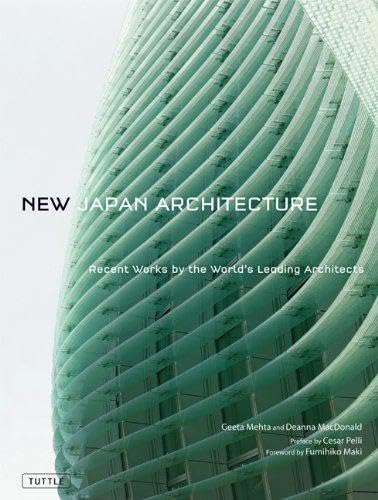

New Japan Architecture : recent works by the world's leading architects. / Geeta Mehta and Deanna MacDonald. txt
Idioma: Español Tokyo : Tuttle, 2011Descripción: 224 p. col. ill. ; plans ; 31 cmISBN:- 9784805309483
- NA1550 M44 2011
| Imagen de cubierta | Tipo de ítem | Biblioteca actual | Biblioteca de origen | Colección | Ubicación en estantería | Signatura topográfica | Materiales especificados | Info Vol | URL | Copia número | Estado | Notas | Fecha de vencimiento | Código de barras | Reserva de ítems | Prioridad de la cola de reserva de ejemplar | Reservas para cursos | |
|---|---|---|---|---|---|---|---|---|---|---|---|---|---|---|---|---|---|---|
| Libro Col. General CARIBET | CARIBET Biblioteca Arquitectura Colección General CARIBET | General NA1550 M44 2011 (Navegar estantería(Abre debajo)) | 1 | Disponible | 91000000023242 |
Descripciones mejoradas de Syndetics:
The global changes taking place in the architectural world are crystallizing right now in Japan, with the past five years being considered one of the most innovative periods in current Japanese design history. Observed by architects and designers from around the world, these changes are illustrated and articulated in New Japan Architecture.
By documenting 48 important projects by 42 established and avant-garde architects, this book takes the reader through a journey of current trends in contemporary Japanese architecture and predicts future directions. While some buildings strive for the ultimate Zen white cube, others exemplify the search for the 'Wow' factor. Cutting edge modernity in some buildings is countered by a concern for sustainability in others. The selection of buildings in New Japan Architecture includes projects that are big and small, private and public, residential and commercial. The informative writings complement beautiful photographs that highlight the remarkable aspects of each building. A must-have book for those interested in architecture and Japan.
Includes Index
Preface by Cesar Pelli 8 --
Foreword by Fumihiko Maki 10 --
From Wabi Sabi to white cubes 14 --
Architecture for Living:
Passage House 22 --
Weekend House Alley 26 --
House in Kitakamakura 30 --
House Like a Museum 34 --
Coal House 40 --
House N 44 --
House C 50 --
M House 54 --
Okurayama Apartments 58 --
A-Ring-Aluminum Ring House 3 62 --
C-1 (Curiosity 1) House 66 --
Jardin 72 --
Natural Cubes 74 --
Glashaus 76 --
Architecture for Culture --
21-21 Design Sight 82 --
National Museum of Contemporary art 86 --
Mihara Performing Arts Center 90 --
Aomori Museum of Art 94 --
The National Art Center, Tokyo 98 --
Bubbletecture H 102 --
Nakamura Keith Haring Museum 104 --
Nezu Museum 108 --
Inujima Art Project “Seirensho” 112--
Shimane Museum of Ancient Izumo 116 --
Architecture for Learning:
Techo Plaza Ota 122 --
Tama Art University Library 126 --
Kanagawa Institute of Technology (kait) workshop 130 --
Fukutake Hall, University of Tokyo 134 --
Fuji Kindergarten Montessori School 138 --
Mode Gakuen Cocoon Tower 142 --
Tama University School Yashiro Media Center 150 --
Architecture for work:
Namics Techno core 156 --
Tokyo Midtown 160 --
Sia Aoyama Building 166 --
F-Town Building 170 --
Architecture for consumers:
The Iceberg 176 --
Prada Aoyama Epicenter 180 --
Tod’s Omotesando 184 --
Nicolas G. Hayek Center 188 --
De Beers Ginza Building 192 --
Gyre Building 194 --
Architecture for the City:
Fussa City Hall 198 --
Hyuga City Station 200 --
Monument at Shi-Yatsushiro 202 --
Architecture for Renewal:
Tomamu Towers 208 --
International House of Japan 210 --
Ginzan Onsen Fujiya 214 --
Architects 218 --
Acknowledgements and Credits 224 --
Tabla de contenidos provista por Syndetics
- Architecture for Living
- Architecture for Culture
- Architecture for Learning
- Architecture for Work
- Architecture for Consumers
- Architecture for the City
- Architecture for Renewal
Reseñas proporcionadas por Syndetics
Publishers Weekly Review
"As the world moves into the second decade of the 21st century, it is clear that the West no longer has all the answers. Japan has moved beyond the need to mimic the West." Columbia University professor Mehta (Japan Style) collaborates with art historian MacDonald for a sweeping survey of 48 recently completed projects, organized in seven categories: Living (private homes), Culture (museums), Learning (schools), Work (office buildings), Consumers (stores), City (public buildings), and Renewal (renovations). From a 102.7 square meter hut on the Chiba coast by Hiroshi Nakamura & NAP Architects ("House C") to Tokyo's massive National Art Center from Kisho Kurokawa Associates and Nihon Sekkei Inc., the 42 featured architects exhibit a dazzling range of outside-of-the-box structures. Mehta and MacDonald present a mesmerizing album of four-color photographs accompanied by text that explains the inspiration and construction of each project. Readers will be delighted to find a Nakamura Keith Haring Museum "that sits like an exclamation mark" on a hill in the village of Kobuchizawa in the Japanese Alps, with a gallery complex by Atsushi Kitagawara that features hot springs (onsen) in fanciful Haring-like shapes. (Sept.) © Copyright PWxyz, LLC. All rights reserved.Notas de autor provistas por Syndetics
Geeta K. Mehta is an adjunct professor of architecture and urban design at Columbia University in New York. A resident of Japan for 23 years, she is a practicing architect who has designed projects in the USA, Japan, India, Vietnam and Indonesia. She is the co-author of several books including Japan Style, Japan Houses and Japan Living.Deanna MacDonald studied art and architectural history in Canada and Europe. She received her MA from the Central European University in Prague and her Ph.D. from McGill University in Montreal. She currently resides in Tokyo.