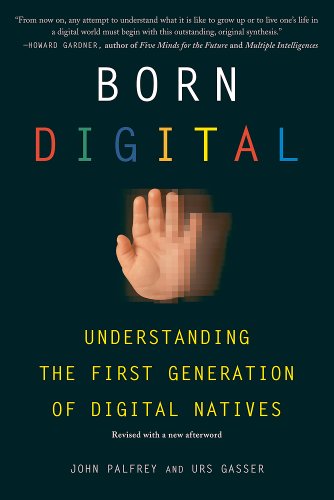

Born digital understanding the first generation of digital natives John Palfrey and Urs Gasser.
Detalles de publicación: New York Basic Books c2008.Descripción: vii, 381 pages 24 cmISBN:- 9780465018567
- 302.2310835 P159b 22
- HM851 .P34 2008b
| Imagen de cubierta | Tipo de ítem | Biblioteca actual | Biblioteca de origen | Colección | Ubicación en estantería | Signatura topográfica | Materiales especificados | Info Vol | URL | Copia número | Estado | Notas | Fecha de vencimiento | Código de barras | Reserva de ítems | Prioridad de la cola de reserva de ejemplar | Reservas para cursos | |
|---|---|---|---|---|---|---|---|---|---|---|---|---|---|---|---|---|---|---|
| Libro | Biblioteca Encarnación Valdés Colección General bev | 302.2310835 P159b (Navegar estantería(Abre debajo)) | Disponible | 80000002459264 |
Descripciones mejoradas de Syndetics:
The first generation of "Digital Natives"--children who were born into and raised in the digital world--are coming of age, and soon our world will be reshaped in their image. Our economy, our politics, our culture, and even the shape of our family life will be forever transformed. But who are these Digital Natives? And what is the world they're creating going to look like?
In Born Digital , leading Internet and technology experts John Palfrey and Urs Gasser offer a sociological portrait of these young people, who can seem, even to those merely a generation older, both extraordinarily sophisticated and strangely narrow. Exploring a broad range of issues, from the highly philosophical to the purely practical, Born Digital will be essential reading for parents, teachers, and the myriad of confused adults who want to understand the digital present--and shape the digital future.
The most enduring change wrought by the digital revolution is neither the new business models nor the new search algorithms, but rather the massive generation gap between those who were born digital and those who were not. The first generation of "digital natives"--children who were born into and raised in the digital world--is now coming of age, and soon our world will be reshaped in their image. Our economy, our cultural life, even the shape of our family life will be forever transformed. But who are these digital natives? How are they different from older generations, and what is the world they're creating going to look like? Based on original research and advancing new theories, the authors explore a broad range of issues, from the highly philosophical to the purely practical.--From publisher description.
Includes bibliographical references (p. 359-369) and index.
Identities -- Dossiers -- Privacy -- Safety -- Creators -- Pirates -- Quality -- Overload -- Aggressors -- Innovators -- Learners -- Activists -- Synthesis.
Reseñas proporcionadas por Syndetics
Library Journal Review
Palfrey (law & executive director, Berkmam Ctr. for Internet & Society, Harvard Law Sch.) and Gasser (law & director, Research Ctr. for Information Law, Univ. of Saint Gallen) offer a concerned evaluation of the challenges facing the generation known as digital natives who have grown up immersed in the use of and dependence upon information technology. This book is significant in its prompting of readers to consider that these young men and women are charting new territory and facing challenges that are distinctly unique to their era. This book is a wake-up call and a how-to guide for being a parent or teacher in an era that defies easy understanding. The authors propose circuitous partnerships of digital natives with parents, teachers, mentors, trusted social utilities, and law enforcement that serve as a means to produce a shift in understanding of digital-era challenges, e.g., the potential daily threats it poses to our privacy, safety, identity, and innovation. Ultimately, the book is an accessible survey of many of these as-yet-unsolved Internet dilemmas of our time and is well executed given the immense task of synthesizing the vast corpus of social science concerns relating to the Internet. Recommended especially for public libraries.--Jim Hahn, Univ. of Illinois Lib., Urbana (c) Copyright 2010. Library Journals LLC, a wholly owned subsidiary of Media Source, Inc. No redistribution permitted.Publishers Weekly Review
In this critical but optimistic overview, academics Palfrey (of Harvard's Berkman Center for Internet & Society) and Gasser (of the Swiss U. of St. Gallen) share their concern about the legal and social ramifications of the Internet with regard to the generation of "Digital Natives" born after 1980. In a wide-ranging examination of "the future opportunities and challenges associated with the Internet as a social space," Palfrey and Gasser find most young people fail to recognize the vulnerability of their information--that internet posts are never really private--and suggest tactful parental and school oversight. They find a more serious problem in the failure of the U.S. to regulate data mining by search engines, which even now have the potential to create cradle-to-grave dossiers on individuals, including online medical and financial records; they compare the U.S. system with Europe's policies, which have put in place much more effective data protection. Parents and educators will benefit from Palfrey and Gasser's discussion of issues like safety, content control and illegal file sharing; with proper attention from them, the authors see a bright future for the Internet that should foster "global citizens" with a "spirit of innovation, entrepreneurship and caring for society at large." (Sept.) Copyright 2008 Reed Business Information.CHOICE Review
Palfrey (Harvard) and Gasser (Univ. of St. Gallen) offer an intriguing perspective on how young adults born after 1980 have been raised in a totally cybernetic age and think differently from their predecessors, who stand in both the pre- and postdigital worlds. The coauthors, both professors of law, demonstrate a commanding grasp of the knowledge base for understanding the changes coming along with the "cybernation" with its near universal Internet availability, omnipresent cell phoning, and digitization of all facets of everyday life. They caution against the dangers of this digital age in which a computer-created identity, made in a whimsical moment, can yield a lasting adverse impact on a person's later life. The authors articulately present many of the dangers linked with this digital age: invasions of personal privacy, online criminals and predators, intellectual piracy, and issues of information quality and overload. Provocative as their initial thesis is, the authors' reliance on focus group and informal interview data from a small number of young people and their intellectual gatekeepers fails to adequately explore their claims of differences between generational cohorts. Summing Up: Recommended. All levels/libraries. W. Feigelman Nassau Community CollegeBooklist Review
Boomers may think they're too cool and forever-young to find themselves on the wrong side of a generation gap, but technology has created a great divide. Digital Natives, the Internet Age generation, are so acclimated to cyberspace they verge on being another species. Palfrey and Gasser, lawyers who specialize in intellectual property and information issues, document the myriad ways downloading, text-messaging, Massively Multiplayer Online Games-playing, YouTube-watching youth are transforming society. Energetic, expert, and forward-looking, the authors serve as envoys between the generations, addressing issues that worry parents and educators, from privacy and safety concerns to the quality of digital information, the psychological and physical effects of information overload and excessive online time, and legal and ethical issues, all the while stressing the need for digital literacy and critical thinking. Palfrey and Gasser believe in the value of the participatory culture the Internet fosters, and in the Internet's nurturing of creativity, collaboration, entrepreneurship, and global citizenship. As old institutions crumble, there is a need for just this sort of enlightening, commonsensical, and positive guide to digital reality.--Seaman, Donna Copyright 2008 BooklistNotas de autor provistas por Syndetics
John Palfrey is Professor of Law and a Vice Dean at Harvard Law School. A faculty director of the Berkman Center for Internet & Society, he is a regular commentator on network news programs, CNN, MSNBC, CNBC, Fox News, NPR, and BBC. He lives in Cambridge, Massachusetts.Urs Gasser is the Executive Director of the Berkman Center for Internet & Society. He has edited six books and has written over sixty articles in books, law reviews, and professional journals. He lives in Cambridge, Massachusetts.