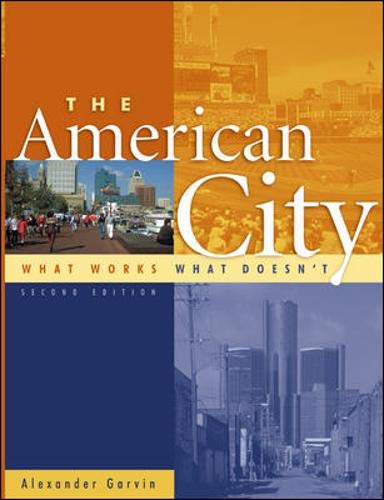

The American city : what works, what doesn't. Alexander Garvin. txt
New York : McGraw-Hill, 2002Edición: 2nd edDescripción: xiv, 560 p. ill. 28 cmTipo de contenido:- text
- unmediaded
- volume
- 0071373675
- 9780071373678
- 711/.4/0973 21
- NA9105 G37 2002
| Imagen de cubierta | Tipo de ítem | Biblioteca actual | Biblioteca de origen | Colección | Ubicación en estantería | Signatura topográfica | Materiales especificados | Info Vol | URL | Copia número | Estado | Notas | Fecha de vencimiento | Código de barras | Reserva de ítems | Prioridad de la cola de reserva de ejemplar | Reservas para cursos | |
|---|---|---|---|---|---|---|---|---|---|---|---|---|---|---|---|---|---|---|
| Libro | CARIBET Biblioteca Arquitectura Colección General CARIBET | General NA9105 G37 2002 (Navegar estantería(Abre debajo)) | 1 | Disponible | 91000000002154 |
Descripciones mejoradas de Syndetics:
This standard refernce on urban planning and design in America analyzes the key projects initiated in major cities, suburban areas, and new towns - more than 250 in all - and clearly shows which strategies and programs work and which do not. The book ranges over all elements of urban life, from stadiums to parks, and its practical recommendations are tested by real-world implementation. Since the publication of the 1/e in 1995, much is new in the rapidly changing world of urban design. Significant new types of programs, such as Business Improvement Districts; national trends such as stadium construction and loft conversions; and exciting new completed projects are all covered here to make the book the definitive guide to planning in the new decade.
Includes bibliographical references and index.
1. A REALISTIC APPROACH TO CITY AND SUBURBAN PLANNING --
Defining the Planning Process --
A New Approach to Urban Planning --
Notes --
2. INGREDIENTS OF SUCCESS --
Market --
Location --
Design --
Financing --
Entrepreneurship --
Time --
Manipulating the Ingredients of Success to Obtain Desirable Private-Market Reaction --
The Role of Government --
Notes --
3. PARKS AND PLAYGROUNDS --
Nature as Restorative --
Recreation as Therapy --
Standardization and Mass Production --
Midcourse Correction --
The Adventure Playground --
Community Gardens --
Parks as a Strategic Public Investment --
Using Parks to Initiate Urbanization --
Using Parks to Change Land Use Patterns --
Using Park Systems to Change Entire Cities --
Ingredients of Success --
Parks as Planning Strategy --
Notes --
4. PALACES FOR THE PEOPLE --
World's Columbian Exposition of 1893 --
Civic Centers --
Cultural Centers --
Sports Centers --
Convention Centers --
Ingredients of Success --
Palaces for the People as a Planning Strategy --
Notes --
5. RETAIL SHOPPING --
Retail Strips --
Public Markets --
Department Stores --
Shopping Centers --
Shopping Arcades --
Suburban Malls --
Urban Malls --
Reviving Urban Retail Districts --
The Festival Marketplace --
Off-Price Retailers --
Prepackaged Urbanity --
Mixed-Use Centers --
Ingredients of Success --
Retailing as a Planning Strategy --
Notes --
6. URBAN REDEVELOPMENT --
Le Corbusier's Vision --
Adapting the City of Tomorrow to Postwar America --
A National Program --
The New Working Environment --
The New Residential Environment --
Opposition --
Transfiguration and Death --
Ingredients of Success --
Redevelopment as a Planning Strategy --
Notes --
7. PLANNING FOR PEDESTRIANS --
Pedestrian Precincts --
Business Improvement Districts --
Ingredients of Success --
Creating a Pedestrian-Friendly Environment as a Planning Strategy --
Notes --
8. INCREASING THE HOUSING SUPPLY --
Providing a Stable Supply of Mortgage Money --
Standardized Mortgages for a National Market --
Multifamily Housing --
The Savings and Loan Crisis --
Ingredients of Success --
Increasing the Housing Supply as a Planning Strategy --
Notes --
9. REDUCING HOUSING COST --
Subsidizing Supply --
Reducing Development Costs --
Reducing Economic Rent --
Increasing After-Tax Income --
Subsidizing Demand --
Supplementing Rent --
Ingredients of Success --
Reducing Housing Cost as a Planning Strategy --
Notes --
10. HOUSING REHABILITATION --
The Housing Stock --
Determining the Level of Rehabilitation --
Three Government Rehabilitation Experiments --
Three Citywide Rehabilitation Programs --
Ingredients of Success --
Rehabilitation as a Planning Strategy --
Notes --
11. CLEARING THE SLUMS --
The Bad Environment --
Strategy 1: The Self-Contained Enclave --
Strategy 2: The Superblock --
Strategy 3: A Net Increase in Apartments --
Strategy 4: Removing Frictional Blight --
Strategy 5: Concentrated, Coordinated Government Action --
The Critics --
Ingredients of Success --
Housing Redevelopment as a Planning Strategy --
Notes --
12. REVITALIZING NEIGHBORHOODS --
Neighborhood Dynamics --
Neighborhood Revitalization Programs --
Ingredients of Success --
Neighborhood Revitalization as a Planning Strategy --
Notes --
13. RESIDENTIAL SUBURBS --
Rectilinear Subdivisions --
Curvilinear Subdivisions --
Cluster Communities --
The New Urbanism --
Ingredients of Success --
A Planning Strategy for the Suburban Landscape --
Notes --
14. NEW-TOWNS-IN-TOWNS --
Utopia arouund the Corner --
The National Effort to Build New-Towns-in-Town --
New City Districts --
Ingredients of Success --
New-Towns-in-Towns as a Planning Strategy --
Notes --
15. NEW-TOWNS-IN-THE-COUNTRY --
Ebenezer Howard and the Garden City --
The Vacation Refuge New Town --
The Utopian Satellite New Town --
National Policy Initiatives --
Neotraditional New Towns --
Ingredients of Success --
The New Town as a Planning Strategy --
Notes --
16. LAND USE REGULATION --
Private Land Use Regulation --
The Police Power --
The Role of Federal, State, and Local Government --
Land Use Regulation Strategies --
Comprehensive Zoning --
Incentive Zoning --
Exactions --
Special Districts --
Growth Management --
Environmental Review --
Ingredients of Success --
Land Use Regulation as a Planning Strategy --Notes --
17. PRESERVING THE PAST --Preserving the Old and Historic --
Instant Roots and Ersatz History --
Protecting the Cultural Patrimony --
Paying for Landmark Preservation --
An Activist Approach --
Ingredients of Success --
Historic Preservation as a Planning Strategy --
Notes --
18. COMPREHENSIVE PLANNING --
Burnham and Company --
A National Movement --
Visions of the Future Metropolis --
Synergistic Government Expenditures --
Planning as a Continuing Process --
Ingredients of Success --
Comprehensive Planning as a City Strategy --
Notes.
Publisher Description (unedited publisher data) This comprehensive, multidisciplinary approach to urban planning and design in America analyzes key projects initiated in 250 U.S. urban areas and details which strategies and programs were successful and which failed. New to the Second Edition: * New sections on stadiums, entertainment centers, business improvement districts, tax credit housing * Checklists and tables for field use * A review of recent failures and successes This classic reference, fully revised for the new millennium, provides proven strategies for professionals and invaluable real-world insights for students.
Reseñas proporcionadas por Syndetics
CHOICE Review
Since the late 19th century, Americans have endeavored to tame the country's cities. Numerous initiatives have been directed at assuring economic viability, enhancing urban form and function, and generally making cities healthy, socially attractive, and desirable to investors. In the second edition (1st ed., CH, May'96) of this compilation of more than 250 projects in over 100 cities, Garvin (professional urban planner and adjunct professor, urban planning and management, Yale Univ.) assesses the strategies used in the last half-century to improve the physical city. Thirteen core chapters review efforts from parks and playgrounds to housing schemes, pedestrian-friendly streets, cultural centers, neighborhood revitalization, and residential suburbs. Replete with illustrations, these chapters also introduce a variety of policy tools: business improvement districts, home mortgage guarantees, and tax abatements among others. Additionally, Garvin provides separate chapters on land use regulations, comprehensive planning, and historic preservation. The book culminates with a list of six ingredients for project success--market demand, location, design, financing, entrepreneurship, and timing--and a call for strategic public actions that generate a positive private market response and sustainable projects. No other book offers such a comprehensive and practical overview of urban reinvestment initiatives. Highly recommended for collections supporting upper-division undergraduate students through professionals and two-year technical program students. R. A. Beauregard New School UniversityNotas de autor provistas por Syndetics
Alexander Garvin has combined a career in urban planning and real estate with teaching, architecture, and public service. He is currently Vice President for Planning, Design, and Development of the Lower Manhattan Development Corporation, commissioner on the New York City Planning Commission, and Managing Director for Planning NYC2012, the committee to bring the Summer Olympics to New York in 2012.Garvin is Adjunct Professor of Urban Planning and Management at Yale University, where he has taught a wide range of subjects including "Introduction to the Study of the City," which for more than three decades has remained one of the most popular courses in Yale College.
Garvin is one of the principal authors of Urban Parks and Open Space published in 1997 jointly by the Trust for Public Land and the Urban Land Institute. His latest book Parks, Recreation, and Open Space: A 21st Century Agenda, was published in 2001 by the American Planning Association.