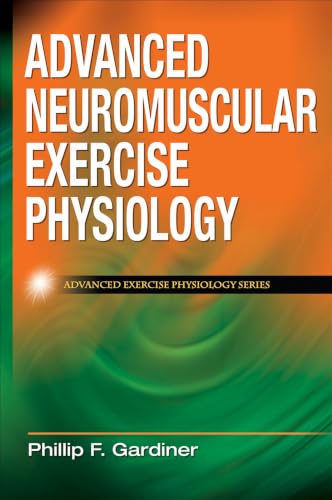

Advanced neuromuscular exercise physiology Phillip F. Gardiner.
Series Detalles de publicación: Champaign Human Kinetics c2011.Descripción: vii, 228 p. ill. 26 cmISBN:- 9780736074674 (hard cover)
- 0736074678 (hard cover)
- 612.044 G221a 22
- QP301 .G365 2011
- WE 500
| Imagen de cubierta | Tipo de ítem | Biblioteca actual | Biblioteca de origen | Colección | Ubicación en estantería | Signatura topográfica | Materiales especificados | Info Vol | URL | Copia número | Estado | Notas | Fecha de vencimiento | Código de barras | Reserva de ítems | Prioridad de la cola de reserva de ejemplar | Reservas para cursos | |
|---|---|---|---|---|---|---|---|---|---|---|---|---|---|---|---|---|---|---|
| Libro | Biblioteca Encarnación Valdés Colección General bev | 612.044 G221a (Navegar estantería(Abre debajo)) | Disponible | 80000002438102 |
Descripciones mejoradas de Syndetics:
Advanced Neuromuscular Exercise Physiology uses a mix of biochemistry, molecular biology, neurophysiology, and muscle physiology to provide a synthesis of current knowledge and research directions in the field. The first text devoted solely to the topic, Advanced Neuromuscular Exercise Physiology assists readers in identifying current directions in research and new avenues for exploration.
Recognizing the rapid changes occurring in the field of neuromuscular exercise physiology, the text provides readers with a foundation of knowledge while detailing the most recent findings. Though the text is written at an advanced level, the author succeeds at making the content accessible. Analyses of research findings and research applications are highlighted in special sidebars. Detailed illustrations and graphs assist readers in understanding research findings. Chapter summaries also help readers determine the key issues presented for each topic.
The author draws attention to a variety of important topics in the field, beginning with a discussion of motor unit types, muscle blood flow, and metabolic pathways in control of metabolism, including a special discussion of the effects of type 2 diabetes. Next, the topic of fatigue is discussed. The author explains possible peripheral and central contributors to fatigue. Chapters 6 and 7 focus on whole-body endurance training, including the effects of aerobic endurance training on the protein profiles of muscle fibers and on the central nervous system. Of particular interest is the applicability of research information to the exercise rehabilitation of individuals with compromised nervous system function, such as spinal cord injury, other trauma, and neuromuscular diseases. The final chapters are devoted to resistance training, including the phenotypic responses of muscles to isometric, slow isotonic, lengthening, and plyometric training. An overview of the effects of resistance training on the nervous system is offered along with clinical applications.
Within the dynamic field of neuromuscular exercise physiology, ideas of how nerves and muscles collaborate during acute and chronic exercise are continually evolving. Advanced Neuromuscular Exercise Physiology offers an authoritative perspective of current research in the field as it seeks to encourage discussion, further study, and new research directions.
Human Kinetics' Advanced Exercise Physiology Series offers books for advanced undergraduate and graduate students as well as professionals in exercise science and kinesiology. These books highlight the complex interaction of the various systems both at rest and during exercise. Each text in this series offers a concise explanation of the system and details how each is affected by acute exercise and chronic exercise training. Advanced Neuromuscular Exercise Physiology is the third volume in the series.
Includes bibliographical references and index.
Muscle fibers, motor units, and motoneurons -- Motor unit recruitment during different types of movements -- Muscle blood flow and metabolism -- Peripheral factors in neuromuscular fatigue -- Central factors in neuromuscular fatigue -- Muscular mechanisms in aerobic endurance training -- Neural mechanisms in aerobic endurance training -- Muscle molecular mechanisms in strength training -- Muscle property changes in strength training -- Neural mechanisms in strength training.
Tabla de contenidos provista por Syndetics
- Series Preface(p. ix)
- Preface(p. xi)
- Acknowledgments(p. xiv)
- Credits(p. xv)
- Chapter 1 Muscle Fibers, Motor Units, and Motoneurons(p. 1)
- Muscle Heterogeneity(p. 2)
- Orderly Motor Unit Recruitment(p. 7)
- Smaller Motoneurons Are More Excitable(p. 9)
- Membrane Resistivity and Motoneuron Size(p. 9)
- Other Factors Determining Action Potential Generation(p. 11)
- Minimal Firing Rates and Afterhyperpolarization Durations(p. 12)
- Motoneuron Current-Frequency Relationship and Excitability(p. 15)
- Late Adaptation(p. 17)
- Motoneuron PICs(p. 20)
- Summary(p. 23)
- Chapter 2 Motor Unit Recruitment During Different Types of Movements(p. 25)
- Measuring Human Motor Unit Recruitment(p. 25)
- Influence of Task(p. 27)
- Slow-Ramp Isometric Contractions(p. 28)
- Maintained Isometric Contractions(p. 32)
- Isometric Contractions in Various Directions(p. 34)
- Isometric Contractions Versus Movements(p. 35)
- Lengthening Contractions(p. 38)
- Cocontraction of Agonists and Antagonists(p. 40)
- Unilateral Versus Bilateral Contractions(p. 40)
- Rhythmic Complex Contractions(p. 41)
- Maximal Voluntary Contractions(p. 42)
- Summary(p. 44)
- Chapter 3 Muscle Blood Flow and Metabolism(p. 46)
- Muscle Blood Flow(p. 46)
- Muscle Metabolism(p. 53)
- Summary(p. 60)
- Chapter 4 Peripheral Factors in Neuromuscular Fatigue(p. 63)
- Intramuscular Factors and Muscle Force(p. 64)
- Involvement of Structures Other Than Muscle(p. 67)
- Research From Animal Experiments(p. 77)
- Summary(p. 80)
- Chapter 5 Central Factors in Neuromuscular Fatigue(p. 83)
- Motoneuron Activity During Sustained Contractions(p. 83)
- Isometric Versus Anisometric Tasks(p. 98)
- Rotation of Motor Units?(p. 99)
- Summary(p. 99)
- Chapter 6 Muscular Mechanisms in Aerobic Endurance Training(p. 101)
- Chronic Muscle Stimulation(p. 102)
- Coordination of Muscle Protein Systems(p. 104)
- Pretranslational Control(p. 106)
- Translational Control(p. 109)
- Posttransiational Modifications(p. 110)
- Simultaneous Expression of Isoforms(p. 112)
- Adaptations Can Occur Ex Vivo(p. 112)
- Adaptations Appear in a Specific Sequence(p. 112)
- Thresholds of Activity for Adaptation(p. 114)
- Chronic Stimulation and Atrophy(p. 115)
- Metabolic Signals and the Adaptive Response(p. 117)
- Degenerative and Regenerative Processes(p. 122)
- Summary(p. 122)
- Chapter 7 Neural Mechanisms in Aerobic Endurance Training(p. 125)
- Adaptation of the Neuromuscular Junction(p. 125)
- Responses of Motoneurons(p. 130)
- Adaptations of Spinal Cord Circuits(p. 134)
- Summary(p. 139)
- Chapter 8 Muscle Molecular Mechanisms in Strength Training(p. 141)
- Acute Responses in Protein Synthesis and Degradation(p. 142)
- Connective Tissue Responses(p. 155)
- Role of Muscle Damage(p. 156)
- Role of Dietary Supplements(p. 157)
- Summary(p. 158)
- Chapter 9 Muscle Property Changes in Strength Training(p. 161)
- Increased Muscle Fiber Cross-Sectional Area(p. 161)
- Fiber Type Composition(p. 162)
- Muscle Fiber Number(p. 163)
- Muscle Composition(p. 165)
- Muscle Architecture(p. 166)
- Muscle Fiber Ultrastructure(p. 166)
- Evoked Isometric Contractile Properties(p. 167)
- Changes in Muscle Force, Velocity, and Power(p. 169)
- Fatigue Resistance(p. 171)
- Role of Eccentric Contractions(p. 171)
- Summary(p. 173)
- Chapter 10 Neural Mechanisms in Strength Training(p. 175)
- Gains in Strength Versus Muscle Girth(p. 175)
- Strength Gains Show Task Specificity(p. 176)
- Surface EMG Response During MVC(p. 178)
- Imaginary Strength Training(p. 179)
- Reflex Adaptations(p. 179)
- Cross Education(p. 181)
- Decreased Activation of Antagonists(p. 183)
- Changes in Motor Unit Recruitment(p. 183)
- Changes in Motor Cortex(p. 186)
- Summary(p. 186)
- References(p. 189)
- Index(p. 225)
- About the Author(p. 229)
Notas de autor provistas por Syndetics
Phillip F. Gardiner, PhD , is a professor and director of the Health, Leisure & Human Performance Research Institute at the University of Manitoba in Winnipeg. He holds professorial positions in kinesiology and physiology and is a member of the Spinal Cord Research Center. Author of the Human Kinetics books Neuromuscular Aspects of Physical Activity (2001) and Skeletal Muscle Form and Function (coauthor, 2006), Dr. Gardiner has also published over 100 research articles on neuromuscular system adaptability.
In 2007, Dr. Gardiner received the highest award bestowed by the Canadian Society for Exercise Physiology, the CSEP Honour Award. He was also awarded a Tier I Canada Research Chair at the University of Manitoba in 2002, which was subsequently renewed for an additional 7 years following peer review in 2009.
Dr. Gardiner served as the president of the Canadian Society for Exercise Physiology and as coeditor in chief of the Canadian Journal of Applied Physiology. He is currently chair of the Advisory Board for the Institute of Musculoskeletal Health and Arthritis, part of the Canadian Institutes of Health Research.
Dr. Gardiner resides in Winnipeg, Manitoba, with his wife, Kalan, where he enjoys fly-fishing, brewing his own beer, playing piano, and wrestling with his two Labrador retrievers.