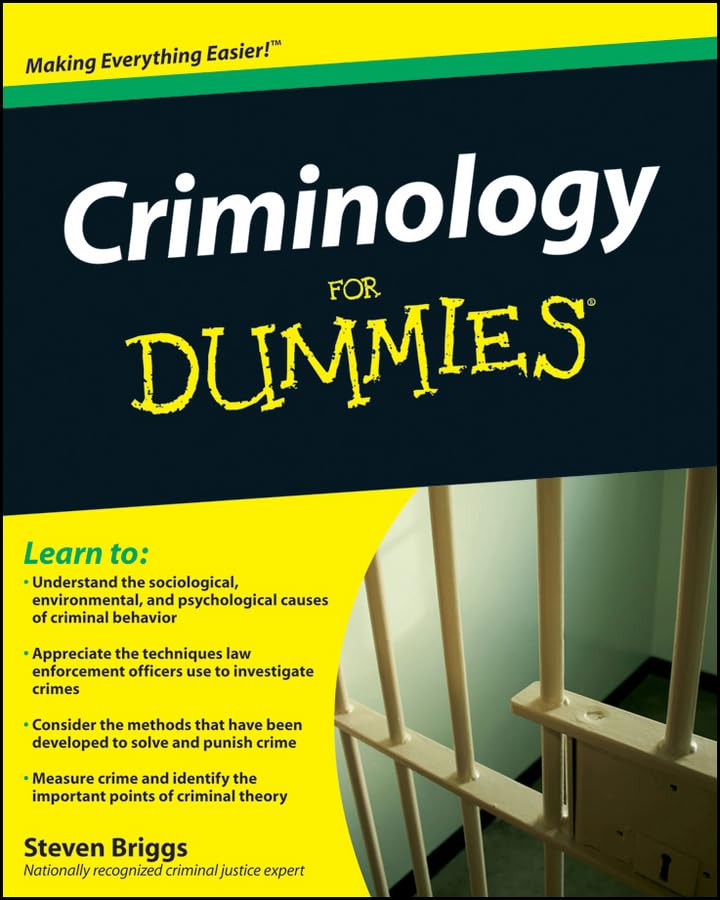

Criminology for dummies by Steven Briggs with Joan Friedman.
Detalles de publicación: Indianapolis,IN John Wiley puiblishing c2009.Descripción: 368 p. 23 cmISBN:- 9780470396964
| Imagen de cubierta | Tipo de ítem | Biblioteca actual | Biblioteca de origen | Colección | Ubicación en estantería | Signatura topográfica | Materiales especificados | Info Vol | URL | Copia número | Estado | Notas | Fecha de vencimiento | Código de barras | Reserva de ítems | Prioridad de la cola de reserva de ejemplar | Reservas para cursos | |
|---|---|---|---|---|---|---|---|---|---|---|---|---|---|---|---|---|---|---|
| Libro | Biblioteca de Mayagüez Colección General mb | HV 6025 .B75 2009 (Navegar estantería(Abre debajo)) | Disponible | 50000003198370 |
Descripciones mejoradas de Syndetics:
Your thorough guide to comprehending and combating crime
Are you fascinated by criminology, forensics, and detective work? This you-are-there guide takes you deep into the world of crime, giving you a better understanding of the dark recesses of the criminal mind and how law enforcement officials investigate crime. You'll gain real-world knowledge of the reasons for and consequences of crime, the way society responds to it, and, most important, how crime can be prevented.
Enter the world of crime -- understand what crime is, how it is measured, and the various ways crime affects victims and society
Identify different types of crime -- from white-collar crime to organized crime to terrorism, examine the nature of crime and why certain criminals are attracted to specific crimes
Know who commits crimes, and why -- explore different theories that attempt to explain why people commit crimes
Take it to the streets -- follow law enforcement officials and federal agencies as they chase and apprehend the bad guys
Seek justice -- meet the key players in the criminal justice system and see why and how the guilty are punished
Deal with juveniles -- know the differences between adult and juvenile systems, realize why youths are treated differently, and review modern methods for treatment
Open the book and find:
Common criminal traits
The causes of violent crimes
Recent efforts to secure victims' rights
The processes used to solve crimes
A step-by-step walkthrough of the criminal justice process
Ways to recognize and fight back against crime
Jobs in the criminal justice field
Ten notorious, unsolved crimes
Includes bibliographical index.
EIGM 03/2010
Tabla de contenidos provista por Syndetics
- Introduction
- Part I Defining and Measuring Crime
- Chapter 1 Entering the World of Crime
- Chapter 2 What Is Crime?
- Chapter 3 How Crime Is Measured and Why It Matters
- Chapter 4 Helping Those in the Wake of Crime: Victims
- Part II Identifying Types of Crime
- Chapter 5 Getting Violent: Crimes of Force
- Chapter 6 Hitting You in the Pocketbook: Property Crimes
- Chapter 7 Dressing Sharp and Stealing Big: White-Collar Crimes
- Chapter 8 A Group Effort: Organized Crime and Gangs
- Chapter 9 Tackling a Worldwide Problem: The Narcotics Trade
- Chapter 10 Front-Page News: Terrorism
- Part III Figuring Out Who Commits Crimes and Why
- Chapter 11 What Factors Lead to Crime?
- Chapter 12 Regarding Crime as a Rational Decision: Rational Choice Theory
- Chapter 13 Looking at Societys Role in Crime
- Chapter 14 Can Your Mind or Body Make You a Criminal?
- Chapter 15 Critical Theory: Theories off the Beaten Path
- Part IV Fighting Crime
- Chapter 16 Battling Crime at the Local Level
- Chapter 17 Tackling Crime at the Federal Level
- Chapter 18 Solving Crimes: The Process
- Part V Prosecuting and Punishing Crime
- Chapter 19 Seeking Justice: The Players and Their Roles
- Chapter 20 Finding the Truth: Pleading Guilty or Going to Trial
- Chapter 21 Punishing the Guilty: Why and How Society Does It
- Chapter 22 Examining the Juvenile Justice System
- Part VI The Part of Tens
- Chapter 23 Ten Jobs to Consider in Criminal Justice
- Chapter 24 Ten Notorious, Unsolved Crimes
- Index