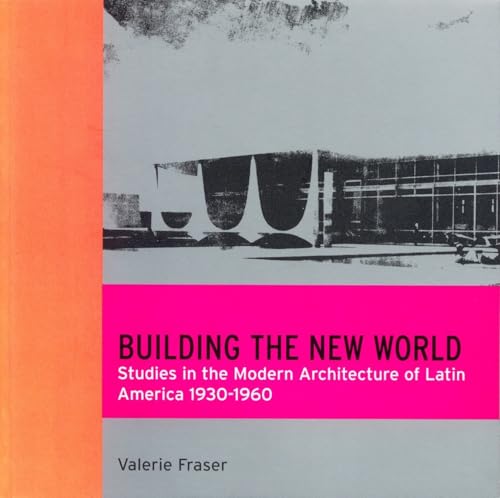

Building the new world studies in the modern architecture of Latin America, 1930-1960 Valerie Fraser. txt
Idioma: Inglés London ; New York : Verso 2000Descripción: vii, 280 p., [16] p. of plates ill. (some col.) 20 cmTipo de contenido:- text
- unmediaded
- volume
- 1859843077 (pbk.)
- 9781859843079
- 1859847870
- 720/.98/0904 21
- NA702.5 F73 2000
| Imagen de cubierta | Tipo de ítem | Biblioteca actual | Biblioteca de origen | Colección | Ubicación en estantería | Signatura topográfica | Materiales especificados | Info Vol | URL | Copia número | Estado | Notas | Fecha de vencimiento | Código de barras | Reserva de ítems | Prioridad de la cola de reserva de ejemplar | Reservas para cursos | |
|---|---|---|---|---|---|---|---|---|---|---|---|---|---|---|---|---|---|---|
| Libro | CARIBET Biblioteca Arquitectura Colección General CARIBET | General NA702.5 F73 2000 (Navegar estantería(Abre debajo)) | 1 | Disponible | 91000000033126 |
Descripciones mejoradas de Syndetics:
The period between 1930 and 1960 in particular saw a dramatic upsurge in Latin American modern architecture as the various governments strove to make public their modernising intentions. After 1960, however, the year in which Brasilia was inaugurated, economic growth in the region slowed and the modernist project faltered. The English-speaking world, which had previously admired Latin American buildings, began to write them out of the history of twentieth-century architecture. Building the New World attempts to redress the balance. It surveys the most important examples of state-funded modernism in Latin America during a period of almost unimaginable optimism, when politicians and architects such as Pani, Costa, Reidy and Niemeyer sought ways, literally, to build their societies out of underdevelopment.
Include index.
Includes bibliographical references (p. [274]-276) and index.
Contets:
Preaface and Acknoledements
Introduction
The Modern Movement in architecture aud urbanism
Translating European theory into Latin American practice
The USA and latin American Practice
The USA and Latin American Modern Architecture
Building new worlds
MEXICO
Vascocelos, Muralism and noecolonial Architecture
Architecture and revolution
Social Housing
The Ciudad Universitaria
Parallel currents
VENEZUELA
Ecleticism under Gómez and beyond
El Silencio
Centro Bolivar
The Banco Obrero superblocks of the 1950
The Caracas Metro: urban integration
BRAZIL
Rio de Janeiro and Beyond
The urban evolution of the Ministerio da Educacao e Saúde building
Theorigins of modern architecture in Rio
Niemeyer and Kubischeck at Pampulha
Social housing in Rio de Janeiro
Cidade Universitariá
Cidade dos Motores
Brasilia
The Origins Brasilia
Failure and of Brasilia
Aftermath
Notes
Select Bibliography
Index
"Brasilia, Caracas, Mexico City, Rio de Janeiro ... cities synonymous with some of the most innovative and progressive architecture of the past century. The period between 1939 and 1960 in particular saw a dramatic upsurge in Latin American modern architecture as the various governments strove to make public their modernising intentions. After 1960, however, the year in which Brasilia was inaugurated, economic growth in the region slowed and the modernist project faltered. The English-speaking world, which had previously admired Latin American buildings, began to write them out of the history of twentieth-century architecture. Building the New World attempts to redress the balance. It surveys the most important examples of state-funded modernism in Latin America during a period of almost unimaginable optimism, when politicians and architects such as Pani, Costa, Reidy and Niemeyer sought ways, literally, to build their societies out of underdevelopment."--Jacket