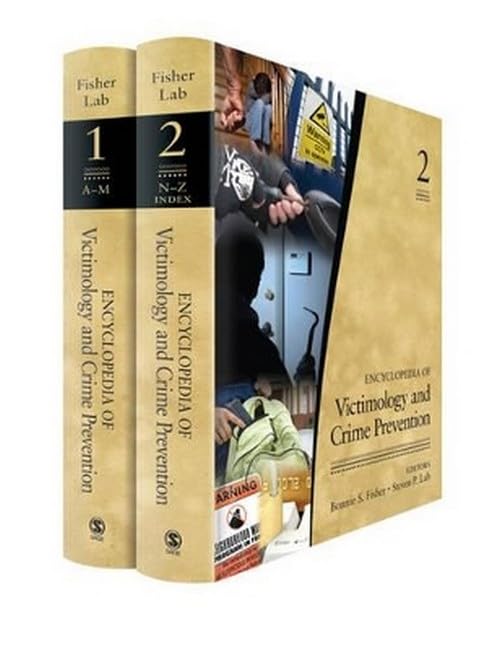

Encyclopedia of victimology and crime prevention editors, Bonnie S. Fisher, Steven P. Lab.
Detalles de publicación: Thousand Oaks, Calif. SAGE Publications c2010.Descripción: 2 v. (xxxv, 1174 p.) ill., maps 29 cmISBN:- 9781412960472 (alk. paper)
- 1412960479 (alk. paper)
- 362.880973/03 22
- HV6250.3.U5 E55 2010
| Imagen de cubierta | Tipo de ítem | Biblioteca actual | Biblioteca de origen | Colección | Ubicación en estantería | Signatura topográfica | Materiales especificados | Info Vol | URL | Copia número | Estado | Notas | Fecha de vencimiento | Código de barras | Reserva de ítems | Prioridad de la cola de reserva de ejemplar | Reservas para cursos | |
|---|---|---|---|---|---|---|---|---|---|---|---|---|---|---|---|---|---|---|
| Libro | Biblioteca Encarnación Valdés Sala de Referencia bev | 362.88 E5636 (Navegar estantería(Abre debajo)) | v.1 | Disponible | 80000002409475 | |||||||||||||
| Libro | Biblioteca Encarnación Valdés Sala de Referencia bev | 362.88 E5636 (Navegar estantería(Abre debajo)) | v.2 | Disponible | 80000002409483 |
Descripciones mejoradas de Syndetics:
For a free 30-day online trial to this title, visit www.sagepub.com/freetrial In many ways, the two fields of victimology and crime prevention have developed along parallel yet separate paths, and the literature on both has been scattered across disciplines as varied as sociology, law and criminology, public health and medicine, political science and public policy, economics, psychology and human services, and others. The Encyclopedia of Victimology and Crime Prevention brings together in one authoritative resource the dispersed information and knowledge on both victimology and crime prevention. With nearly 375 entries, this two-volume set moves victimology and crime prevention one step further into recognized scholarly fields whose research informs practice and whose practice informs research.
Key Features
Provides users with the most authoritative and comprehensive coverage available on victimology and crime prevention Presents victimology and crime prevention as their own separate, justifiable disciplines rather than subfields within more established disciplines Discusses the status of victims within the criminal justice system, as well as topics of deterring and preventing victimization in the first place and responding to victims′ needs Offers "anchor essays" written by leading scholars in their respective fields to provide starting points for investigating the more salient victimology and crime prevention topicsKey Themes
Business Prevention Actions Civil Justice System Correlates of Victimization Courts: Alternative Remedies Courts: Law and Justice Crime Prevention Crime Prevention Partnerships Criminal Justice System Fear of Crime Individual Protection Actions Interventions and Intervention Programs for Victim and Offender Intrafamilial Offenses Legislation and Statutes Media and Crime Prevention Methodology Offenses, Special Topics Official Crime Data Personal Offenses Property Offenses Psychological, Mental, and Physical Health Issues Residential Community Crime Prevention School and Workplace Offenses School-Based Crime Prevention Services and Treatment for Victims Theory Victimization Scales and Surveys Victimology Youth-Focused Crime PreventionThe victimology-crime prevention nexus provides the foundation for a comprehensive and, hopefully, long-lasting approach to addressing the public′s risk of being victimized and aids individuals who are targeted by a criminal act. This is a welcome addition to any academic library. The availability in print and electronic formats provides students with convenient, easy access wherever they may be.
v. 1. A - M -- v. 2. N - Z, Index.
From the Publisher: In many ways, the two fields of victimology and crime prevention have developed along parallel yet separate paths, and the literature on both has been scattered across disciplines as varied as sociology, law and criminology, public health and medicine, political science and public policy, economics, psychology and human services, and others. The Encyclopedia of Victimology and Crime Prevention brings together in one authoritative resource the dispersed information and knowledge on both victimology and crime prevention. With nearly 375 entries, this two-volume set moves victimology and crime prevention one step further into recognized scholarly fields whose research informs practice and whose practice informs research. Key Features: Provides users with the most authoritative and comprehensive coverage available on victimology and crime prevention. Presents victimology and crime prevention as their own separate, justifiable disciplines rather than subfields within more established disciplines. Discusses the status of victims within the criminal justice system, as well as topics of deterring and preventing victimization in the first place and responding to victims' needs. Offers "anchor essays" written by leading scholars in their respective fields to provide starting points for investigating the more salient victimology and crime prevention topics. Key Themes: Business Prevention Actions, Civil Justice System, Correlates of Victimization, Courts: Alternative Remedies, Courts: Law and Justice, Crime Prevention, Crime Prevention Partnerships, Criminal Justice System, Fear of Crime, Individual Protection Actions, Interventions and Intervention Programs for Victim and Offender, Intrafamilial Offenses, Legislation and Statutes, Media and Crime Prevention, Methodology, Offenses, Special Topics, Official Crime Data, Personal Offenses, Property Offenses, Psychological, Mental, and Physical Health Issues, Residential Community Crime Prevention, School and Workplace Offenses, School-Based Crime Prevention, Services and Treatment for Victims, Theory, Victimization Scales and Surveys, Victimology, and Youth-Focused Crime Prevention. The victimology-crime prevention nexus provides the foundation for a comprehensive and, hopefully, long-lasting approach to addressing the publics risk of being victimized and aids individuals who are targeted by a criminal act. This is a welcome addition to any academic library. The availability in print and electronic formats provides students with convenient, easy access wherever they may be.
Includes bibliographical references and index.
Reseñas proporcionadas por Syndetics
Library Journal Review
Defining victimology as "issues related to actions that fall under the criminal law," this two-volume set features 373 signed, alphabetically arranged articles that are accessible via a comprehensive index and a topical guide. Rather than a table of contents, both volumes include a list of entries identifying the 11 anchor articles that run 5000 words in length and the shorter 1000- to 3000-word essays. Topics range from "Reassurance Policing" and "Neighborhood Watch Programs" to "Football Hooliganism" and "Victim Blaming"; several feature charts, graphs, or maps. Each signed article includes See also references (also found in the detailed index), a suggested reading bibliography, and recommended websites (a feature in the appendix as well). While the majority of the 331 contributors are from U.S. academic institutions, a few contributors represent views from England, the West Indies, Canada, and Israel. The Contributors Index identifies the authors by name and institutional affiliation or a vague title such as Independent Consultant. This work could be improved by a commitment to either go global throughout the set or limit the title to the United States. Plenty of current, accurate titles on both subjects exist, but this is the first work to link crime prevention and victimology overtly in one resource. Criminal justice professors Fisher (Univ. of Cincinnati) and Lab (Bowling Green State Univ.) have edited and authored numerous books and journal articles on this topic. BOTTOM LINE Those studying law enforcement, the judicial system, victim's services, criminal justice, and social services as well as victims caught in the criminal justice system will find this helpful. Purchase where needed.-Laurie Selwyn, formerly with Grayson Cty. Law Lib., Sherman, TX (c) Copyright 2010. Library Journals LLC, a wholly owned subsidiary of Media Source, Inc. No redistribution permitted.CHOICE Review
This encyclopedia features some 370 signed articles by leading authorities and practitioners on topics within the separate but complementary fields of victimology and crime prevention. A short bibliography attached to each article guides further research and investigation. According to the editors, the aim is to develop a synergy between the two fields where "research informs practice and practice informs research." Although this two-volume set is organized in the traditional A to Z format, a reader's guide in the front of volume 1 groups together articles on related thematic topics (28 in all); individual articles also have cross-references to related topics. Special features include appendixes identifying key agencies/organizations and sources of electronic information dealing with victimization, victims of crime, and crime prevention; a chronology of key events, laws, and developments; and a very detailed index. This set will be useful for colleges and universities supporting programs in criminology or law, feminist studies, psychology and human services, political science and public policy, and sociology. It is also offered electronically through Sage Reference Online (CH, Mar'10, 47-3536). Summing Up: Recommended. Lower-level undergraduates and above. J. J. Harrison Michigan State UniversityBooklist Review
Although humans have experienced crime since the beginning of history, the ideas of crime prevention (stopping crime before it happens) and victimology (studying and aiding those who have suffered from crime) are relatively new concepts. Other reference works touch on these two fields, but this is the first encyclopedia to focus on victimization and prevention within the broader field of criminal justice. Entries cover a wide array of topics, including methods for preventing crime, the psychology and fear of crime, domestic violence, legislation, school and workplace violence, measurement scales and surveys, and theoretical issues in the field. Entries tend to be academic in nature, covering the theory and research behind each topic. Each entry has a bibliography for further reading. Appendixes provide lists of organizations and government agencies and a time line of historical developments in the field. A Reader's Guide serves as a classified index, grouping the entries under 28 general topical headings. Although this is the first comprehensive reference work in these two areas of study and it fills a gap within the broader discipline of criminal justice, its academic nature will make it too specialized for many libraries. Recommended for academic libraries with criminology and criminal justice collections. Also available as an e-book.--Tyckoson, David Copyright 2010 BooklistNotas de autor provistas por Syndetics
Bonnie S. Fisher is a Professor in the Division of Criminal Justice and Research Fellow in the Center for Criminal Justice Research at the University of Cincinnati. Professor Fisher received her Ph.D. (1988) in Political Science from Northwestern University. She is a nationally recognized expert in the areas of sexual, violent and stalking victimization of college women, including repeat victimization, self-protection effectiveness, and fear of crime, and how post-secondary schools' respond to reports of sexual victimization. She has authored more than 150 publications in national and international peer-reviewed criminology, criminal justice, crime prevention, gerontology, legal, medical, methodological, nursing, urban planning, public administration, psychology, security, and victimology periodicals. She also has edited three volumes that focus on victimization issues: Encyclopedia of Victimology and Crime Prevention; Campus Crime (with Steven P. Lab) ; Legal, Social and Political Perspectives, 2ndedition (with John Sloan, III); Violence Against Women and Family Violence; and Developments in Research, Practice, and Policy. She has been the co-editor of the Security Journal since 1998. She has served as the Deputy Editor of Justice Quarterly and since 2008 has been the Associate Editor of the Journal of Research Crime and Delinquency . She has been the Principal Investigator or Co-PI on several U.S. Department of Justice grants examining a range of college student victimization issues and on a grant from the British Home Office to examine college student victimization in the East Midlands, United Kingdom. Currently she is a Co-PI on a National Institute of Health grant examining forensic sexual examinations and the use of digital images and staining techniques to enhance the detection of injuries and the use of digital images in decision making among the police, prosecutors, defense attorneys, judges and juries in the criminal justice process.
Steven P. Lab (Ph.D., Criminology, Florida State University, 1982) has been a member of the Criminal Justice faculty at Bowling Green State University since 1987 and is currently Professor and Director of the Criminal Justice Program and Chair of the Department of Human Services. Dr. Lab is a nationally recognized expert in the area of crime prevention and is the author of Crime Prevention: Approaches, Practices and Evaluations, Fifth Edition. His research interests also include juvenile delinquency, school crime, and victims of crime. He is the author of over three dozen articles or book chapters and author or editor of 5 books. He has also served as editor of the Journal of Crime and Justice. Dr. Lab is a regular consultant for the National Institute of Justice on research and funding activities in the areas of crime prevention, community policing, school crime, gang behavior and interventions, and police partnerships to address crime. He is currently leading an effort to develop a 5-year strategic plan to direct NIJ funding in the area of crime prevention. Dr. Lab is a Past President of the Academy of Criminal Justice Sciences and has served in many other capacities for ACJS, the Midwestern Criminal Justice Association, the Ohio Council of Criminal Justice Educators, and the Police Section of ACJS.