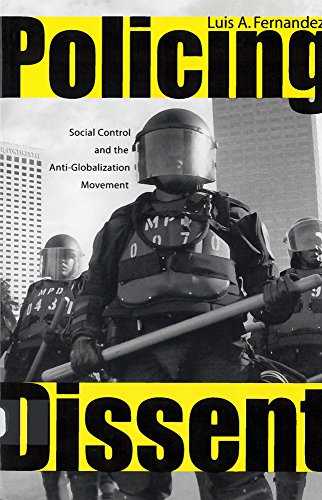

Policing dissent social control and the anti-globalization movement Luis A. Fernandez.
Series Critical issues in crime and societyDetalles de publicación: New Brunswick, N.J. Rutgers University Press c2008.Descripción: x, 192 p. ill. 22 cmISBN:- 9780813542157 (pbk. : alk. paper)
- 0813542154 (pbk. : alk. paper)
- 363.32/30973 22
- HV8138 .F454 2008
| Imagen de cubierta | Tipo de ítem | Biblioteca actual | Biblioteca de origen | Colección | Ubicación en estantería | Signatura topográfica | Materiales especificados | Info Vol | URL | Copia número | Estado | Notas | Fecha de vencimiento | Código de barras | Reserva de ítems | Prioridad de la cola de reserva de ejemplar | Reservas para cursos | |
|---|---|---|---|---|---|---|---|---|---|---|---|---|---|---|---|---|---|---|
| Libro | Biblioteca Encarnación Valdés Colección General bev | 363.323 F3631p (Navegar estantería(Abre debajo)) | Disponible | 80000002438144 |
Descripciones mejoradas de Syndetics:
In November 1999, fifty-thousand anti-globalization activists converged on Seattle to shut down the World Trade Organization's Ministerial Meeting. Using innovative and network-based strategies, the protesters left police flummoxed, desperately searching for ways to control the emerging anti-corporate globalization movement. Faced with these network-based tactics, law enforcement agencies transformed their policing and social control mechanisms to manage this new threat.
Policing Dissent provides a firsthand account of the changing nature of control efforts employed by law enforcement agencies when confronted with mass activism. The book also offers readers the richness of experiential detail and engaging stories often lacking in studies of police practices and social movements. This book does not merely seek to explain the causal relationship between repression and mobilization. Rather, it shows how social control strategies act on the mind and body of protesters.
Includes bibliographical references (p. 177-188) and index.
Protest, control, and policing -- Perspectives on the control of dissent -- The anti-globalization movement -- Managing and regulating protest : social control and the law -- This is what democracy looks like? : the physical control of space -- "Here come the anarchists" : the psychological control of space -- Law enforcement and control.
Tabla de contenidos provista por Syndetics
- Acknowledgments(p. ix)
- 1 Protest, Control, and Policing(p. 1)
- 2 Perspectives on the Control of Dissent(p. 19)
- 3 The Anti-Globalization Movement(p. 35)
- 4 Managing and Regulating Protest: Social Control and the Law(p. 68)
- 5 This Is What Democracy Looks Like?: The Physical Control of Space(p. 92)
- 6 "Here Come the Anarchists": The Psychological Control of Space(p. 138)
- 7 Law Enforcement and Control(p. 165)
- Notes(p. 173)
- Bibliography(p. 177)
- Index(p. 189)