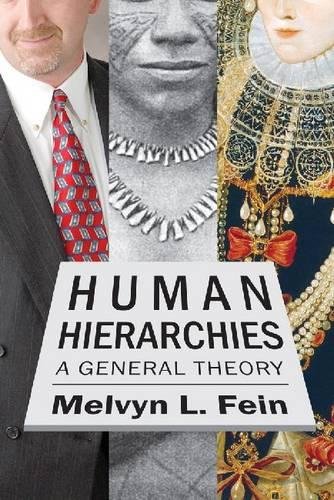

Human hierarchies a general theory Melvyn L. Fein.
Detalles de publicación: New Brunswick Transaction Publishers c2012.Descripción: xiii, 393 p. 24 cmISBN:- 9781412845960
- 305.512 F2991h 23
- HM821 .F45 2012
| Imagen de cubierta | Tipo de ítem | Biblioteca actual | Biblioteca de origen | Colección | Ubicación en estantería | Signatura topográfica | Materiales especificados | Info Vol | URL | Copia número | Estado | Notas | Fecha de vencimiento | Código de barras | Reserva de ítems | Prioridad de la cola de reserva de ejemplar | Reservas para cursos | |
|---|---|---|---|---|---|---|---|---|---|---|---|---|---|---|---|---|---|---|
| Libro | Biblioteca Encarnación Valdés Colección General bev | 305.512 F2991h (Navegar estantería(Abre debajo)) | Disponible | 80000002464520 |
Descripciones mejoradas de Syndetics:
Human beings are hierarchical animals. Always and everywhere, people have developed social ranking systems. These differ dramatically in how they are organized, but the underlying causal mechanisms that create and sustain them are the same. Whether they are on the top or bottom of the heap, people attempt to be superior to some other persons or group. This is the root of Melvyn L. Fein's thesis presented in Human Hierarchies: A General Theory.
Fein traces the development of changes from hunter-gatherer times to our own techno-commercial society. In moving from small to large communities, humans went from face-to-face contests for superiority to more anonymous and symbolic ones. Societies evolved from hunting bands where the parties knew each other through big-men societies, chieftainships, agrarian empires, patronage chains, caste societies, estate systems, and market-oriented democracies. Where once small groupings were organized primarily by strong forces such as personal relationships, the now standard large groupings are more dependent on weaker forces such as those provided by social roles.
Bureaucracies and professional roles have become prominent. Bureaucracies allow large-scale organizations to maintain control of people by limiting the potential destructiveness of unregulated tests of strength and by clarifying chains of command. Their rigidity and unresponsiveness requires that they be supplemented by professional roles. At the same time, a proliferation of self-motivated experts delegate authority downward, thereby introducing a more flexible decentralization. This analysis is a unique and significant advance in both the sociology and anthropology of stratification among humans.
Includes bibliographical references and index.
Tabla de contenidos provista por Syndetics
- Introduction(p. vii)
- 1 Hierarchy and Science(p. 1)
- Causal Mechanisms
- The Moralistic Imperative
- The Neo-Marxist Hegemony
- Science versus Philosophy.
- 2 A Hierarchical Animal(p. 27)
- The Universality of Hierarchy
- A Biological Imperative
- Functionalism versus Teleology
- Hierarchical Functions.
- 3 The Mechanisms of Hierarchy(p. 61)
- From Neo-Marxist to Post-Weberian
- Tests of Strength
- Reputations
- Dominance and Submission
- Forms of Power
- Social Distance.
- 4 A Profile of Relative Strengths(p. 99)
- The Indeterminacy Principle
- Areas of Strength
- Anonymous Alliances.
- 5 Hierarchical Changes(p. 135)
- Social Generalists
- Dimensions of Change
- Mechanisms of Change
- The Sequencing of Changes.
- 6 Historical Trends(p. 169)
- A Succession of Historical Eras
- The Succession of Civilizations
- Social Leadership
- Status Strata
- Hierarchical Collapses.
- 7 Bureaucracies and Professionalism(p. 205)
- Organizational Hierarchies
- Bureaucratic Organizations
- The Limitations of Bureaucracy
- Professionalism
- Bureaucracies versus Professionals.
- 8 The Middle-Class Ascendancy(p. 239)
- The Middle-Class Revolution
- Special Knowledge
- Professional Authority
- Professionalized Socialization and Culture
- Self-Discipline
- Code of Ethics.
- 9 The Working and Lower Classes(p. 273)
- Plato's Dilemma
- Social Losers
- Socialization and Inequality
- Non-Professionalization.
- 10 On Loss and Social Mobility(p. 309)
- Not Money
- Status Scripts
- Resocialization
- Rites of Passage.
- Epilogue: Age and Gender(p. 343)
- Gerontocracies
- The Male Hegemony.
- Bibliography(p. 357)
- Index(p. 385)
Reseñas proporcionadas por Syndetics
CHOICE Review
Starting from a position that takes as given a liberal, "neo-Marxist" orientation in the social sciences, Fein (Kennesaw State Univ.) argues that this has wrongly shifted focus from the scientific study of hierarchies in human societies to a philosophical and moralistic construction of inequalities, and seeks to recuperate a scientific view of hierarchy as innately human, probably biologically determined. Those who see conservative values as marginalized and penalized in contemporary academia will find resonance with these arguments, while some of the formulations of "liberal" positions and the invective used against them will likely turn others off. The absence of citations in the text makes it difficult at times to determine which sources are being used (or neglected) and where arguments may be original or borrowed; the reasonably extensive bibliography similarly is unclear: are these works of inspiration, for further reading, direct sources, or any or all of the above? Summing Up: Recommended. Graduate students/faculty. F. W. Gleach Cornell UniversityNotas de autor provistas por Syndetics
Melvyn L. Fein is professor of sociology at Kennesaw State University in Georgia. In addition to being editor of the Journal of Public and Professional Sociology, he is the author of numerous books, including Human Hierarchies and On Loss and Losing (both published by Transaction).