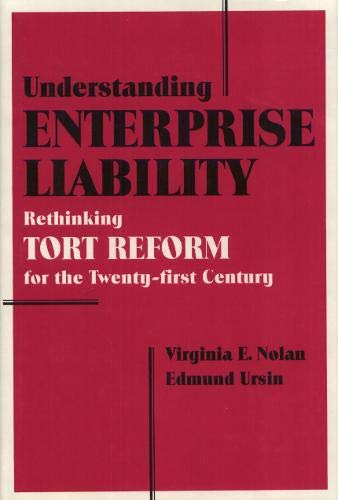

Understanding enterprise liability rethinking tort reform for the Twenty-first Century Virginia E. Nolan, Edmund Ursin.
Detalles de publicación: Philadelphia Temple University Press 1995.Descripción: ix, 254 pages 22 cmTipo de contenido:- 1566392306
- 9781566392303
- 346.7303 347.3063 20
- KF 1300 .N65 1995
| Imagen de cubierta | Tipo de ítem | Biblioteca actual | Biblioteca de origen | Colección | Ubicación en estantería | Signatura topográfica | Materiales especificados | Info Vol | URL | Copia número | Estado | Notas | Fecha de vencimiento | Código de barras | Reserva de ítems | Prioridad de la cola de reserva de ejemplar | Reservas para cursos | |
|---|---|---|---|---|---|---|---|---|---|---|---|---|---|---|---|---|---|---|
| Libro | Biblioteca de Derecho Mons. Fremiot Torres Oliver Colección General biblioteca derecho | KF 1300 .N65 1995 (Navegar estantería(Abre debajo)) | Disponible | 70000000608633 |
Descripciones mejoradas de Syndetics:
In recent years critics have assailed the cost, inefficiency, and unfairness of American tort law, including products liability and medical malpractice. Yet victims of accidental injury who look to the tort system for deserved compensation often find it a formidable obstacle. Those who seek to reform tort law find legislatures, particularly the United States Congress, paralyzed by the clash of powerful special interest groups.
Understanding Enterprise Liability sheds new light on the raging tort reform debate by challenging its fundamental assumptions. Offering historical insights and fresh perspectives on the politics and possibilities for sensible reform, Virginia Nolan and Edmund Ursin pragmatically assess alternative routes to a workable, balanced, and equitable system of compensation for personal injury. They offer a specific proposal, based on the precedent of strict products liability that incorporates the insights of no-fault compensation plan scholarship to create an enterprise liability doctrine that should appeal to courts and to tort reformers.
Includes bibliographical references (pages 179-241) and index.
pt. I. Enterprise Liability: An Introduction. 1. Contemporary Tort Reform and Enterprise Liability. 2. Traditional Tort Theory and Enterprise Liability: An Overview -- pt. II. The Compensation Plan Strategy. 3. Workers' Compensation Plans and Enterprise Liability. 4. Leon Green: Explication and Application. 5. The Columbia Plan and Dashed Hopes. 6. Renewed Focus on Compensation Plans in the 1950s. 7. The Keeton-O'Connell Plan, Legislative Successes, and Proposed Extensions of No-Fault. 8. Dashed Hopes (Again) and the Need for Alternatives -- pt. III. The Common Law Strategy. 9. Leon Green and the "Tort" Version. 10. Karl Llewellyn and the "Sales Law" Version: Strict Products Liability Proposed. 11. Perspectives on Courts and Legislatures: The 1930s. 12. Increased Focus on the Common Law: The 1940s. 13. The Possibility of a Judicially Created Strict Enterprise Liability. 14. Strict Products Liability: Recognition and Adoption. 15. The Damages Agenda of the 1950s.
In recent years critics have assailed the cost, inefficiency, and unfairness of American tort law, including products liability and medical malpractice. Yet victims of accidental injury who look to the tort system for deserved compensation often find it a formidable obstacle. Those who seek to reform tort law find legislatures, including the United States Congress, paralyzed by the clash of powerful special interest groups. Understanding Enterprise Liability sheds new light on the tort reform debate by challenging its fundamental assumptions. Offering historical insight and fresh perspectives on the politics and possibilities for sensible reform, Virginia Nolan and Edmund Ursin pragmatically assess alternative routes to a workable, balanced, and equitable system of compensation for personal injury.
Tort reformers commonly equate "enterprise liability" with strict products liability and other expansive tort developments of recent decades. Damages reform and no-fault alternatives are, in turn, seen as a repudiation of a failed theory of enterprise liability. In contrast, the authors demonstrate that both strict product liability and no-fault compensation plans are a product of the enterprise liability theory first articulated early in this century by Leon Green and Karl Llewellyn. As the theory of enterprise liability matured, damages reform became an integral part of the enterprise liability agenda, establishing that both no-fault and damages reform are an aspect, not a repudiation, of enterprise liability theory.
Nolan and Ursin examine proposals to displace tort law by no-fault schemes, including the medical no-fault proposal of the American Law Institute's Reporters' Study on Enterprise Responsibility for Personal Injury. Noting that even automobile no-fault plans have been blocked by special interests and legislative stalemate, the authors suggest that we rethink the common assumption that courts have no role to play in tort reform. Their own specific proposal, based on the precedent of strict products liability, incorporates the insights of no-fault compensation plan scholarship to create an enterprise liability doctrine that should appeal to courts and to tort reformers.
Notas de autor provistas por Syndetics
Virginia E. Nolan is Professor of Law at the University of San Diego Law School.Edmund Ursin is Professor of Law at the University of San Diego Law School.
Together they have authored numerous law review and popular articles, as well as the California Trial Lawyers Association's amicus brief in Becker v. IRM Corporation that led the California Supreme Court in 1985 to extend the strict products liability theory beyond products to apply to landlords.