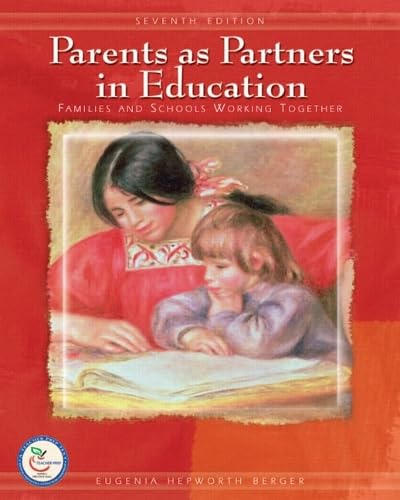

Parents as partners in education families and schools working together Eugenia Hepworth Berger.
Detalles de publicación: Upper Saddle River, New Jersey Pearson/Prentice Hall 2008.Edición: 7th edDescripción: 488 p. 25 cmISBN:- 9780132286701 (pbk.)
| Imagen de cubierta | Tipo de ítem | Biblioteca actual | Biblioteca de origen | Colección | Ubicación en estantería | Signatura topográfica | Materiales especificados | Info Vol | URL | Copia número | Estado | Notas | Fecha de vencimiento | Código de barras | Reserva de ítems | Prioridad de la cola de reserva de ejemplar | Reservas para cursos | |
|---|---|---|---|---|---|---|---|---|---|---|---|---|---|---|---|---|---|---|
| Libro | Biblioteca Mons. Iñaki Mallona (Arecibo) Colección General ab | 371.19 B496p7 (Navegar estantería(Abre debajo)) | Disponible | 60000010090394 |
Descripciones mejoradas de Syndetics:
For courses in Parents/Home-School Relations in Early Childhood Education and Elementary Education. Parents as Partners in Education: Families and Schools Working Together, seventh edition, is the most comprehensive book on the market covering the history of parenting and parent/school collaboration, current issues and population trends affecting American schools and communities, diverse family structures, and techniques for establishing a connection with parents and encouraging involvement with their child's learning. Many chapters also feature sample case studies of children. Throughout, students will find useful illustrations, summaries, review questions, and Web links. Following the introductory chapter that provides a rationale for strong family involvement, Chapter 2 provides an overview of population and immigration trends, diverse family structures. Chapter 3 discusses ways to understand the community with which professionals work, cultural diversity, and the diverse ethnic groups that compose American communities. An historical overview of family life and parent involvement follows in Ch. 4. effective home-school-community relationships, communication and parent programs, and developing collaborative relationships with parents. Presentation on school-based parent involement programs and home-based parent involvement programs follow in Chapters 8 and 9. The text ends with three chapters on working with parents of a child with disabilities (to understand processes in schools, parents' rights, and laws in special education), child abuse (including bullying and ways to spot and intervene in abuse situations), and children's and parents' rights and advocacy.
Includes bibliographical references and index.
Tabla de contenidos provista por Syndetics
- Chapter 1 Family Involvement-Essential for a Child's Development
- Chapter 2 Families and Communities: Overview, Trends, and Insights
- Chapter 3 Working with Culturally Diverse Groups
- Chapter 4 Historical Overview of Family Life, Diverse Famlies, and Parent Involvement
- Chapter 5 Effective Home-School-Community Relationships
- Chapter 6 Communication and Parent Programs
- Chapter 7 Collaborative Leadership-Working with Parents
- Chapter 8 School-Based Programs
- Chapter 9 Home-Based Programs
- Chapter 10 Working with Parents of a Child with Disabilities
- Chapter 11 The Abused Child
- Chapter 12 Rights, Responsibilities, and Advocacy
- Bibliography
- Index
Extracto provisto por Syndetics
Notas de autor provistas por Syndetics
Eugenia Hepworth Berger became interested in parent involvement when she and her husband, Glen, became the parents of three children who attended public schools. A professional in early childhood education, sociology, family-life education, and parent education for 30 years, she has two master's degrees and a Ph.D. in sociological foundations of education. Eugenia is active in many professional organizations, including the Association for Childhood Education International, the National Council on Family Relations, the National Association for the Education of Young Children (life member), the National Council for Social Studies, and the American Sociological Association. In 1994-1995 she served on the board of the National Association of Early Childhood Teacher Educators. She has been a board member of the Colorado Association for Childhood Education, served as president of the Rocky Mountain Council on Family Relations for three years, and served on the board of the Colorado Association for the Education of Young Children, 1998-2001. She has coordinated many conferences, ranging from the Colorado Year of the Child in 1979 to ACEI and RMCF state conferences in the 1980s and 1990s. Prior to becoming a college professor, she was a public school teacher and director of a parent education program. A faculty member at Metropolitan State College of Denver since 1968, she wrote the early childhood education certification program and the minor in early childhood, and coordinated the early childhood education program for eight years. She retired in December 1997 and is now professor emerita of education.
Dr. Berger has been elected to a variety of honorary associations, including Pi Kappa Lambda, Mortar Board, Mu Phi Epsilon, Pi Lambda Theta, and Kappa Delta Pi. She received the Distinguished Service Award from Metropolitan State College of Denver. She is included in Who's Who in the West and Who's Who of American Women.