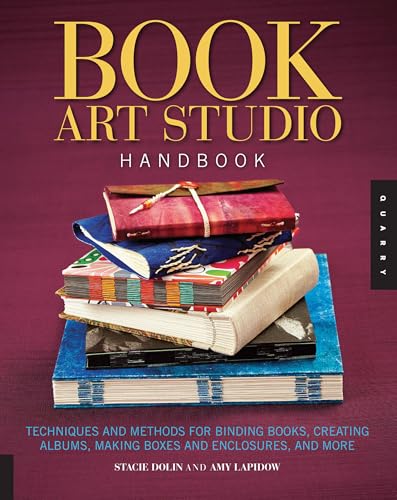
Imagen de portada de Amazon
Imagen de Amazon.com
Imagen de cubierta Syndetics
Portada de Syndetics
Imagen de OpenLibrary

Book art studio handbook techniques and methods for binding books, creating albums, making boxes and more Stacie Dolin and Amy Lapidow.

Por: Colaborador(es): Detalles de publicación: Beverly Quarry Books 2013.Descripción: 160 pages illustrations 26 cm Tipo de medio:
Tipo de soporte:
ISBN:
  • 9781592538188 (pbk.)
Tema(s): Clasificación CDD:
  • 686.3 D664b 23
Clasificación LoC:
  • Z271 .D63 2013
Resumen: "As the "book" morphs and evolves into a malleable, digital file, interest in the classic form is reignited in book lovers and crafters. The Book Art Studio Handbook offers readers a comprehensive and accessible guide to not only the nuts and bolts of this classic art, but insight into the artisan's lifestyle. This book goes beyond quick craft projects and into the heart of bookmaking, binding, letterpress printing, decorative cover techniques, book conservation, and other book arts. It is an essential companion book for all paper lovers and bibliophiles--especially as the book as object becomes more prominent a concept"-- Provided by publisher.
Valoración
    Valoración media: 0.0 (0 votos)
Existencias
Imagen de cubierta Tipo de ítem Biblioteca actual Biblioteca de origen Colección Ubicación en estantería Signatura topográfica Materiales especificados Info Vol URL Copia número Estado Notas Fecha de vencimiento Código de barras Reserva de ítems Prioridad de la cola de reserva de ejemplar Reservas para cursos
Referencia Biblioteca Encarnación Valdés Sala de Referencia bev 686.3 D664b (Navegar estantería(Abre debajo)) Disponible 80000002488891
Total de reservas: 0

Descripciones mejoradas de Syndetics:

How to Make Books, Albums, Slipcases, and More
There's nothing like making your own sketchbook, or wrapping a favorite book in the perfect homemade slipcase. And you can create it all yourself! Select the tools and materials you'll need, master basic book-binding techniques, and practice your new skills on 12 eye-catching projects. Then explore the gallery of variations for more inspiration to make each book form your own. Whether you're an experienced book binder or new to the art, Book Art Studio Handbook will help you take your books to the next level. With Book Art Studio Handbook , you'll learn how to: - Set up your workspace or studio - Choose the right board, paper, book cloth, and other supplies for your project - Fold a textblock, make a sewing template, glue a cover, and practice other essential techniques - Create albums: Imagine your photos in an Accordion Album with Frames, for example - Create books: How about a flexible Tacketed Book to customize? - Create enclosures: From Slipcase to French Box - Challenge yourself: Try your hand at an advanced project, such as a Travel Journal

"As the "book" morphs and evolves into a malleable, digital file, interest in the classic form is reignited in book lovers and crafters. The Book Art Studio Handbook offers readers a comprehensive and accessible guide to not only the nuts and bolts of this classic art, but insight into the artisan's lifestyle. This book goes beyond quick craft projects and into the heart of bookmaking, binding, letterpress printing, decorative cover techniques, book conservation, and other book arts. It is an essential companion book for all paper lovers and bibliophiles--especially as the book as object becomes more prominent a concept"-- Provided by publisher.

Tabla de contenidos provista por Syndetics

  • Introduction(p. 6)
  • Part 1 Getting Started(p. 9)
  • Chapter 1 Planning Your Studio(p. 10)
  • Create Your Workspace(p. 12)
  • Basic Equipment to Have on Hand(p. 14)
  • Tools and Equipment That Are Nice to Have(p. 20)
  • Chapter 2 Basic Techniques and Definitions(p. 24)
  • Plan Your Project(p. 24)
  • Choose a Binding Style(p. 26)
  • Determine the Grain(p. 26)
  • How Much Paper Do You Need?(p. 28)
  • Cut the Materials(p. 37)
  • Glue the Materials(p. 37)
  • Other Techniques(p. 37)
  • Part 2 Studio Projects(p. 41)
  • Chapter 3 Albums(p. 42)
  • Studio Project: Woven Album(p. 47)
  • Studio Project: Stiff-Leaved Stub Album(p. 55)
  • Studio Project: Accordion Album with Frames(p. 63)
  • Chapter 4 Books(p. 70)
  • Studio Project: Tacketed Book(p. 73)
  • Studio Project: Friend-of-a-Friend Book(p. 79)
  • Studio Project: Sketchbook(p. 87)
  • Chapter 5 Enclosures(p. 94)
  • Studio Project: 5-Minute Slipcase(p. 97)
  • Studio Project: Slipcase(p. 103)
  • Studio Project: French Box(p. 113)
  • Chapter 6 Advanced Projects(p. 118)
  • Studio Project: Limp Paper(p. 121)
  • Studio Project: Travel Journal(p. 129)
  • Studio Project: Book in a Box(p. 141)
  • The Book Artist's Gallery(p. 146)
  • Resources(p. 152)
  • About the Authors(p. 154)
  • Acknowledgments(p. 155)
  • Index(p. 156)

Extracto provisto por Syndetics

Here are some points to consider when beginning an album and choosing the best structure for your project: - How many items (such as photos, drawings, or three-dimensional objects) will the album hold? Will the items be on both sides of the leaves or just one? Make sure the structure you choose will accommodate them. - How heavy are your items? If they are heavy enough, you may need a heavier-weight text paper to support them. This could range from watercolor paper to mat board to a heavy-weight drawing paper. The pages should support your objects. However, heavier-weight text papers mean stiffer pages. Stiffer pages in the book won't turn as well, and could lead to their own structural issues, such as cracking. Make sure you find the right balance of support and usability. - Will your items be displayed both horizontally and vertically? If so, you will need a larger page to accommodate this. If you're planning to use a landscape format, consider the weight of the paper and how it will be supported on the fore edge. An item that is too heavy for the supporting paper will cause the supporting paper to rip, sag, and not display or shelve correctly. Choose a support that is sturdier--as thick or heavy, or thicker or heavier--than the item. - How will your items be attached to the page? You could use solutions such as slots at the item corners, photo-mounting corners, or mounting strips--or you could make an album with frames. - What color pages will bring out the best in the items on them? Black is great. It has a traditional look and makes colors pop, but it scratches easily. White is classic, but it can look dirty easily. - Does the album need a title label on the cover? Paper labels are easy to make with word processing applications. Experiment with text boxes and borders. - How about embellishments? Where could you easily integrate a ribbon, beads, or other collage material? You need to consider the collective height of any inclusions when planning your album and how it will function. Adding enough room for the inclusions at the spine when making the book will help the album function well into the future. Excerpted from Techniques and Methods for Binding Books, Creating Albums, Making Boxes and Enclosures, and More by Stacie Dolin, Amy Lapidow All rights reserved by the original copyright owners. Excerpts are provided for display purposes only and may not be reproduced, reprinted or distributed without the written permission of the publisher.

Notas de autor provistas por Syndetics

Stacie Dolin is a bookbinder and consummate crafter located in Arlington, MA. After working in the silkscreen industry for a number of years, she moved to Boston to study bookbinding at the North Bennet Street School. She now teaches numerous bookbinding workshops and does independent binding and book repair. When not playing with books, Stacie knits, spins, and quilts, and looks for ways to integrate her fiber activities into her bookbinding.Amy Lapidow is a hand bookbinder, trained through The North Bennet Street School and several other institutions including Rare Book School and CBBAG. She teaches through the NBSS workshop program, where she has developed classes on a number of bookbinding concepts. Her personal interest is taking historic bookbinding structures and updating them by using alternate materials and for contemporary uses. Her work has been seen in 500 Handmade Books and as part of the exhibit One Book Many Interpretations at The Chicago Public Library, where she combined a classic binding style with QR codes. She lives in Somerville, MA. Amy Lapidow is a hand bookbinder, trained through The North Bennet Street School and several other institutions including Rare Book School and CBBAG. She teaches through the NBSS workshop program, where she has developed classes on a number of bookbinding concepts. Her personal interest is taking historic bookbinding structures and updating them by using alternate materials and for contemporary uses. Her work has been seen in 500 Handmade Books and as part of the exhibit One Book Many Interpretations at The Chicago Public Library, where she combined a classic binding style with QR codes. She lives in Somerville, MA.
Compartir
logopucpr-y-vive

Contáctanos

¡Queremos saber de ti!

Tel. 787.841.2000 Ext. 1801

bibliotecavaldes@pucpr.edu

⁣Búscanos en las redes

© 2026 Desarrollado por Ignite Online • All Rights Reserved • Powered by Koha.