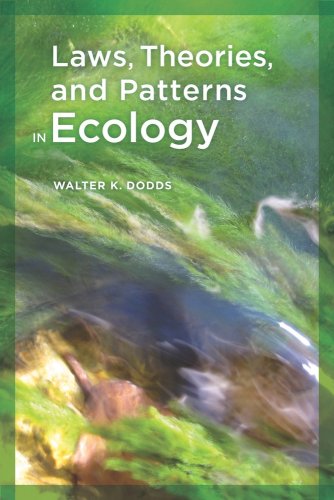
Imagen de portada de Amazon
Imagen de Amazon.com
Imagen de cubierta Syndetics
Portada de Syndetics
Imagen de OpenLibrary

Laws, theories and patterns in ecology / Walters K. Dodds.

Por: Detalles de publicación: Berkeley ; Los Angeles, California : University of California Press, c2009.Descripción: xiv,232p. ; 21 cmISBN:
  • 9780520260405
Tema(s):
Valoración
    Valoración media: 0.0 (0 votos)
Existencias
Imagen de cubierta Tipo de ítem Biblioteca actual Biblioteca de origen Colección Ubicación en estantería Signatura topográfica Materiales especificados Info Vol URL Copia número Estado Notas Fecha de vencimiento Código de barras Reserva de ítems Prioridad de la cola de reserva de ejemplar Reservas para cursos
Libro Biblioteca de Mayagüez Colección General mb QH541 .D64 2009 (Navegar estantería(Abre debajo)) Disponible 50000003199246
Total de reservas: 0

Descripciones mejoradas de Syndetics:

Physics and chemistry are distinguished from biology by the way generalizations are codified into theories tested by observation and experimentation. Some theories have been sufficiently tested to qualify as laws. In ecology, generalizations worthy of being called theories are less common because observations and experimentation are difficult and exceptions are more common. In this book, Walter K. Dodds enumerates generalizations in ecology. Introductory material describes how the practice of science in general, and ecology specifically, yields theories and laws. Dodds also discusses why such ideas are only useful if they have predictive ability, and delineates the scope of these generalizations and the constraints that limit their application. The result is a short book that delves deeply into important ecological ideas and how they predict and provide understanding.

Includes bibliographical references and index.

EIGM 04/2010

Reseñas proporcionadas por Syndetics

CHOICE Review

In this short, very concise, well-written book, Dodds (Kansas State) attempts to provide the philosophical underpinnings for the ecological sciences. He begins with a general treatment of how ecological topics have been researched in the past. He then addresses some definitions and ideas that ecologists have used. He follows up with a list of 30+ laws. For each law, Dodds identifies at which scale it is applied and to what area of ecology it is associated. Next, he delves into the theories that have been used in ecology, identifying which law or laws are the basis of each theory and at which level the theory is applied. Dobbs is an aquatic microbiologist, but his examples are from a wide variety of fields in ecology and different hierarchical levels. The black-and-white diagrams are few in number, but they visually explicate the text. The work would be most useful at the graduate/professional level, although an advanced undergraduate might find it interesting but challenging. R. Karban and M. Huntzinger's How to Do Ecology (CH, Feb'07, 44-3280) more generally covers the practice of ecology. T. Sherratt and D. Wilkinson's recent Big Questions in Ecology and Evolution (CH, Dec'09, 47-1988) covers the opposite side of the spectrum. Summing Up: Highly recommended. Upper-division undergraduates and above. L. T. Spencer Plymouth State University

Notas de autor provistas por Syndetics

Walter K. Dodds is Professor of Biology at Kansas State University and the author of Freshwater Ecology and Humanity's Footprint .
Compartir
logopucpr-y-vive

Contáctanos

¡Queremos saber de ti!

Tel. 787.841.2000 Ext. 1801

bibliotecavaldes@pucpr.edu

⁣Búscanos en las redes

© 2026 Desarrollado por Ignite Online • All Rights Reserved • Powered by Koha.