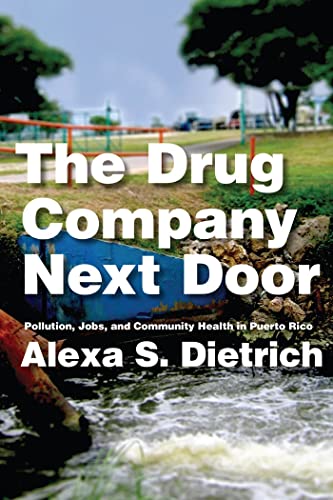

The drug company next door pollution, jobs, and community health in Puerto Rico Alexa S. Dietrich.
Editor: New York New York University Press [2013]Descripción: xx, 231 pages illustrations 23 cm Tipo de medio:- 9780814724996 (hardback)
- 081472499X (hardback)
- 9780814724736 (pb)
- 0814724736 (pb)
- Pollution, jobs, and community health in Puerto Rico
- Pharmaceutical Industry -- Environmental aspects -- Puerto Rico
- Social participation -- Puerto Rico
- Risk assessment -- Puerto Rico
- Public Policy -- Puerto Rico
- Environmental Pollution -- adverse effects -- Puerto Rico
- Environmental Pollutants -- toxicity -- Puerto Rico
- Drug Industry -- ethics -- Puerto Rico
- Environmental policy -- Puerto Rico -- Citizen participation
- Pollution -- Economic aspects -- Puerto Rico
- Pollution -- Social aspects -- Puerto Rico
- Pharmaceutical Industry -- Risk assessment -- Puerto Rico
- 363.73/1 23
- TD428.P54 D54 2013
- 2014 C-760
- QV 736 DP8
- SOC002000 | SOC020000
| Imagen de cubierta | Tipo de ítem | Biblioteca actual | Biblioteca de origen | Colección | Ubicación en estantería | Signatura topográfica | Materiales especificados | Info Vol | URL | Copia número | Estado | Notas | Fecha de vencimiento | Código de barras | Reserva de ítems | Prioridad de la cola de reserva de ejemplar | Reservas para cursos | |
|---|---|---|---|---|---|---|---|---|---|---|---|---|---|---|---|---|---|---|
| Libro | Biblioteca Encarnación Valdés Colección de Puerto Rico | 363.731 D566d 2013 (Navegar estantería(Abre debajo)) | Disponible | 80000002534595 |
Descripciones mejoradas de Syndetics:
"This fascinating and most timely critical
medical anthropology study successfully binds two still emergent areas of
contemporary anthropological research in the global world: the nature and
significant impact of multinational pharmaceutical manufacturers on human
social life everywhere, and the contribution of corporations to the fast-paced
degradation of our life support system, planet Earth. . . . Focusing on a
pharmaceutically-impacted town on the colonized island of Puerto Rico, Dietrich
ably demonstrates the value of ethnography carried out in small places in
framing the large issues facing humanity."
--Merrill Singer, University of Connecticut
The production of pharmaceuticals is among the
most profitable industries on the planet. Drug companies produce chemical
substances that can save, extend, or substantially improve the quality of human
life.However, even as the companies
present themselves publicly as health and environmental stewards, their
factories are a significant source of air and water pollution--toxic to people
and the environment. In Puerto Rico, the pharmaceutical industry is the
backbone of the island's economy: in one small town alone, there are over a
dozen drug factories representing five multinationals, the highest
concentration per capita of such factories in the world. It is a place where
the enforcement of environmental regulations and the public trust they ensure
are often violated in the name of economic development.
The Drug Company Next Door unites the concerns of
critical medical anthropology with those of political ecology, investigating
the multi-faceted role of pharmaceutical corporations as polluters, economic
providers, and social actors. Rather
than simply demonizing the drug companies, the volume explores the dynamics
involved in their interactions with the local community and discusses the
strategies used by both individuals and community groups to deal with the consequences
of pollution.
The Drug Company Next Door puts a human face on a
growing set of problems for communities around the world. Accessible and engaging, the book encourages
readers to think critically about the role of corporations in everyday life,
health, and culture.
Includes bibliographical references (pages 209-223) and index.
Key events timeline for Nocora's environmental health -- Understanding political ecologies of risk in Puerto Rico -- Little by Little. The dose makes the poison: how making drugs harms environments and people. -- Progress. In the beginning was the corporation: progress, pollution, and the public trust. -- Playing Politics. The rituals and consequences of community politics and dissent. -- "Fresh minds" on Parade. Environmental justice is not always just. -- Good Neighbors (a Conversation). The pharmaceutical industry and the problem of "stakeholders". -- "Salud te Recomienda". Radical redistributions of knowledge: a holistic view of environmental health.
The production of pharmaceuticals is among the most profitable industries on the planet. Drug companies produce chemical substances that can save, extend, or substantially improve the quality of human life. However, even as the companies present themselves publicly as health and environmental stewards, their factories are a significant source of air and water pollution, toxic to people and the environment. In Puerto Rico, the pharmaceutical industry is the backbone of the island's economy: in one small town alone, there are over a dozen drug factories representing five multinationals, the highest concentration per capita of such factories in the world. It is a place where the enforcement of environmental regulations and the public trust they ensure are often violated in the name of economic development. This book unites the concerns of critical medical anthropology with those of political ecology, investigating the multi-faceted role of pharmaceutical corporations as polluters, economic providers, and social actors. Rather than simply demonizing the drug companies, the volume explores the dynamics involved in their interactions with the local community and discusses the strategies used by both individuals and community groups to deal with the consequences of pollution. It puts a human face on a growing set of problems for communities around the world. The book encourages readers to think critically about the role of corporations in everyday life, health, and culture. -- Provided by publisher.