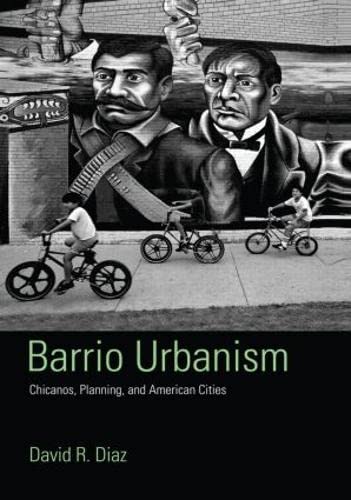

Barrio urbanism chicanos, planning, and American cities David Ralph Diaz. txt
New York Oxon Routledge 2005Descripción: xii, 347 p. maps 24 cmTipo de contenido:- text
- unmediaded
- volume
- 0415945410
- 0415945429
- 9780415945424
- 307.1
- E184.M5 D525 2005
| Imagen de cubierta | Tipo de ítem | Biblioteca actual | Biblioteca de origen | Colección | Ubicación en estantería | Signatura topográfica | Materiales especificados | Info Vol | URL | Copia número | Estado | Notas | Fecha de vencimiento | Código de barras | Reserva de ítems | Prioridad de la cola de reserva de ejemplar | Reservas para cursos | |
|---|---|---|---|---|---|---|---|---|---|---|---|---|---|---|---|---|---|---|
| Libro | CARIBET Biblioteca Arquitectura Colección General CARIBET | General E184.M5 D525 2005 (Navegar estantería(Abre debajo)) | 1 | Disponible | 91000000043968 |
Descripciones mejoradas de Syndetics:
This, the first book on Latinos in America from an urban planning/policy perspective, covers the last century, and includes a substantial historical overview the subject. The authors trace the movement of Latinos (primarily Chicanos) into American cities from Mexico and then describe the problems facing them in those cities. They then show how the planning profession and developers consistently failed to meet their needs due to both poverty and racism. Attention is also paid to the most pressing concerns in Latino barrios during recent times, including environmental degradation and justice, land use policy, and others. The book closes with a consideration of the issues that will face Latinos as they become the nation's largest minority in the 21st century.
Include index.
Includes bibliographical references (p. 317-332)
Early history of urban locational patterns, 1880-1950 -- Barrio logic and the consolidation of Chicanas/os in the city, 1950-1975 -- Transformation of barrios and the impact of reforms of racist real estate and banking industry practices -- Housing affordability : practical influence of local and federal policies -- Economic development in Chicana/o communities -- Open space, cultural programs and recreational resources -- Redevelopment policy in the barrio -- The history of confrontational urban politics : a reliance on social movements -- Land use conflicts and the politics of environmental justice -- The political and social transformation of California -- The new cities of the Southwest -- The challenge to future political coalitions and the question of land use policy -- Chicanas/os and the urban challenges of the 21st century.
Tabla de contenidos provista por Syndetics
- Preface(p. ix)
- Part I History of Chicana/o Residential Patterns
- 1 Introduction: The Structural Influence of Chicanas/os on Spatial Relations in the Cities of the Southwest(p. 3)
- 2 The Early History of Chicana/o Urban and Locational Patterns in the Southwest, 1880-1945(p. 29)
- 3 Barrio Logic and the Consolidation of Chicanas/os in the City: 1945-1975(p. 49)
- 4 Transformation of Regional Culture and the Impact of Civil Rights Reforms on Racist Real Estate and Banking Industry Practices: 1975-2000(p. 63)
- Part II Major Urban Issues and the Chicana/o Community
- 5 Housing Policy and the Crisis of Affordability in the Southwest(p. 91)
- 6 Economic Development in Chicana/o Communities(p. 121)
- 7 Open Space and Recreation(p. 145)
- 8 Redevelopment Policy in the Barrio(p. 161)
- Part III Land Use and Politics Arena in the Post-World War II Suburban Expansion
- 9 The History of Confrontational Urban Politics: A Reliance on Social Movements(p. 191)
- 10 The Politics of Environmental Justice in the Southwest(p. 211)
- 11 The Political and Social Transformation of California(p. 235)
- Part IV The Future of Urban Policy in the Southwest
- 12 The New Cities of the Southwest(p. 263)
- 13 Political Coalitions, Chicanas/os, and the Question of Urban Policy(p. 283)
- 14 Chicanas/os and the Urban Challenges of the Twenty-First Century(p. 299)
- Appendix(p. 309)
- Bibliography(p. 317)