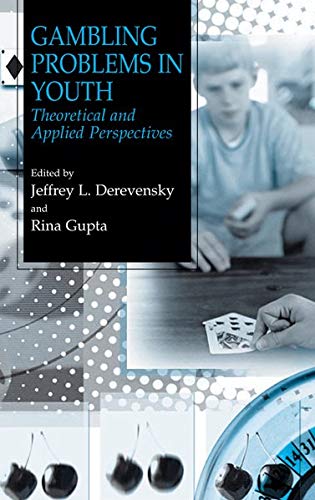

Gambling Problems in Youth [electronic resource] Theoretical and Applied Perspectives edited by Jeffrey L. Derevensky, Rina Gupta.
Idioma: Español Detalles de publicación: Boston, MA Springer US 2005.ISBN:- 9780306485862
| Imagen de cubierta | Tipo de ítem | Biblioteca actual | Biblioteca de origen | Colección | Ubicación en estantería | Signatura topográfica | Materiales especificados | Info Vol | URL | Copia número | Estado | Notas | Fecha de vencimiento | Código de barras | Reserva de ítems | Prioridad de la cola de reserva de ejemplar | Reservas para cursos | |
|---|---|---|---|---|---|---|---|---|---|---|---|---|---|---|---|---|---|---|
| Libro electrónico | Biblioteca de Mayagüez Acceso en línea | EBooks (Navegar estantería(Abre debajo)) | Disponible | 50000003232674 | ||||||||||||||
| Libro electrónico | Biblioteca Encarnación Valdés Acceso en línea | E-book (Navegar estantería(Abre debajo)) | Disponible | 8ebook00000078 | ||||||||||||||
| Libro electrónico | Biblioteca Mons. Iñaki Mallona (Arecibo) Acceso en línea | Ebooks (Navegar estantería(Abre debajo)) | Disponible | 60000000000177 |
Descripciones mejoradas de Syndetics:
Howard J. Shaffer, Ph. D. More than 20 years ago, I first noted that young people in North America were growing up in a context of legalized gambling for their entire lifetime. By the 1980s, for young people, gambling had become an average and expectable part of the social landscape. Amid legal opportunities to gamble in all but two of the United States and with illicit opportunities to gamble in every state, gambling is now ubiquitous in America. With few social sa- tions to limit a young person's interest in gambling--like their adult co- terparts--young people now gamble in larger numbers and for seemingly higher stakes. Gradually, gambling-related problems became more visible for young people and the culture slowly but increasingly took notice. By the late 1990s, every sector of American and Canadian society had started to c- sider the effects of legalized gambling on youth. For different reasons, r- resentatives of the gambling and health care industries led the movement to prevent youthful gambling and reconcile existing problems whenever p- sible. Scientists also recognized that there was much to be learned by stu- ing young gamblers. Toward the end of the 20th century, there was a rapid increase in gambling research focusing on developmental issues; half of what is known about gambling emerged during the 1990s. This volume represents an important event in the continuing growth of a field.
Tabla de contenidos provista por Syndetics
- Part I Prevalence
- 1. Youth Gambling in North America: Long Term Trends and Future Prospects(p. 1)
- Part II Youth Gambling Problems: Correlates and Risk Factors
- 2. Demographic, Psychosocial, and Behavioral Factors Associated with Youth Gambling and Problem Gambling(p. 27)
- 3. Gambling, Depression, and Suicidality in Adolescents(p. 41)
- 4. Gambling and Drug Abuse in Adolescence(p. 57)
- 5. Adolescent Problem Gambling: Neurodevelopment and Pharmacological Treatment(p. 81)
- Part III New Technologies
- 6. Youth and Technology: The Case of Gambling, Video-Game Playing and the Internet(p. 101)
- Part IV Measurement Issues
- 7. The Measurement of Youth Gambling Problems: Current Instruments, Methodological Issues, and Future Directions(p. 121)
- Part V Treatment
- 8. A Dynamic Process Perspective on Gambling Problems(p. 145)
- 9. A Treatment Approach for Adolescents with Gambling Problems(p. 165)
- 10. A Pathways Approach to Treating Youth Gamblers(p. 189)
- Part VI Prevention
- 11. Prevention Efforts Toward Reducing Gambling Problems(p. 211)
- Part VII Social Policy Issues
- 12. Youth Gambling Problems: A Need for Responsible Social Policy(p. 231)
- Index(p. 253)