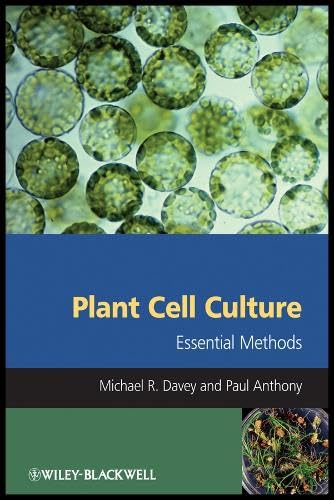

Plant cell culture essential methods Michael R. Davey and Paul Anthony.
Detalles de publicación: Hoboken, NJ Wiley-Blackwell 2010.Descripción: xvi, 341 p. ill. 25 cmISBN:- 9780470686485 (cloth)
- 571.6382 D248p 22
- QK725 .D38 2010
| Imagen de cubierta | Tipo de ítem | Biblioteca actual | Biblioteca de origen | Colección | Ubicación en estantería | Signatura topográfica | Materiales especificados | Info Vol | URL | Copia número | Estado | Notas | Fecha de vencimiento | Código de barras | Reserva de ítems | Prioridad de la cola de reserva de ejemplar | Reservas para cursos | |
|---|---|---|---|---|---|---|---|---|---|---|---|---|---|---|---|---|---|---|
| Libro | Biblioteca Encarnación Valdés Colección General bev | 571.6382 D248p (Navegar estantería(Abre debajo)) | Disponible | 80000002466640 |
Descripciones mejoradas de Syndetics:
The ability to culture cells is fundamental for mass propagation and as a baseline for the genetic manipulation of plant nuclei and organelles. The introduction to Plant Cell Culture: Essential Methods provides a general background to plant cell culture, including basic principles, technologies and laboratory practices that underpin the more detailed techniques described in subsequent chapters. Whilst each chapter provides a background to the topic area and methodology, a crucial aspect is the provision of detailed protocols with emphasis on trouble shooting, describing common problems and detailed advice for their avoidance. Plant Cell Culture: Essential Methods provides the reader with a concise overview of these techniques, including micropropagation, mutagenesis, cryopreservation, genetic and plastid transformation and somatic cell technologies. This book will be an essential addition to any plant science laboratory's bookshelf. Highlights the best and most up-to-date techniques for working on plant cell culture Explains clearly and precisely how to carry out selected techniques in addition to background information on the various approaches Chapters are written by leading international authorities in the field and cover both well-known and new, tried and tested, methods for working in plant cell culture
An essential laboratory manual for students and early-career researchers.
Tabla de contenidos provista por Syndetics
- Preface
- Contributors
- 1 Plant Micropropagation
- 1.1 Introduction
- 1.2 Methods and approaches
- 1.2.1 Explants and their surface disinfection
- 1.2.2 Culture media and their preparation
- 1.2.3 Stages of micropropagation
- 1.2.4 Techniques of micropropagation
- 1.3 Troubleshooting
- References
- 2 Thin Cell Layers: The Technique
- 2.1 Introduction
- 2.2 Methods and approaches
- 2.2.1 TCL
- 2.2.2 Choice of material: Cymbidium hybrid
- 2.3 Troubleshooting
- 2.3.1 General comments
- References
- 3 Plant Regeneration - Somatic Embryogenesis
- 3.1 Introduction
- 3.2 Methods and approaches
- 3.2.1 Selection of the cultivar and type of explant
- 3.2.2 Culture media
- 3.2.3 Preparation of culture media
- 3.2.4 Sterilization of tissues and sterile technique
- 3.2.5 Culture and growth of tissue
- 3.2.6 Culture and induction of somatic embryos
- 3.2.7 Embryo development
- 3.2.8 Transfer to soil - the final stage of regeneration
- 3.3 Troubleshooting
- References
- 4 Haploid Plants
- 4.1 Introduction
- 4.2 Methods and approaches
- 4.2.1 Androgenesis
- 4.2.2 Diploidization
- 4.3 Troubleshooting
- References
- 5 Embryo Rescue
- 5.1 Introduction
- 5.2 Methods and approaches
- 5.2.1 Identification of the time and type of barrier in hybridization
- 5.2.2 Isolation of plant material after fertilization
- 5.2.3 Culture conditions and media
- 5.2.4 Confirmation of hybridity and ploidy
- 5.2.5 Conditions for regeneration of embryos to plants
- 5.3 Troubleshooting
- References
- 6 In vitro Flowering and Seed Set: Acceleration of Generation Cycles
- 6.1 Introduction
- 6.2 Methods and approaches
- 6.2.1 Protein legumes [7]
- 6.2.2 Arabidopsis thaliana [13]
- 6.3 Troubleshooting
- References
- 7 Induced Mutagenesis in Plants Using Physical and Chemical Agents
- 7.1 Introduction
- 7.2 Methods and approaches
- 7.2.1 Determination of the optimal doses of mutagens for inducing mutations
- 7.3 Troubleshooting
- 7.3.1 Factors influencing the outcome of mutagenesis using chemical mutagens
- 7.3.2 Factors influencing the outcome of mutagenesis using physical mutagens
- 7.3.3 Facts about induced mutations
- References
- 8 Cryopreservation of Plant Germplasm
- 8.1 Introduction
- 8.2 Methods and approaches
- 8.2.1 Main principles
- 8.2.2 Slow (two-step) freezing
- 8.2.3 Vitrification
- 8.2.4 Encapsulation-dehydration
- 8.2.5 DMSO droplet freezing
- 8.2.6 Combined methods
- 8.2.7 Freezing of cold-hardened buds
- 8.2.8 Freezing of orthodox seeds
- 8.2.9 Freezing of pollen and spores
- 8.3 Troubleshooting
- References
- 9 Plant Protoplasts: Isolation, Culture and Plant Regeneration
- 9.1 Introduction
- 9.2 Methods and approaches
- 9.2.1 Protoplast isolation
- 9.2.2 Protoplast culture
- 9.3 Troubleshooting
- References
- 10 Protoplast Fusion Technology - Somatic Hybridization and Cybridization
- 10.1 Introduction
- 10.2 General applications of somatic hybridization
- 10.3 Methods and approaches
- 10.4 Troubleshooting
- References
- 11 Genetic Transformation - Agrobacterium
- 11.1 Introduction
- 11.2 Methods and approaches
- 11.2.1 Agrobacterium as a natural genetic engineer
- 11.2.2 Vector systems for transformation
- 11.2.3 Inoculation procedures
- 11.3 Troubleshooting
- References
- 12 Genetic Transformation - Biolistics
- 12.1 Introduction
- 12.2 Methods and approaches
- 12.2.1 Biolistic technology
- 12.2.2 Optimization of gene delivery parameters
- 12.2.3 Target tissues
- 12.2.4 Reporter gene assays
- 12.2.5 Selection and plant regeneration
- 12.3 Troubleshooting
- References
- 13 Plastid Transformation
- 13.1 Introduction
- 13.2 Methods and approaches
- 13.2.1 Principles of plastid transformation
- 13.2.2 Biolistic-mediated plastid transformation
- 13.2.3 PEG-mediated plastid transformation
- 13.2.4 Identification and characterization of transplastomic plants
- 13.3 Troubleshooting
- 13.3.1 Biolistic-mediated transformation
- 13.3.2 PEG-mediated transformation
- References
- 14 Molecular Characterization of Genetically Manipulated Plants
- 14.1 Introduction
- 14.2 Methods and approaches
- 14.2.1 Plant DNA extraction
- 14.2.2 Polymerase chain reaction
- 14.2.3 Southern blot technique
- 14.2.4 Analysis of the integration site: inverse PCR (iPCR) and thermal asymmetric interlaced PCR (Tail-PCR)
- 14.3 Troubleshooting
- References
- 15 Bioreactors
- 15.1 Introduction
- 15.2 Methods and approaches
- 15.2.1 Medium scale disposable or semidisposable airlift reactors
- 15.2.2 The RITA temporary immersion reactor
- 15.2.3 The LifeReactor
- 15.2.4 Immobilized cell bioreactors
- 15.2.5 Mini-bioreactors
- 15.3 Troubleshooting
- References
- 16 Secondary Products
- 16.1 Introduction
- 16.2 Methods and approaches
- 16.2.1 Plant cell cultures
- 16.2.2 Scale-up and regulation of secondary metabolite production
- 16.2.3 Detection of secondary products
- 16.3 Troubleshooting
- References
- 17 Plant Cell Culture - Present and Future
- 17.1 Introduction
- 17.2 Micropropagation
- 17.3 Embryogenesis
- 17.3.1 Background
- 17.3.2 Commercial exploitation of somatic embryos
- 17.3.3 Molecular aspects of somatic embryogenesis
- 17.3.4 Microspore derived embryos
- 17.4 Haploid methodology
- 17.4.1 Haploids and their exploitation
- 17.4.2 Induction of haploid plants
- 17.4.3 Molecular aspects of haploid induction from microspores
- 17.4.4 Ab initio zygotic-like embryogenesis from microspores
- 17.5 Somaclonal variation
- 17.6 Transgenic methods
- 17.6.1 Background
- 17.6.2 Regeneration and transformation techniques
- 17.6.3 Chloroplast transformation
- 17.6.4 Biopharming
- 17.7 Protoplasts and somatic hybridization
- 17.8 Bioreactors
- 17.8.1 Production of plant products
- 17.8.2 Production of pharmaceuticals
- 17.8.3 Production of food ingredients
- 17.8.4 Production of cosmetics
- 17.8.5 Analytical methodology
- 17.9 Cryopreservation
- 17.10 Intellectual property and commercialization
- 17.10.1 Background
- 17.10.2 Sources of patent and other relevant information
- 17.11 Conclusion
- References
- Index
Notas de autor provistas por Syndetics
Michael R. Davey and Paul Anthony are the authors of Plant Cell Culture: Essential Methods, published by Wiley.