Gernot Hertl is one of Austria's most successful young architects. He has put together an impressive oeuvre in only a few years that has received international recognition for the architect's unusual projects and solutions. 'Space and Texture' is the central element in this philosophy. Homogenous surfaces with innovative materials and textures are just as important in Hertl Architect's language of shapes as free flowing, open inside room shapes within his buildings. The breadth of realized projects ranges from small garden houses to medium-sized commercial buildings and social housing projects as well as multipurpose high-rise buildings. The first monograph of this young office in Steyr (Upper Austria) features beautiful photo essays by the acclaimed architecture photographer Paul Ott that offer an insight into one of the most ambitious architecture labs in Central Europe. The volume also includes a subject overview and documentation section that gives the reader an inspiring, representative view of the architect's work. Gernot Hertl zahlt zu den erfolgreichsten jungen Architekten Osterreichs. In wenigen Jahren hat er ein beeindruckendes Oeuvre vorgelegt, das durch zahlreiche ungewohnliche Aufgaben und Losungen bereits internationale Aufmerksamkeit erweckte. "Space & Texture" ist das zentrale Element dieser Philosophie. Homogene Oberflachen in innovativen Materialien und Texturen sind ebenso wichtige Bestandteile der klaren Formensprache von Hertl.Architekten wie die frei fliessenden, offenen Raumformen im Inneren der Hauser. Die Bandbreite der realisierten Bauten reicht vom Kleingartenhaus uber mittelgrosse Gewerbebauten und soziale Wohnbauten bis zu Hochhausern gemischter Nutzung. Die erste Monografie des jungen Buros mit Sitz in Steyr (Oberosterreich) bietet mit hochwertigen Fotoessays des renommierten Architekturfotografen Paul Ott in einem Themen- und einem Dokumentationsteil einen inspirierenden, reprasentativen Einblick in eines der ambitioniertesten Architekturlabors Mitteleuropa
Tabla de contenidos provista por Syndetics
Introduction(p. xiii)
Book 1 Calories(p. 1)
Book 2 Cash(p. 53)
Book 3 Engineering(p. 115)
Book 4 The New Longevity Bestiary(p. 157)
Book 5 One Million Centenarians(p. 173)
Recipes For Eternity(p. 195)
Notes(p. 199)
Select Bibliography(p. 217)
Acknowledgments(p. 221)
Crbbits(p. 225)
Index(p. 227)
Extracto provisto por Syndetics
Book One Calories "We must resist old age, Scipio and Laelius; we must compensatefor its deficiencies by careful planning. We must take up defenses against oldage as against a disease, taking due thought for good health, following aprogram of moderate exercise, eating and drinking enough to rebuild our bodies,but not to overload them." --Cicero *** "Rubbish!" Silence. "Rubbish, I say!" Silence. The speaker, Josh Mitteldorf, having quietly taken in the one-word critique issuing from somewhere in thehotel conference room, commenced again. He was trying to convince a gathering of the Caloric Restriction Society, gathered for their second international conference in Tucson, Arizona, that death wasn't really such a bad thing, that nature evolved the genetic program for apoptosis--programmed cell death--for a reason: to keep the planet from getting overcrowded. "I kept asking myself," said Mitteldorf, a slim, tousle-haired environmental scientist, yoga teacher, and philosopher, "why would evolution create an organism with a program to kill cells? And a lot of the answer came from looking around at the world today--at obesity, overpopulation, pollution, consumerism--and that all led me to thisquest to understand why nature made us to die." He had recently published a paper in Science about it, and... "Rubbish! " This time there was an audible ripple of protest through the crowd, directed toward the source of this indecorous behavior, a tall, skinny manwearing a T-shirt with the words END AGING NOW! His name was Michael Rae, only twenty-nine and who was, along with his equally young girlfriend, April Smith, quickly emerging as the new poster children for the CR Society, an organization long saddled with the dour image of some of its older practitioners. Rae, who had already charmed everyone by openly flossing his teeth during an earlier presentation--the better to reduce his inflammatory burden--was having none of Mitteldorf's ideas, and instead of waiting for the formal question-and-answer period, bounded up to the podium, cranked the microphone his way, and began to recite data to the contrary. "Can someone let me use their computer--I want to look up a reference?" he said. He then went on, with a barrage of...data. "So how can you possibly make this argument?" Rae said, winding up, to an apparently unperturbed Mitteldorf. (There had been a yoga class that morning.) "How can you say that?" I had come to Tucson at the invitation of Lisa Walford, a former president of the Caloric Restriction (CR) Society and the daughter of one of the organization's founders, the late Roy Walford. Tucson held some special significance both for the society and for Walford. About an hour's ride out into the desert stood the site of one of the first, albeit unintentional, sites of human caloric restriction--Biosphere 2. The biosphere was an attempt to live for two years in a fully contained, self-supporting environment. It ended in a rash of controversy, partly because the dome failed to produce enough food or air for its eight inhabitants. Roy Walford, one of them, had never been the same after, and many quietly suspected that his recent death, at age seventy-nine of Lou Gehrig's disease, to be a direct result of the biosphere experience. The scientific program of the CR conference included a number of highly placed scientists who had been friends with Walford, here partly to respect that, partly because, when you think about it, CR people are the only lab animals that can talk. "You can learn all kinds of things from them," said Edward Masoro of the University o Excerpted from Eternity Soup: Inside the Quest to End Aging by Greg Critser All rights reserved by the original copyright owners. Excerpts are provided for display purposes only and may not be reproduced, reprinted or distributed without the written permission of the publisher.
Reseñas proporcionadas por Syndetics
Library Journal Review
In an era where average life spans are higher and there are more centenarians than ever before, many people invest small fortunes and fantastic hopes in pursuit of prolonged youth. But what's science and what's snake oil? Critser (Fat Land; Generation Rx) is a frequent commentator on modern medicine, known for his rapid-fire prose and glib sense of humor. Whether killer diets, hormone therapy, and/or various biological or mechanical engineering antiaging solutions will dramatically increase longevity is, to date, a matter of speculation, but there's no shortage of enthusiasts for the possibilities. Critser's ribald (occasionally irreverent) tone makes for vivid reading and easy comprehension. Verdict This is sure to be popular among general readers. A more expansive yet still engaging treatment is Stephen Hall's Merchants of Immortality, and students and academic readers wanting a more technical and theoretical discussion can turn to Mark Benecke's The Dream of Eternal Life.-Gregg Sapp, Evergreen State Lib., Olympia, WA (c) Copyright 2010. Library Journals LLC, a wholly owned subsidiary of Media Source, Inc. No redistribution permitted.
Publishers Weekly Review
Bringing his signature wit and insight to the field of biogerentology, Critser (Fat Land, Generation Rx) produces a vigorous report of frontier science, charlatanry, and hope for a new, much longer, way of life. Beginning with a discussion with his septuagenarian parents, who receive "compounded hormone" treatment from a "longevity doctor," Critser travels the U.S. to investigate the enterprises "forging onward into a brave new pro-longevist world." (Crister's own horse in the race-besides finding the natural aging process "cruel, capricious and unrelenting"-is a "form of accelerated brain aging" he suffers as a result of a concussion.) Crister's first stop is a gathering of the Caloric Restriction Society, which advocates minimal caloric intake as a way of slowing cell damage; a conference breakfast consists of five blueberries and three potato chips. More trendy, and pricey, is hormone treatment, which claims to "add thirty years to maximum life span," backed up by promising trials on mice (though more recent studies have called the science into question). Critser's own course of treatment turns out ambiguously, but sends him to an intriguing third line of research, bio-engineering replacement body parts and other tissues from a patient's own cells. A light and critical eye makes this excursion into front-end science an entertaining, enlightening trek. (Jan.) Copyright 2010 Reed Business Information.
Notas de autor provistas por Syndetics
GREG CRITSER is the author of Fat Land: How Americans Became the Fattest People in the World and Generation Rx: How Prescription Drugs Are Altering American Lives, Minds, and Bodies . His work has appeared in many magazines and newspapers, and he is a well-known commentator on medicine, health, and food, with regular appearances on public radio and television. His blog can be found at scientificblogging.com.
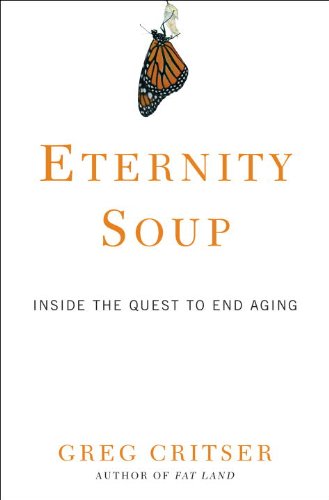
Eternity soup :
APA
Critser G., . (2010). Eternity soup: inside the quest to end aging. New York: Harmony Books.
Chicago
Critser Greg, . 2010. Eternity soup: inside the quest to end aging. New York: Harmony Books.
Harvard
Critser G., . (2010). Eternity soup: inside the quest to end aging. New York: Harmony Books.
MLA
Critser Greg, . Eternity soup: inside the quest to end aging. New York: Harmony Books. 2010.