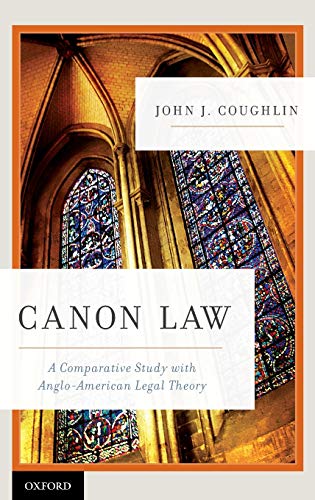

Canon law a comparative study with Anglo-American legal theory John J. Coughlin.
Detalles de publicación: New York Oxford University Press 2011.Descripción: xix, 226 p. 24 cmISBN:- 9780195372977 ((hardback) : alk. paper)
- 0195372972 ((hardback) : alk. paper)
- 262.9 22
- KB 243 .C68 A33 2011
| Imagen de cubierta | Tipo de ítem | Biblioteca actual | Biblioteca de origen | Colección | Ubicación en estantería | Signatura topográfica | Materiales especificados | Info Vol | URL | Copia número | Estado | Notas | Fecha de vencimiento | Código de barras | Reserva de ítems | Prioridad de la cola de reserva de ejemplar | Reservas para cursos | |
|---|---|---|---|---|---|---|---|---|---|---|---|---|---|---|---|---|---|---|
| Libro | Biblioteca de Derecho Mons. Fremiot Torres Oliver Colección General biblioteca derecho | KB 243 .C68 A33 2011 (Navegar estantería(Abre debajo)) | Disponible | 70000000892361 |
Descripciones mejoradas de Syndetics:
Canon Law: A Comparative Study with Anglo-American Legal Theory, by the Reverend John J. Coughlin, explores the canon law of the Roman Catholic Church from a comparative perspective. The Introduction to the book presents historical examples of antinomian and legalistic approaches to canon law (antinomianism diminishes or denies the importance of canon law, while legalism overestimates the function of canon law in the life of the Catholic Church). The Introduction discusses these approaches as threats to the rule of law in the Church, and describes the concept of the rule of law in the thought of various Anglo-American legal theorists. Chapter One offers an overview of canon law as the "home system" in this comparative study. The remaining chapters consider antinomian and legalistic approaches to the rule of law in light of three specific issues: the sexual abuse crisis, ownership of church property, and the denial of Holy Communion to Catholic public officials. Chapters Two and Three discuss the failure of the rule of law as a result of antinomian and legalistic approaches to the sexual abuse crisis. Chapters Four and Five compare the concept of property in canon law with that of liberal political theory; they discuss the ownership of parish property in light of diocesan bankruptcies, the relationship between church property and the law of the secular state, and the secularization of Catholic institutions and their property. Chapters Six and Seven raise the indeterminacy claim with regards to canon law and the arguments for and against the denial of Holy Communion to Catholic public officials. Although the three issues arise in the context of the United States, they raise broader theoretical issues about antinomianism, legalism, and the rule of law. Throughout the comparative study, American legal theory functions to clarify these broader issues in canon law. The concluding chapter offers a synthesis of this comparative study.
Includes bibliographical references and index.
An overview of canon law -- Canon law and the sexual abuse crisis : antinomianism, legalism, and the failure of the rule of law -- Canon law and the sex abuse crisis continued : the consequences of the failure of the rule of law -- Church property : a comparison of the theories of property in canon law and liberal theory -- Church property continued : the diocese and parish; canon law and state law -- Indeterminancy in canon law : the refusal of holy communion to catholic public officials : canon 915: "a central case" -- The indeterminacy claim continued : canon 915 : "a doubtful or hard case"?.
Tabla de contenidos provista por Syndetics
- Preface and Acknowledgments(p. xiii)
- Abbreviations(p. xvii)
- Introduction(p. 1)
- I Antinomianism and Legalism(p. 3)
- II Comparative Law and Anglo-American Legal Theory(p. 6)
- III Canon Law and the Rule of Law(p. 10)
- Chapter 1 An Overview of Canon Law(p. 17)
- I Examples of the Scriptural and Historical Origins of Canon Law(p. 17)
- A Via Negativa(p. 18)
- B The Juridical Form of Community, Sacrament, and Mission in the New Testament(p. 21)
- C Paul of Tarsus: Law and Spirit(p. 24)
- D The Council at Jerusalem(p. 26)
- E The Patristic Church of Northern Africa(p. 28)
- F The Medieval Canonists(p. 31)
- II Contemporary Canon Law and the Rule of Law(p. 35)
- A Twentieth-Century Codifications(p. 35)
- B Other Sources and Types of Canon Law(p. 38)
- 1 Legislative, Executive, and Judicial Power(p. 38)
- 2 Universal and Particular Law(p. 41)
- 3 Custom as a Source of Law(p. 42)
- 4 International Law(p. 42)
- 5 The Canonization of Civil Law(p. 43)
- 6 Liturgical Law(p. 44)
- C Canonical Equity, Dispensation, Exception, and Privilege(p. 44)
- 1 Canonical Equity(p. 44)
- 2 Dispensation, Exception, and Privilege(p. 46)
- D The Unity of Law and Theology(p. 48)
- Chapter 2 Canon Law and the Sexual Abuse Crisis: Antinomianism, Legalism, and the Failure of the Rule of Law(p. 51)
- I The Failure of Canon Law in Responding to Clergy Sexual Abuse Cases(p. 52)
- A Canonical Provisions for the Investigation, Adjudication, and Resolution of an Allegation of Clergy Sexual Abuse of a Minor(p. 52)
- B Statistical Evidence and Canon Law(p. 56)
- C Difficulties with the Canonical Process(p. 58)
- II The Failure of the Rule of Law: Antinomian and Legalistic Approaches(p. 65)
- A Antinomianism and Legalism during the Nineteenth Century(p. 65)
- B Post-Vatican II Antinomianism: The Psychological Approach(p. 67)
- C The Legalist Response(p. 72)
- Chapter 3 Canon Law and the Sexual Abuse Crisis Continued! The Consequences of the Failure of the Rule of Law(p. 75)
- I The Canonical Requirement of Celibacy and the Sexual Abuse of Minors(p. 75)
- A Clerical Celibacy: Witness to Faith or Threat to the Public Good?(p. 75)
- B The Sexual Abuse Crisis and American Anti-Catholicism(p. 81)
- II Canon Law and Theology(p. 84)
- A Original Sin and the Limitation of Law(p. 84)
- B Law and the Theology of Forgiveness(p. 85)
- C Priesthood as a State of Life(p. 88)
- III Antinomianism, Legalism, and the Nature of Canon Law(p. 90)
- Chapter 4 Church Property: A Comparison of the Theories of Property in Canon Law and Liberal Theory(p. 97)
- I Elements in Canon Law's Approach to Property(p. 97)
- A Anthropological Basis for Private Property(p. 98)
- B The Fall and Private Property(p. 100)
- C The Early Church(p. 101)
- D Medieval Theory(p. 104)
- E The Social Teaching of the Church(p. 108)
- II Property in Liberal Political Theory(p. 109)
- III Comparison of Catholic and Liberal Theories of Property(p. 112)
- Chapter 5 Church Property Continued: The Diocese and Parish; Canon Law and State Law(p. 115)
- I The Diocese and the Parish(p. 116)
- A The Unity of Law and Theology(p. 117)
- B Parish Property in Canon Law(p. 122)
- II Congregationalist v. Hierarchical Forms of Church Governance(p. 124)
- III Canon Law and State Law(p. 129)
- A The Harmony of State and Canon Law(p. 130)
- B The Relationship between Diocese and Parish in State Law(p. 132)
- IV Antinomian and Legalistic Approaches to Church Property(p. 133)
- Chapter 6 Indeterminacy in Canon Law! The Refusal of Holy Communion to Catholic Public Officials: Canon 915: "A Central Case"(p. 139)
- I Canon 915 and Indeterminacy(p. 141)
- II The Rule of Recognition and the Internal Aspect of Law(p. 145)
- A The Rule of Recognition and Canon 915(p. 146)
- B The Internal Aspect of Law and the Application of Canon 915(p. 149)
- III The Open Texture of Law: A Central Case(p. 151)
- A The Plain Meaning(p. 152)
- 1 "Are Not To Be Admitted"(p. 152)
- 2 "Manifest Grave Sin"(p. 152)
- 3 "Obstinately Persists"(p. 154)
- B The Justifications for the Application of Canon 915(p. 155)
- C Effects of Canon 915(p. 155)
- Chapter 7 The Indeterminacy Claim Continued! Canon 915: "A Doubtful or Hard Case"(p. 157)
- I Doubt Regarding the Attribution of "Grave Sin" to the Public Official(p. 158)
- A Political Autonomy(p. 158)
- B Formal and Material Cooperation(p. 159)
- C Individual Conscience(p. 161)
- D Doubtful Law(p. 162)
- II Undue Interference in the Political Process Through an Arbitrary Application of Law(p. 163)
- III Political and Financial Threats to the Church's Social Teaching and Charitable Works(p. 164)
- IV Sacramental Theology(p. 165)
- V Other Provisions of Canon Law(p. 167)
- A The Right to Receive the Sacraments(p. 167)
- B The Autonomy of Diocesan Bishop(p. 168)
- VI Antinomianism and Legalism(p. 168)
- A Antinomianism(p. 169)
- B Legalism(p. 170)
- Chapter 8 Concluding Observations: Antinomianism, Legalism, and the Rule of Law(p. 173)
- I The Natural and Supernatural Ends of Canon Law(p. 173)
- II The Three Examples of Antinomianism and Legalism(p. 175)
- A Clergy Sexual Abuse(p. 175)
- B Church Property(p. 176)
- C Canon 915(p. 179)
- D General Conclusions about Antinomianism and Legalism(p. 180)
- III The Rule of Law: Comparison of Canon Law with Anglo-American Legal Theory(p. 181)
- A Does Canon Law Count as Law?(p. 181)
- 1 Canon Law and Coercive Power(p. 182)
- 2 Canon Law as Command(p. 183)
- 3 The Intellectus of Canon Law(p. 184)
- B Does Canon Law Constitute a System of law?(p. 186)
- C Does Canon Law Fulfill the Requirements oftheRuleofLaw?(p. 191)
- 1 Procedural Justice(p. 191)
- 2 Substantive Justice(p. 193)
- 3 Unjust Law(p. 195)
- 4 Indeterminacy of law(p. 196)
- IV Conclusion(p. 197)
- Bibliography(p. 199)
- Index(p. 217)