Horario:
lunes a jueves : 8:00 a.m. a 6:00 p.m.
viernes: 8:00 a.m. a 4:00 a.m.
Horario:
lunes a jueves: 7:30 a.m. a 10:00 p.m.
viernes: 7:30 a.m. a 9:00 p.m.
sábados: 9:00 a.m. a 5:00 p.m
feriados: 8:00 a.m a 4:00 p.m
Total de reservas: 0
Descripciones mejoradas de Syndetics:
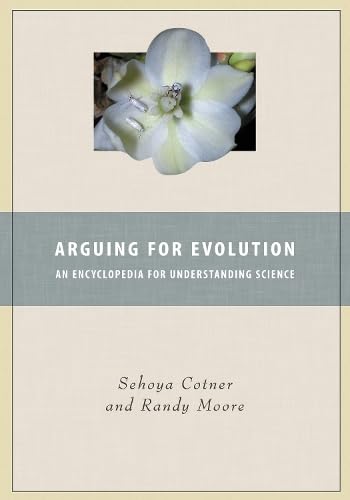
This timely encyclopedia presents an arsenal of evidence for evolution that goes beyond the typical textbook examples. Arguing for Evolution: An Encyclopedia for Understanding Science provides readers with a single source for the scientific evidence supporting evolution. The book shows how scientists have tested the predictions of evolutionary theory and created an unshakeable foundation of evidence supporting its truth. As such, it demonstrates how evolution serves as a case study for understanding the scientific method and presents a logical model for scientific inquiry.The evidence for evolution is presented historically and topically in an accessible, example-rich, and logical format, using an arsenal of examples that goes beyond the typical textbook matter. The chapters are structured around a series of hypotheses that the authors put to the test, amassing evidence on fossils, comparative anatomy, molecules, and evolutionary biology in order to conclude that evolution is scientific fact. Learning about this fascinating field is enhanced through "see for yourself" examples that include original data and figures from key historical and contemporary papers in evolutionary biology.
Instrucciones de uso: Recurso electrónico favor presionar sobre el URL disponible en la parte inferior. En caso de dudas favor consulte al Bibliotecario.
Includes bibliographical references and index.
Understanding the natural world: evolution and the process of science -- Age of earth -- Fossils -- Biogeography -- Molecular evidence foe evolution -- Anatomical evidence for evolution -- Conflict and cooperation Pt. I: behavior -- Conflict and cooperation Pt. II: coevolution -- Human evolution.
eigm 11/2015
Reseñas proporcionadas por Syndetics
CHOICE Review
This work is an interesting exploration into the nature of scientific inquiry, using evolution as a model. No other model generates as much discord or disagreement as evolution because no other appears to assail such a vital component of religious belief. Cotner and Moore (both, Univ. of Minnesota; coauthors with M. Decker, Chronology of the Evolution-Creationism Controversy, CH, Jul'10, 47-6024) examine the elements of creationist theory and the scientific rebuttal. They have done an admirable job of selecting material from the past and integrating it with current techniques. They address the question of the age of the Earth, for example, as determined in Darwin's time and earlier periods, and then review present concepts based on modern technology applications, which serve to refute the "young-Earth" theorists. Most chapters begin with a set of predictions related to the occurrence of evolution, followed by responses to the resolution of each prediction--an interesting, effective technique. Sidebars support the general concepts presented and are useful additions to the main theme. Photographic illustrations, well selected, are not printed well; they are often so poorly done that the point is lost, but this is the only real weakness of the volume. Summing Up: Recommended. Academic and general readers, all levels. F. W. Yow emeritus, Kenyon College
Booklist Review
Presenting the overwhelming evidence for evolution in the natural world, this title makes a step-by-step case for evolution. The age of earth, the existence of transitional species, and the anatomical and molecular evidence for the actions of evolution are discussed. Individual chapters explore this premise: assuming evolution has occurred, what adaptations can be observed? Examples used are recent and of high interest. For instance, a male predatory fly gives a female a nuptial gift to encourage her to mate longer with him. The front matter includes a topical arrangement. Appendixes include chapters from Charles Darwin's Origin of Species, the geological timescale, and a listing of Hominin species. There is also a glossary of terms. Chapter bibliographies are in the back of the book, except for the first chapter's references, which seem to be missing. This title is appropriate for a high-school or college science class or a general adult reader. It could be a circulating book, a reference book, or even a textbook for students of evolution. Comparative titles include The Counter-Creationism Handbook (2007), which refutes specific charges against evolution. Arguing for Evolution is more about making the case for evolution rather than refuting creationism. More Than Darwin (2008) is a guide to the people and places of both evolution and creationism. The Chronology of the Evolution-Creationism Controversy (2010) presents information about both sides of the issues. This title takes a pragmatic, scientific approach to the case for evolution.--O'Gorman, Jack Copyright 2010 Booklist
Notas de autor provistas por Syndetics
Sehoya Cotner , PhD, is associate professor of teaching in the biology program at the University of Minnesota, Minneapolis, MN. Randy Moore , PhD, is professor in the biology program at the University of Minnesota, Minneapolis, MN.