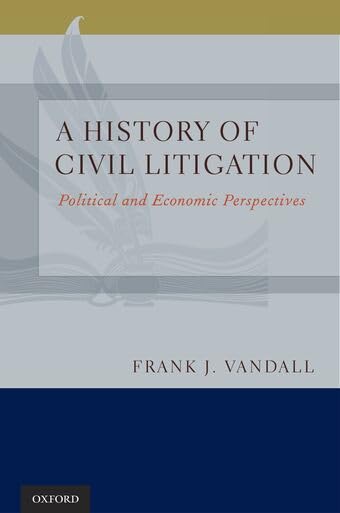

A history of civil litigation political and economic perspectives Frank J. Vandall.
Detalles de publicación: Oxford New York Oxford University Press c2011.Descripción: xix, 241 p. 25 cmISBN:- 9780195391916 (hbk. : alk. paper)
- 0195391918 (hbk. : alk. paper)
- 346.03 22
- KF 1250 .V36 2011
| Imagen de cubierta | Tipo de ítem | Biblioteca actual | Biblioteca de origen | Colección | Ubicación en estantería | Signatura topográfica | Materiales especificados | Info Vol | URL | Copia número | Estado | Notas | Fecha de vencimiento | Código de barras | Reserva de ítems | Prioridad de la cola de reserva de ejemplar | Reservas para cursos | |
|---|---|---|---|---|---|---|---|---|---|---|---|---|---|---|---|---|---|---|
| Libro | Biblioteca de Derecho Mons. Fremiot Torres Oliver Colección General biblioteca derecho | KF 1250 .V36 2011 (Navegar estantería(Abre debajo)) | Disponible | 70000000890049 |
Descripciones mejoradas de Syndetics:
A History of Civil Litigation: Political and Economic Perspectives, by Frank J. Vandall, studies the expansion of civil liability from 1466 to 1980, and the cessation of that growth in 1980. It evaluates the creation of tort causes of action during the period of 1400-1980. Re-evaluation and limitation of those developments from 1980, to the present, are specifically considered. The unique focus of the book is first, to argue that civil justice no longer rests on historic foundations, such as, precedent, fairness and impartiality, but has shifted to power and influence. Reform in the law (legislative, judicial, and regulatory) is today driven by financial interests, not precedent, not a neutral desire for fairness, and not to "make it better." It uses products, cases and policies for much of its argument. These policies can be summarized as a shift from a balanced playing field, negligence, to one that favors injured consumers. The strict liability foreshadowed by Judge Traynor, in Escola v. Coca Cola (1944), was not adopted until 1962, when Traynor wrote the majority opinion in Greenman v. Yuba Power Products for the California Supreme Court. Second, the book examines the role of persuasive non-governmental agencies, such as the American Law Institute, in reforming and shaping civil justice. Never has it been less true that we live under the rule of law. Congress, agencies and the courts make the law, but they are driven by those who have a large financial stake in the outcome. Today, those with power shape the character of products liability law, at every turn.
Includes bibliographical references (p. [xiii]) and index.
The development of civil liability 1466-1916 -- The dissatisfaction with negligence : policies supporting strict liability 1916-1980 -- The core issue in strict liability : an appropriate test for defect -- Legal reform emanates from the corporate boardroom, 1980-present -- Corporations write the law -- The application of concepts to contemporary examples.
Tabla de contenidos provista por Syndetics
- Acknowledgments(p. xiii)
- Introduction(p. xv)
- Chapter 1 The Development of Civil Liability 1466-1916(p. 1)
- A The Period 1400-1850(p. 1)
- B The Period 1850-1916(p. 3)
- Chapter 2 The Dissatisfaction with Negligence: Policies Supporting Strict Liability 1916-1980(p. 13)
- A Abnormally Dangerous Activities(p. 15)
- B Res Ipsa Loquitur(p. 16)
- C The Law's Dissatisfaction in Regard to the Theory for Resolving Products Cases(p. 17)
- 1 Dissatisfaction with Commercial Law(p. 17)
- 2 Negligence Leads to Unjust Results(p. 19)
- 3 Specific Policy Reasons for Strict Liability(p. 20)
- a Loss Shifting(p. 20)
- b Safety(p. 21)
- c Superior Knowledge(p. 21)
- d Insurance(p. 22)
- e Economic Analysis of Strict Liability(p. 22)
- f Distance from the Manufacturer(p. 24)
- g Strict Liability Avoids Universal Health Care(p. 25)
- Chapter 3 The Core Issue in Strict Liability: An Appropriate Test for Defect(p. 27)
- A The Emergence of Strict Liability(p. 27)
- B The Several Tests for Defect(p. 30)
- 1 Section 402A: ôDefective Condition Unreasonably Dangerousö(p. 30)
- 2 The Risk-Benefit Test(p. 32)
- 3 The Barker v. Lull Tests(p. 33)
- 4 Negligence with Imputed Knowledge(p. 34)
- 5 The Communicative Tort(p. 35)
- 6 The Cheapest Cost Avoider(p. 36)
- 7 Absolute Liability(p. 37)
- C Comparative Fault(p. 38)
- D The Role of the Court and the Jury Under Strict Liability(p. 41)
- 1 The Court(p. 41)
- 2 The Jury(p. 43)
- 3 Cases Applying the Restatement (Second) § 402A(p. 44)
- E An Embrace of Negligence(p. 45)
- Conclusion(p. 46)
- Chapter 4 Legal Reform Emanates from the Corporate Boardroom, 1980-Present(p. 49)
- A Constrictions in Legal Theory(p. 49)
- B Procedural Retrenchments: The Presentation of the Products Case in the Courtroom(p. 57)
- C Other Legislation Designed to Impede the Victim's Access to the Courts(p. 67)
- 1 State Legislative ôReformsö of Products Liability Law(p. 67)
- a The Impetus for Legislative Change(p. 67)
- b A Radical Change: The Statute of Repose(p. 69)
- c Further Alterations to the Products Liability System(p. 74)
- i Compliance with Governmental Standards(p. 74)
- ii The State-of-the-Art Defense(p. 75)
- iii Misuse(p. 76)
- iv Other Alterations That Further Protect the Powerful(p. 77)
- 2 Comparison of Fundamental Tort Policies with State Legislative Reforms(p. 81)
- a Loss Shifting(p. 81)
- b Prevention(p. 83)
- c Judge Learned Hand's Theory(p. 85)
- d Precedent(p. 85)
- e Justice and Administration(p. 87)
- D Powerful Institutes and Associations Rewrite the Law(p. 88)
- 1 The American Law Institute (ALI)(p. 88)
- a The Tripartite Structure of Section 2: Magic Boxes(p. 90)
- i The Structure of Section 2(p. 90)
- ii Section 2: The Practice(p. 92)
- iii The Draft Lacks an Analysis of the Traditional Policies Underlying Strict Liability(p. 93)
- iv Section 6(c) Design Defects in Drugs: A Tabula Rasa(p. 94)
- v The Restatement (Third) of Torts: Products Liability Section 2(b) Does Not Reflect the Law(p. 97)
- b The Restatement (Third) Section 2(b) Design Defect Should Be Rejected(p. 99)
- i Under the Restatement (Third), Fewer Suits Will Be Brought(p. 101)
- ii Institutionalizing Needless Ambiguity(p. 102)
- c An Examination of the Cases That Have Considered Reasonable Alternative Design Since Promulgation of the Restatement (Third) Section 2(b)(p. 103)
- i States Rejecting the Restatement (Third)'s Reasonable Alternative Design Requirement(p. 103)
- A California(p. 103)
- B Missouri(p. 104)
- C Maryland(p. 105)
- D Pennsylvania(p. 105)
- ii States Holding Reasonable Alternative Design as One of Several Factors to Consider in Determining Whether a Product Design is Defective(p. 106)
- A Colorado(p. 106)
- B New York(p. 106)
- C Oregon(p. 107)
- iii States Favorably Mentioning the Reasonable Alternative Design Requirement(p. 108)
- A Georgia(p. 108)
- B New Jersey(p. 108)
- C Michigan(p. 110)
- iv States Incorporating the Restatement's Reasonable Alternative Design Requirement into Their Statutes(p. 110)
- A Louisiana(p. 110)
- B Texas(p. 111)
- C Mississippi(p. 113)
- d You Won, Now Let Us Reduce the Amount of Your Recovery: Apportionment(p. 114)
- i History of Joint and Several Liability(p. 114)
- ii Analysis of the ALI's Proposal to Eliminate Joint and Several Liability(p. 118)
- iii Analysis of the Potential Impact of the Restatement (Third): Apportionment on the Pennsylvania Law of Joint and Several Liability(p. 121)
- A Track A(p. 122)
- B Track B: Several Liability(p. 123)
- 2 The Council for Tobacco Research(p. 129)
- 3 The American Association for Justice(p. 131)
- Appendix A (p. 134)
- Chapter 5 Corporations Write the Law(p. 137)
- A Tobacco Litigation(p. 140)
- 1 The 1960s and the Green v. American Tobacco Co. Case(p. 142)
- 2 The Cipollone v. Liggett Group, Inc. Case(p. 143)
- 3 The Castano v. American Tobacco Co. Case(p. 144)
- 4 Why the Early Cigarette Trials Were Lost(p. 146)
- 5 The Theory and the Visionaries That Won the War(p. 147)
- 6 The Tobacco Settlement(p. 152)
- a Components of the Settlement(p. 152)
- b Post-Settlement(p. 153)
- 7 A Solution to the Power Tobacco Exercises Over the Legal System(p. 154)
- a The History, Policy, and Economics of Absolute Liability as Applied to Cigarette Manufacturers(p. 156)
- i A Historical View of Absolute Liability(p. 156)
- ii The Reasons for Applying Absolute Liability to Tobacco Manufacturers(p. 158)
- A Reallocating the Loss(p. 159)
- B Health Protection(p. 160)
- C Superior Knowledge(p. 161)
- D The Cheapest Cost Avoider(p. 161)
- E Economic Analysis(p. 162)
- F Other Considerations(p. 164)
- iii Absolute Liability for Damages from Smoking(p. 168)
- iv The Policies Supporting a Modification to Cause-in-Fact(p. 171)
- v The Cause-in-Fact Proposal(p. 176)
- B Gun Policy(p. 179)
- 1 Suits Against the Gun Manufacturers Have Foundered in the State Courts(p. 180)
- 2 The United States is Facing a Gun Violence Epidemic(p. 184)
- 3 An Analysis of Gun Control and Liability(p. 188)
- a Self-Protection(p. 188)
- b Enforce Existing Gun Laws(p. 190)
- c Personal Responsibility(p. 193)
- d Economic Impact(p. 194)
- 4 Immunity Legislation for Firearms Sellers(p. 195)
- C The SUV Rollover Index(p. 197)
- Chapter 6 The Application of Concepts to Contemporary Examples(p. 205)
- A Lobbies are Effective(p. 205)
- B Government Rewards the Powerful: Corporate Bailouts(p. 208)
- C Examples of Weak Regulations and Agency Policy Favoring the Regulated Industry: Pharmaceuticals, Aircraft, and Securities(p. 210)
- 1 Pharmaceutical Regulation(p. 210)
- 2 Aircraft Regulation(p. 212)
- 3 The SEC-Madoff Example(p. 213)
- D Persuasive Organizations(p. 215)
- E Corporations Dictate Morality(p. 217)
- F Proximate Cause v. Tort ôReformö(p. 218)
- G The Supreme Court(p. 219)
- H Congress, Agency Failure, Lobbying, and Crashes: The Toyota Example(p. 221)
- Conclusion(p. 223)
- Table of Cases(p. 225)
- Index(p. 235)