Imagen de Amazon.com

Portada de Syndetics
Imagen de OpenLibrary
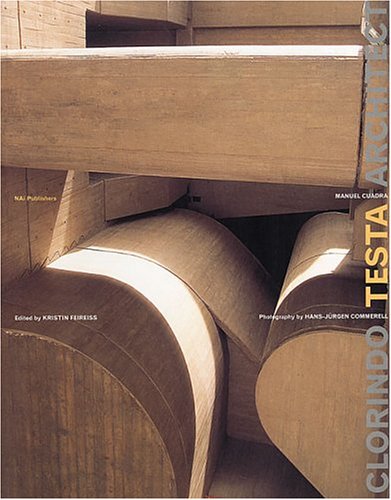
Clorindo Testa, architect Manuel Cuadra with Alfonso Corona Martínez ; photography by Hans-Jürgen Commerell ; edited by Kristin Feireiss.
Idioma: Español Detalles de publicación: Rotterdam NAI Publishers c2000.Descripción: 160 p. ill. 28 cmISBN:- 9056621432 (pbk.)
- NA839 T47 A4 2000
| Imagen de cubierta | Tipo de ítem | Biblioteca actual | Biblioteca de origen | Colección | Ubicación en estantería | Signatura topográfica | Materiales especificados | Info Vol | URL | Copia número | Estado | Notas | Fecha de vencimiento | Código de barras | Reserva de ítems | Prioridad de la cola de reserva de ejemplar | Reservas para cursos | |
|---|---|---|---|---|---|---|---|---|---|---|---|---|---|---|---|---|---|---|
| Libro | CARIBET Biblioteca Arquitectura Colección General CARIBET | NA839 T47 A4 2000 (Navegar estantería(Abre debajo)) | Disponible | 91000000026799 |
Total de reservas: 0
Descripciones mejoradas de Syndetics:
The Argentinian architect Clorindo Testa (1923) earned a worldwide reputation with his designs for the Banco de Londres y America del Sud (1960-66) and the Biblioteca Nacional (1961-95), both in Buenos Aires. These powerful urban megastructures of rough concrete reveal the influence of Le Corbusier. At the same time they propose a dialectical synthesis of public and private space that places Testa on a par with the Japanese Metabolists and other futuristic movements of the early sixties.
Published on the occasion of the exhibition of Clorindo Testa, Netherlands Architecture Institute, Rotterdam, 15 September-5 November 2000.
Includes bibliographical references (p. 155-158).
Tabla de contenidos provista por Syndetics
- Preface(p. 6)
- Time and Timelessness in two Buildings by Clorindo Testa(p. 8)
- Clorindo Testa, Portrait of an Architect and an Architecture(p. 11)
- First World, Third World: The international context(p. 12)
- The local context: Twentieth century Argentina(p. 14)
- Between Ceppaloni and Santa Rosa de La Pampa(p. 15)
- Living in Buenos Aires(p. 16)
- Development of sensibility(p. 17)
- Seeking a path of his own(p. 18)
- Challenges: public life, urban fabric, architecture(p. 20)
- Creative detachment(p. 21)
- Art and politics(p. 23)
- The Architecture of Clorindo Testa(p. 26)
- Internationalism and Avant-garde(p. 26)
- An early work of great maturity: The Civic Centre of Santa Rosa de La Pampa(p. 31)
- What remains is the city: The Bank of London and South America(p. 43)
- The head of the nation: The National Library(p. 53)
- A twentieth century patio house: The Guido di Tella Residence(p. 63)
- Like a ship: The Central Naval Hospital(p. 69)
- Space and structure: The Apartment Building Calle Rodriguez Pena(p. 77)
- One or two?: The Apartment Building Calle Castex(p. 81)
- Spirit, Time and Architecture(p. 85)
- Fantastic Realism(p. 87)
- Unity of art and architecture: The Cultural Centre of the City of Buenos Aires and the Buenos Aires Design Centre(p. 91)
- The house of the architect: The 'Capotesta' Beach House(p. 101)
- Form, space, structure: 'La Tumbona' Beach House(p. 107)
- The city and the sea: 'La Perla' Beach Complex(p. 113)
- Old and new: The Ghirardo Residence(p. 121)
- An architecture of earthly peace: The Soka Gakkai International Auditorium(p. 129)
- Architecture, Art and Structure(p. 136)
- Simple and complex: The 'Altera' Art Gallery(p. 139)
- Modern and Baroque in one: The Notaries Association Building(p. 145)
- The Green House of Mrs. R: House R(p. 149)
- Biography(p. 153)
- Bibliography(p. 155)